A Foreshadowing…..

It is my pleasure to precede the release of a work by my dear friend and fellow grad, Vivi Vallin, which will grace this page in three parts – the first of which will be released on Wednesday.

The whole point of A Year in Yoga is to challenge contemporary thinking and explore alternative traditions, to ideally arrive at a new way of being – that we each choose for ourselves – that is whole, fulfilling and brings us joy. In this endeavor, we MUST confront discomfort, recognize our vices and create different channels through which we can navigate the world.

One of the most important “vices” is one’s relationship with and identity of oneself and others, (encompassing body image and personal bias). Recognizing difference, not as “diversity” but as different shades of a flower bloom; each color and shade equally beautiful and equally cherished. This is how we can all jointly see the world with joy.
In an effort to support and draw attention to the emergence of the Black Yoga Teachers Alliance, I defer to a scholar with much more insight to share than I on an important evolution in what contemporary “yoga” is and can be. I hope you’ll tune in on Wednesday to read part I of III of her inspiring work….

Stay tuned! In the meantime, here’s more about Vivi…


Viviana Vallin is a yoga teacher, naturalist and LPCC trainee in the field of mental health.  She is passionate about finding the intersections of traditional therapy, yoga therapy and nature therapy to provide wellness support to individuals and communities in need, especially those who are marginalized and under-served by our nation.

Viviana worked as a Teacher Naturalist with the Audubon Center at Debs Park for 2 years, and was then promoted to Education & Outreach Manager. In this role, she created and led programming for K-8 students, teens, adults and families in the community to connect to the nature that was in their own neighborhoods, and learn about how to become stewards of these special pockets of green in Los Angeles. Viviana was selected as a Toyota Together Green fellow while at Audubon to lead her project entitled Empowering Communities: Building Capacity Through Youth Leadership Programs. The emphasis of the project was giving teenagers from communities of color the tools and knowledge to lead their own initiatives of change by engaging their communities in a place-based conservation project. Viviana strongly believes that individuals have to care about the nature in their own backyards first, in order to build a relationship with nature which will lead to changing behaviors for the betterment of the planet.

Viviana left Audubon to complete her education at Loyola Marymount University, and in May 2016, she graduated from the Masters in Yoga Studies program at LMU. She was simultaneously enrolled in the Masters in Counseling program at LMU and plans to complete her second graduate degree over the summer months. Viviana is currently completing an internship at Open Paths Counseling Center in Culver City as one of their bilingual therapists; a community mental health organization which provides accessible services to diverse clientele. Viviana works with a client load of 8-10 Spanish-speaking individuals per week and has co-led the Spanish parenting class as well. Viviana will complete her internship at Open Paths in December and plans to register for her intern number with the BBS at this time.  Her focus in mental health has been working with clients who suffer from addictions, eating disorders, and trauma.

Beginning in September 2015, Viviana began working as a yoga therapist at Reasons Eating Disorder Center located in Alhambra, CA. As a yoga therapist, she leads restorative yoga sessions at both their hospital intensive program and the residential house located in Pasadena, CA. Viviana creates a class which aims to help clients reveal a new relationship with their body, focused on the meditative aspects of yoga and learning to listen to one’s own body. This approach aims to redefine what a client might typically think about yoga (as exercise) and instead creates a practice of self-inquiry and supports processing emotions and thoughts which arise in their treatment process. Viviana has also led yoga for a girls residential program for Optimist Youth Homes & Family Services in Highland Park. This population of girls included at-risk youth who had been mandated by the court to be placed at Optimist Youth to support their academic learning and emotional/social needs, after challenging circumstances early in their life.

Viviana has trained to support individuals experiencing trauma through their yoga practice including attending the Yoga for Trauma: Mind/Body Resources for Working with Marginalized Communities Conference in Seattle, WA (2015) and the Recovery 2.0 Move Beyond Addiction Conference (2015). Specific counseling courses in trauma, crisis, multicultural, and addiction have also provided rich knowledge for working with clients with these specific needs.

Viviana is incredibly excited to continue to find ways to connect yoga, mental health and nature. Each practice on their own has been shown to provide healing and health benefits to the practitioner, but the combination of the three practices allows for a deeper engagement with the individual and the potential to shift the way in which they interact with the world.


Living Yoga: A Tribute to India

Preparing myself for India, I anticipated change. Particularly, I imagined a life-changing, entirely radical moment of clarity. One that snaps you back down to Earth exactly where you need to be at that very moment. A transformational moment. Samyag drsti.*

But, of course, what we get is rarely what we want, and what we want is rarely what we really need. For me, India was an amazing experience. I learned so much about the world, Jainism and Indian culture, and even more about myself – my strengths and limitations. I learned that compassion can and should be inclusive toward all living things, even and especially Nature. I learned that I do well with heat and humidity, but am considerably bad at managing bugs and dirty streets (not entirely new knowledge). I learned a lot about my privilege as a caucasian American, not from a workshop or a round table discussion, but first-hand gazing out the car window into the desperate, withered faces of starving women and children in the streets. I learned that in the midst of chaos and hell (whatever that may be for you), it is still possible to smile, to shed light, to lend kindness, and to have faith. I learned that despite my studies and efforts in yoga and meditation, I still struggle to maintain peace in the chaos. In fact, I still have a long way to go.

India was stealthy in her approach, overwhelming my senses with new sights, scents, and sounds while my mind was consumed by an intensive course itinerary of lectures, temple visits and reading, reading, reading (six books in three weeks warrants the repetition). We spent our first two weeks at an ashram in New Delhi where we were greeted with warm smiles, tea & biscuits, and an impressive schedule of lectures and puja ceremonies for our full immersion in Jainist tradition. In contrast, our third week was marked by long, bumpy bus rides, too much Limica soda (for my unending “Delhi belly”) and countless hours gazing out at the expanse of Indian countryside in sleepless, silent reflection. There was so much to process, to take in, to debrief that I allowed my mind to wander. I found, and often still find, that my mind is consumed by incessant questions into the “why” for all of this – past, present and future: How did I get here? What are my goals? How can people live in these dire conditions and still embody such contentment and happiness? What can I learn from them? Is yoga the answer? What can I do to help? Am I doing enough? What is that man smiling about? Does he have a family he loves? Does he bear the responsibility to support them? What does he do? Where are they? I hope they’re smiling, too…**

I came back from India with many more questions than answers. Yet I’ve noticed (and am grateful) that, over the past year and particularly since my return, I’ve become more mindful and free to ask questions, to consider difference, and to explore new places with equanimity. The more open I allow my mind to become, questioning the basic ideas and norms I have always taken for granted, the more questions and freedom arise. So a year after I began this endeavor to chronicle my year in yoga, I feel in many ways that I know much less now than when I started. However discouraging it may sometimes feel, any Indian guru will tell you: Admitting you know nothing is the first step to true wisdom.

What I found in India was not samyag drsti, but instead was as much an experience of internalization, as it was an outward excursion. It was a passive process; my mind like a camera capturing each moment as it came with mindful awareness, acknowledging each moment’s value and relentless brevity. Practicing yoga for me in India wasn’t predominantly physical asana, but was a conscious effort in self-compassion and non-judgment as I sought balance between pushing beyond my limits and caring for myself. As I like to see it, India was the perfect culmination to a long and taxing process of change, accompanied and instigated by a newly emerging, intensive year in yoga studies. Learning, living and practicing yoga from and among dedicated yogis has undoubtedly changed me for the better by opening my eyes to all I still have left to learn: about myself, my connection to others, to the Earth and to the world around me.

In 21st Century Yoga: Culture, Politics & Practice (a recommended, easy read!), Chelsea Roff shares a short essay on her nearly lethal battle with anorexia and her experience with yoga. She says with beautiful concision:

“For so long, I’d come to my mat to run away from myself. Now I came to connect. I had to reconnect in order to thrive.”

For over six years, while indulging in and learning from yoga communities across two cities and three continents, yoga is my constant. Its purpose and form in my life is ever evolving, and yet it remains unconditional and devotedly focused on revealing my best self to the world, even and especially when I’ve given up on myself.

Sometimes my mat is my hideaway, and other times it’s my own slice of heaven, a sun-soaked temple on my bedroom floor. At times it’s a complicated relationship (when I find myself avoiding my mat, afraid of what I might face there), but it is always consistent, welcoming and one of deep, penetrating compassion. From this place, I’ve grown and continue on knowing that whatever I face in the future I can withstand with contentment and kindness in my heart. India reminded me of this fact, and of the importance of remaining humble and eternally eager to learn. To care for ourselves, others and the world around us, to live each day and each moment purposefully in seeking love and connection, this is living in yoga.

May you find a few moments of solitude today and everyday.

In love,

Amy

——-

*Translated literally from Sanskrit as “right insight.”
**Unfortunately, with a busy schedule in India I fell away from my regular meditation practice. ‘Sitting,’ though, is just the practice of observing your own incessant (and often disjoint) thoughts as they arise non-judgmentally and, over a period of time and daily practice, learning that you can control and quiet your own mind (and thereby reduce anxiety, stress, and signs of depression at their onset). I wonder how my trip to India might have been different if I had prioritized my practice…I won’t waste any valuable time or brain space mulling that over (it’s in the past!), but I know that I’m a brighter, better person when I sit for 10 min a day. (It has to be consistent/daily for your brain to catch on – Check out more on neuroplasticity here.) The free app Headspace is a great resource.

No Regrets: A Guide to Managing the Chaos

I’ve experienced quite a shift in the past few weeks. And from what I’ve heard from family, and especially friends – going through the same grad school grind or 40-hour funk – the feeling is mutual. Perhaps the New Year holiday isn’t such a pointless occasion. Maybe, something actually does happen worth celebrating; a shift into greater consciousness. Or, as it’s more likely be familiar as, a new perspective. Suddenly, we’re all asking: Where am I going? What am I doing this for? Is this really where I want to be?

A new year will do that to you. Just when you think you have it all figured out, and you’re in full-out holiday 2014 turn up mode. Routine strikes again, and we find ourselves asking: Why? Why do I do the things I do? Is this really what I want?

Doubts inevitably start sweeping in. And then you have a choice – continue doing what you’re doing, or change it. Well, unfortunately I’ve (pretty much always) opted for the path of most resistance. Change it. Or change something. Because, if you’re noticing there’s an issue – how can you go forward with it any other way?

After spending a good part of my holiday ‘break’ formulating my plan for change, I realized that all of my commitments (work, school, research) are important to me, and worth going after. There’s nothing I want to, or can change, at this point in time. And, I’ve also learned bailing isn’t always the answer. There’s always something to be learned and gained, even from the most difficult situations. Then, I came to an interesting thought: You can’t muscle through it. You can only breath through it.

I’d been pushing and pushing, and putting my head down and hoping for ‘the end.’ (Whatever that means…) I was muscling through it, and hoping that would be enough. But of course, my strategy didn’t sustain and despite my efforts, I couldn’t see the end of the tunnel. But, even in the worst situations, there’s always a light; a way to make it better for yourself. I’d been trying to muscle through it when I really needed to just stop and breath.

Distinguishing these moments, when you’re running out of gas and it’s time to switch gears, is the secret. It’s everything. Because, if you can keep your self in tact, you can do anything you want to do without feeling mysteriously (and overwhelmingly) exhausted, or stressed, or angry. For me, allowing myself to have downtime; to take care of myself (who knew a home manicure could feel so amazing?) and in turn, devoting myself back to the hustle; to stay true to the commitments I’ve already made, and be present to all the things I’m looking forward to this year. It’s an ongoing balance and it takes work. But, most importantly, this means ‘checking in’ (or as somatic psychologists call it: a body scan) – every day, as often as you can. How am I feeling? Am I thirsty or hungry? Tired or getting sick? Am I agitated or stressed? Am I angry or irritable? What can I do to take care of myself right now?

We’re used to – and good at – putting things off. Especially, when it comes to self-care. The last priority on our “To Do lists,” often are the items that involve taking care of ourselves. But, what good are we really after we reach our breaking point? I know when I was working a corporate job, this came before lunchtime. Last semester, it came even sooner. So naturally, you start to wonder: Why am I doing this?

I found it helpful to consider why I’d started instead. School or work is tough sometimes, sure. But it must be that the reasons why we’re there in the first place are far more worthy of consideration – the long-term vision, rather than the day-to-day grind. Now that the honeymoon period has ended, what’s your motivation?

Only you can answer that, and it’s for no one else to judge. It’s your life, and you should make it yours. No matter what position you find yourself in, there can always be a reason to get you through (especially, the tougher times) – be it personal, professional; trials, tribulations; learning, growing, sharing. If you allow yourself to believe there is a purpose for this place in this time, then you allow a feeling of forward movement and fulfillment to supersede. And if you check in with yourself, and put yourself first (for the benefit of everything and everyone that comes after), there’s only joy.

Whether you decide to muscle through it, or breath through it – only an attitude, a perspective changes simply by changing your focus. And, you control it. (Imagine that, in this crazy, scary world of ours…You ultimately have control.)

Like many I know, I’m off to a very busy and daunting 2015; but I’m optimistic. I’m taking one day at a time, and trying my best to be present when and where I am, in each moment. If these events, and people, jobs and classes are important enough to be part of my life, then I owe it to myself to be present for them. (Also, you can be sure this way: you’ll have no regrets.) We can choose when and how, and if we want to change. But ultimately, it’s all a matter of perspective.

Wishing you all the very best things a new year can bring, and all the joy that can possibly come along with it.

No Regrets,

Amy

Personal Photo: Meditation Retreat @ Benedict Canyon, Los Angeles, CA (January 17, 2015)

Happy Holidays! (Your Asana Cheatsheet)

Wishing all a very happy holidays this season!

As we look forward to food, family, and fun over the next couple days, I wanted to offer a few quick and very easy asana postures for an energy boost and peace of mind in the midst of what can be a very busy and stressful time.

Here are a few of my favorite postures that I practice regularly and often incorporate into my classes. They can be practiced in sequence or on their own, whenever (and wherever) you have a couple minutes to spare. Accompany each with slow, deep breathing and – if you like – while repeating the mantra: “Love of the Present Moment” (or whatever phrase resonates most with you. Others might be: Let Go; Peace; Love; or Om Namah Shivaya translated as “I am Shiva,” meaning “I am the light” ^^ link to my favorite rendition by Steve Gold)

Whether practiced before bed, in the kitchen between cooking prep, or on the living room rug – I hope these postures will bring you peace and grounding (self-care) to help you cherish every moment spent with loved ones this holiday.

Happy Holidays from my corner to yours xx

Amy

Holiday Asana Cheatsheet
*Click posture name for in-depth instruction and benefits from;
*All are safe & easy to practice for all body types;
*Practice each for as little as 30 seconds, or combine and hold for up to a 30-45 min. personal practice

Warrior I with backbend/Virabhadrasana I
*Heart opener, gentle backbend, promotes energy & circulation; great for when you feel you need to ‘get moving’
(hold 30 sec. – 1 min. each side)

Crescent Lunge with Backbend

Legs-Up-the-Wall Pose/Viparita Karani
*Detoxifying, boosts your immune system, stimulates your circulatory system, strengthens your diaphragm/respiratory system (An inversion a day keeps the doctor away!
Hold anywhere from 30 sec. to 5 or 10 minutes)

image-2

Reclining Bound Angle Pose/Supta Baddha Konasana
*Hip opener, releases tension, stimulates respiratory system through thoracic breathing – expand rib cage with inhale, spine neutralizer (hold 2 min. or up to 5-10 min.)

image-3

Easy Pose/Sukhasana
*Meditative posture, straight spine and shoulders back, abdomen engaged to support your torso, neutral position. (If you like: Engage in slow, deep breathing with an elongated exhalation (2x inhale) and introduce your mantra here. Hold 5 to 10 min. or as long as you’d like. This is an easy introduction to a regular meditation practice.)

image-4

**BONUS: (My favorite, if you’re up for a challenge!)**

Lord of the Dance Pose/Natarajasana
*Balancing posture, hip opener, core/strength building (Hold for 30 sec. to 1 min. on each side. Be sure to find a drishti, or stationary visual point about 4 feet in front of you to lock your gaze and help maintain balance.)

image-6

Xx Cheers! xX

Reset & Let Go (+ Juice Recipe)

Two unlikely themes kept popping up in my conversations this past week: Juicing and Karma. This hardly seems like a compatible duo, but I was surprised (after closer consideration) that my conversations on both topics stemmed from the same concern: How can we get a fresh start? When we feel like our diets, our actions, or our temperament (mood swings, stress level, etc.) have spiraled out of control, how can we wipe the slate and move forward? Whether, the result of enduring a big life change or a big weekend out, letting go and hitting the “reset” button can be a welcome relief – and really, a necessity – to get you back on track, feeling better and more like yourself.

Karma-Juicing (verb): to enhance one’s actions by the process of purifying or resetting

I juice when I want to “reset.” Sometimes it’s after a few too many glasses of wine or slices of pizza, but other times it’s just when I’m feeling groggy and sluggish (or bloated). So, as you might guess, I like to juice most days – whenever I can. Because: a nutrient-packed [delicious] mug of green juice, when consumed semi-regularly (2-4x a week), helps give you more energy, boosts your immune system and cleans out your pipes 😉 So, food is digested easily and you feel lighter. And, as a result, when you do splurge on that pizza, the bloated sluggish feeling won’t stick around as long.

I still drink coffee, I’m learning to love tea, and I stock my fridge with pumpkin ale all season long. (Try Trader Joe’s Pumpkin Ale! So yummy.) Juicing doesn’t have to come solely as part of a “cleanse,” but it is still cleansing. Approaching juicing this way – drinking it when I want because of how it makes me feel, rather than how it could make me look – is empowering and effective, without being stressful or expensive. It’s nice to notice the difference in my body, to know how my body reacts to what I consume and how it likes to be treated. (Which really gives you more energy in the morning – coffee or fresh-made juice? You may be surprised…) Once you notice the difference it’s easy to eat healthily; you’ll do it because you feel better when you do. And, of course, because food is love and you, and your body, deserve only the best. There’s no limit to how often you can hit “reset.” (And it doesn’t have to be $10/day — see my recipe and recommendations below).

Resetting when applied to our daily lives can take on a different meaning. Have you ever wanted to just press a button and undo whatever you just said, or did (or wore)? Or even better, have you ever been confronted with a period of transition – a new job, a big move, a bad break-up, or settling into a new relationship – and just wanted to hit “reset” and reap the benefits of moving forward? I never paid much attention to this connection, or this urge, until a few recent conversations with friends, all of which centered on the same theme: Karma. More specifically, how karma – or our actions and behavior – is influenced by different periods in our lives, of light and dark.

*In this sense, “karma” is defined as one’s behavior or actions (versus the mainstream definition which is focused on the results or consequences of one’s actions); I also take “karma” to imply notions of one’s temperament, or general way of being. “Light and dark” can be thought of as life’s really high highs and really low lows, where you inevitably put forth your very best and very worst self (respectively).*

My friends and I discussed that, when you’re in a period of transition, you’re more vulnerable because your foundation has been disturbed or is suffering an imbalance. In daily life, this can take shape as a disruption at home, in relationships (family, love and friendships), and/or as general sense of stability and groundedness; in yogic and Ayurvedic terms, this refers more literally to Muladhara, or your root chakra. Regardless of the terminology, the resulting imbalance or turmoil while enduring periods of vulnerability and ‘darkness,’ directly affects our mindset, and thereby our actions on a daily basis. What you’re thinking and how you’re feeling (perhaps, in the broadest sense: anger, jealously, pride, love) determine your behavior and actions (whether you even apply for that job, move to that city, or can fall in love). When we feel our best and brightest, we live in that light and spread it to others. This way, periods of light and dark, or up’s and down’s, influence our daily behavior and way of being in the present moment – or our karma.

Sometimes, when we’re feeling like we’ve lost control, it would certainly be nice to hit reset. Luckily, yoga philosophy (namely in the Bhagavad Gita, a famously popular story and spiritual text) has an answer…In the Gita, Sri Krishna, cousin and charioteer to the heroic warrior, Arjuna, shares this advice before entering into battle. Among the many worthy take-away’s from this epic dialogue, he says:

“As the heat of a fire reduces wood to ashes, the fire of knowledge burns to ashes all karma.”

However eloquent, this statement – put simply – acknowledges the need to reset or let go of our past mistakes and hang-ups, and even offers a solution. Knowledge, specifically “self-knowledge” or striving to understand your Truth, is capable of burning away any negative lingering feelings – of anger, of jealousy, of pride – that stand in the way of moving forward. Dr. Chris Chapple describes this process of “burning karma” as putting your darkness on the table and asking [yourself] the hard questions. In yoga, detoxing can mean confronting your own feelings (often, on the mat) to purify, cleanse and reset your mindset and way of being, to move forward as – and ideally remain – a better person. All yoga practices (breath work or pranayama, asana postures, meditation and observing your own thoughts) prepare us and enable our efforts in this process; to reveal and confront whatever’s holding us back, hit reset (aka let go) and move forward as a stronger, happier, and more grounded person in our daily lives.

Hitting reset isn’t always the easy way, but – when it comes to our health and well-being – it is the only way. Bottling up negative emotions and bodily toxins has long-term effects on your overall wellness. Whether on your mat or at the juicer, I encourage you to make the investment – be it time, money or effort – to try resetting for yourself.

If, for you, this means taking the leap with at-home juicing, here’s my favorite recipe to get you started – full of warm, root vegetables, and simple Autumn goodness ❤

Autumn Spritzer
Makes about 16 oz.

  • 1 Sweet Potato (= 1 small or ½ large)
  • 1 Pear or Apple
  • 1 Lime
  • 2-3 Celery stalks
  • 3-4 Carrots, whole
  • 3-4 Kales leaves (or 1/4 bag, chopped)
  • Ginger root (~ 2-3 inches of root is plenty, less to taste)

*Try adding fresh Mint leaves and/or a dash of Cayenne pepper to reset and kick-start your metabolism

Remember, I urge you to use what you already have at home and make substitutions of similar ingredients to make it something you’ll enjoy! (i.e. lemon instead of lime, spinach instead or in addition to kale, [1] cucumber for [3-4] carrots, or take out sweet potato for a smoother consistency, to name a few…)

Preferably, drink in the sunshine, wearing a big cozy sweater (this is how I most enjoy it, anyway) – and drink through a straw, to avoid staining your teeth ❤

Now, that’s love. Enjoy!

With love,
Amy

Suggestion: If you are in the market for an at-home juicer, I would highly recommend a Fagor Slow Juicer. It was inexpensive among the high-quality brands (~$130 on Amazon) and has a 5-year warranty on all its parts. (Woo! Priceless…) If you’ve heard juicers are a pain to clean, you’d be right! But, just like anything, the more you do it, the faster you get and the easier it becomes. Some added incentive to rinse and repeat…

Reset & Let Go (+ Juice Recipe)

Two unlikely themes kept popping up in my conversations this past week: Juicing and Karma. This hardly seems like a compatible duo, but I was surprised (after closer consideration) that my conversations on both topics stemmed from the same concern: How can we get a fresh start? When we feel like our diets, our actions, or our temperament (mood swings, stress level, etc.) have spiraled out of control, how can we wipe the slate and move forward? Whether, the result of enduring a big life change or a big weekend out, letting go and hitting the “reset” button can be a welcome relief – and really, a necessity – to get you back on track, feeling better and more like yourself.

Karma-Juicing (verb): to enhance one’s actions by the process of purifying or resetting

I juice when I want to “reset.” Sometimes it’s after a few too many glasses of wine or slices of pizza, but other times it’s just when I’m feeling groggy and sluggish (or bloated). So, as you might guess, I like to juice most days – whenever I can. Because: a nutrient-packed [delicious] mug of green juice, when consumed semi-regularly (2-4x a week), helps give you more energy, boosts your immune system and cleans out your pipes 😉 So, food is digested easily and you feel lighter. And, as a result, when you do splurge on that pizza, the bloated sluggish feeling won’t stick around as long.

I still drink coffee, I’m learning to love tea, and I stock my fridge with pumpkin ale all season long. (Try Trader Joe’s Pumpkin Ale! So yummy.) Juicing doesn’t have to come solely as part of a “cleanse,” but it is still cleansing. Approaching juicing this way – drinking it when I want because of how it makes me feel, rather than how it could make me look – is empowering and effective, without being stressful or expensive. It’s nice to notice the difference in my body, to know how my body reacts to what I consume and how it likes to be treated. (Which really gives you more energy in the morning – coffee or fresh-made juice? You may be surprised…) Once you notice the difference it’s easy to eat healthily; you’ll do it because you feel better when you do. And, of course, because food is love and you, and your body, deserve only the best. There’s no limit to how often you can hit “reset.” (And it doesn’t have to be $10/day — see my recipe and recommendations below).

Resetting when applied to our daily lives can take on a different meaning. Have you ever wanted to just press a button and undo whatever you just said, or did (or wore)? Or even better, have you ever been confronted with a period of transition – a new job, a big move, a bad break-up, or settling into a new relationship – and just wanted to hit “reset” and reap the benefits of moving forward? I never paid much attention to this connection, or this urge, until a few recent conversations with friends, all of which centered on the same theme: Karma. More specifically, how karma – or our actions and behavior – is influenced by different periods in our lives, of light and dark.

*In this sense, “karma” is defined as one’s behavior or actions (versus the mainstream definition which is focused on the results or consequences of one’s actions); I also take “karma” to imply notions of one’s temperament, or general way of being. “Light and dark” can be thought of as life’s really high highs and really low lows, where you inevitably put forth your very best and very worst self (respectively).*

My friends and I discussed that, when you’re in a period of transition, you’re more vulnerable because your foundation has been disturbed or is suffering an imbalance. In daily life, this can take shape as a disruption at home, in relationships (family, love and friendships), and/or as general sense of stability and groundedness; in yogic and Ayurvedic terms, this refers more literally to Muladhara, or your root chakra. Regardless of the terminology, the resulting imbalance or turmoil while enduring periods of vulnerability and ‘darkness,’ directly affects our mindset, and thereby our actions on a daily basis. What you’re thinking and how you’re feeling (perhaps, in the broadest sense: anger, jealously, pride, love) determine your behavior and actions (whether you even apply for that job, move to that city, or can fall in love). When we feel our best and brightest, we live in that light and spread it to others. This way, periods of light and dark, or up’s and down’s, influence our daily behavior and way of being in the present moment – or our karma.

Sometimes, when we’re feeling like we’ve lost control, it would certainly be nice to hit reset. Luckily, yoga philosophy (namely in the Bhagavad Gita, a famously popular story and spiritual text) has an answer…In the Gita, Sri Krishna, cousin and charioteer to the heroic warrior, Arjuna, shares this advice before entering into battle. Among the many worthy take-away’s from this epic dialogue, he says:

“As the heat of a fire reduces wood to ashes, the fire of knowledge burns to ashes all karma.”

However eloquent, this statement – put simply – acknowledges the need to reset or let go of our past mistakes and hang-ups, and even offers a solution. Knowledge, specifically “self-knowledge” or striving to understand your Truth, is capable of burning away any negative lingering feelings – of anger, of jealousy, of pride – that stand in the way of moving forward. Dr. Chris Chapple describes this process of “burning karma” as putting your darkness on the table and asking [yourself] the hard questions. In yoga, detoxing can mean confronting your own feelings (often, on the mat) to purify, cleanse and reset your mindset and way of being, to move forward as – and ideally remain – a better person. All yoga practices (breath work or pranayama, asana postures, meditation and observing your own thoughts) prepare us and enable our efforts in this process; to reveal and confront whatever’s holding us back, hit reset (aka let go) and move forward as a stronger, happier, and more grounded person in our daily lives.

Hitting reset isn’t always the easy way, but – when it comes to our health and well-being – it is the only way. Bottling up negative emotions and bodily toxins has long-term effects on your overall wellness. Whether on your mat or at the juicer, I encourage you to make the investment – be it time, money or effort – to try resetting for yourself.

If, for you, this means taking the leap with at-home juicing, here’s my favorite recipe to get you started – full of warm, root vegetables, and simple Autumn goodness ❤

Autumn Spritzer
Makes about 16 oz.

  • 1 Sweet Potato (= 1 small or ½ large)
  • 1 Pear or Apple
  • 1 Lime
  • 2-3 Celery stalks
  • 3-4 Carrots, whole
  • 3-4 Kales leaves (or 1/4 bag, chopped)
  • Ginger root (~ 2-3 inches of root is plenty, less to taste)

*Try adding fresh Mint leaves and/or a dash of Cayenne pepper to reset and kick-start your metabolism

Remember, I urge you to use what you already have at home and make substitutions of similar ingredients to make it something you’ll enjoy! (i.e. lemon instead of lime, spinach instead or in addition to kale, [1] cucumber for [3-4] carrots, or take out sweet potato for a smoother consistency, to name a few…)

Preferably, drink in the sunshine, wearing a big cozy sweater (this is how I most enjoy it, anyway) – and drink through a straw, to avoid staining your teeth ❤

Now, that’s love. Enjoy!

With love,
Amy

Suggestion: If you are in the market for an at-home juicer, I would highly recommend a Fagor Slow Juicer. It was inexpensive among the high-quality brands (~$130 on Amazon) and has a 5-year warranty on all its parts. (Woo! Priceless…) If you’ve heard juicers are a pain to clean, you’d be right! But, just like anything, the more you do it, the faster you get and the easier it becomes. Some added incentive to rinse and repeat…

Clean Eating Connoisseur (+ Recipe)

Once a week I receive a large package on my doorstep in the middle of the night. Like Christmas elves of organic produce, the local farm folk tip toe to my stoop and leave a box full of crisp, yummy delights hand-picked just for me! (I guess Santa’s preoccupied with the late-summer harvest.)

I rant and rave about my weekly produce deliveries to anyone who will listen – not only because it does feel like Christmas every Thursday! – but mostly because these deliveries are what effortlessly pushed me over from being a Lean Cuisine-loving, perpetual dieter to a self-proclaimed, clean eating connoisseur! They took all the guess-work and effort out of buying produce (which for a novice can feel very overwhelming), and now – a year later – I’m comfortable hitting the produce aisle for what’s ripe and in-season, including fruits and veggies I’d never tried or heard of before.

But the best part is that it gets you cooking. Being in transition has meant constantly looking for cheap and easy meals – so I’m adamant about not letting things go to waste. As a result, I’ve been cooking up a storm (to my boyfriend’s delight) making asian stir frys, veggie pastas, and colorful summer salads until my heart’s content. Becoming comfortable in the kitchen is all about practice, and experimentation. I’ve never been one for following a recipe to the T (sorry, Gramma), but believe that if I’m going to cook with what little time and money I have, it better be quick, easy and delicious. The same outcome can be achieved by hitting your local grocery store, farmer’s market, or registering for your own weekly, biweekly or monthly produce deliveries.* (Click here to find CSA deliveries near you – See below for more info.) Always try your best to find what’s fresh and “in season.” A farmer’s market is a great place to learn, and have fun while you’re at it!

Don’t overwhelm yourself. Go ahead and grab your favorite fruits and veggies, but also try one or two things that are new to your kitchen each time you hit the store. (My seasonal favorites lately have been heirloom tomatoes, eggplant, watermelon, and the ever-delicious fresh mint and basil.) Once home, consider what is already in your cabinets and what old or new creation you might cook up. A quick Google search (or my personal favorite: all recipes.com) will give you guidelines, times and temperatures to bring your creation to life. But don’t feel obligated to follow it exactly. You can add things you like, subtract things you don’t like, and replace comparable items with what you have at home. Don’t stress – so what is it’s not a five-star feast? It’s still healthy and delicious! And as you go, you’ll learn what works and what doesn’t, creating your own personal arsenal of 20-minute meals that feed your body, mind and soul.

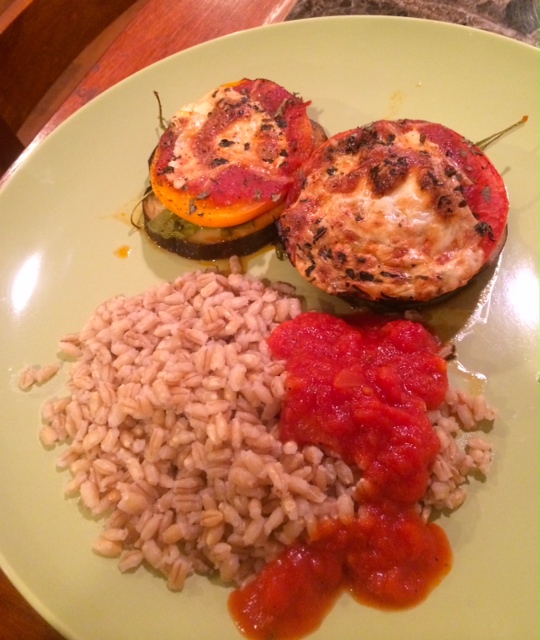
A favorite meal I recently added to my home cooking arsenal is what I call an “Eggplant Bake.” Straight forward and simple, it takes little to no preparation and allows you to put a delicious, but often befuddling, seasonal vegetable to use: the eggplant. Here’s my own take on the dish, which runs a little longer at 35-45 minutes with prep time. (But remember, cooking can also be a meditative process – Take the time out for you, to be and live well!) Feel free to try it out, and make it your own…

Eggplant Bake (feeds 2-4, with leftovers)

Ingredients:

  • 1 eggplant
  • 2-3 tomatoes (depending on size, use your judgement)
  • greens of your choice (spinach, kale, arugula, swiss chard – oh my!)
  • cheese of your choice (I used parmesan and fresh mozzarella)
  • olive oil
  • basil, oregano, and/or italian seasoning; salt & pepper

*To make this meal more filling, consider adding a quick & easy whole grain like couscous, whole wheat pasta, or brown rice (Uncle Ben’s is ready in 90 seconds!). If you have a bit longer to cook, try a heartier grain like barley, quinoa or farro – Mmmm!

Instructions:

1. Preheat oven to 400 degrees. Add and spread 1-2 tablespoons of olive oil in baking dish. (Can also use cooking spray, but olive oil makes your heart healthy – why skip out on the extra goodness?)

2. Slice tomato and eggplant in 1/2 inch rounds (no need to peel!) and place a single layer of eggplant in baking dish. Place a small handful of greens on top of each round and cover with tomato slice.

3. Add cheese – Don’t be stingy, but be mindful. Add seasoning and additional olive oil (sparingly) as desired.

4. Bake for 30 minutes. Switch to “broil” and bake an additional 5 minutes. (It takes a bit of extra time, but I promise it’s worth it.)

5. Enjoy! My final product is depicted above. I’d love to see yours!

Note: Dish is best served when you enjoy the process, and pair with wine and friends. Remember, food is love. 


Bon Appetite xx

Amy


*A bit more about Community Supported Agriculture (CSA):

Investing in weekly, biweekly, or monthly produce deliveries can be a fun and affordable way to jumpstart your new hobby of cooking up your own “clean eating” creations. (I pay $25/box and still grab protein (beans, tofu, chicken) and a few favorite items at the store – This way I spend less than $200/month on groceries! And eat damn well.) Often times, you can even choose what arrives in your box. Not a carrot fan? No problem, swap in potatoes or peppers instead!

Check online if there is a CSA group in your area. These are the folks, or “elves,” that coordinate with local farms to deliver fresh, delectable, and affordable produce to your door. This way, you’ll also know where it came from, how it was grown (often, organic), and even who’s growing it! To find out if there’s a CSA near you, click here.

As an example, this week my box looks like this:

  • 1 lb. Heirloom Tomatoes
  • 4 Barlett Pears
  • 1 Cantaloupe Melon
  • 1 bunch Celery
  • 1/2 lb. Gypsy Peppers
  • 1 bunch Red Chard (luscious greens!)
  • 1 bag Red Grapes
  • 2 Yellow Nectarines

Mmm, can’t wait to dive in! Happy eating 🙂