Married to Yoga.

Wow, what a wild ride.

There are moments I have an awareness of how much changed I’ve endured, how much I’ve shifted in the past 6 months…year……okay, 5 years.

In the past five years, I am plus one Master’s degree, plus one yoga studio and subsequently down one “wedding fund” (and boyfriend, for that matter). I made the decision to use my wedding fund to live my dream, henceforth I am: Married to Yoga.

From Boston to Los Angeles to SW Florida, from government affairs to yoga studies, from over-time perfectionist to master delegator, relationship lover to solo adventurer. I think mostly I’ve realized the importance of realizing that nothing is perfect. Nothing can be forced. Very little is actually known. I now fully know that what we allow ourselves to feel and think is how we see the world. That the world is not what we thought it was, or is. And that, in fact, the rest of the world is just like us. We are one.

It’s difficult to settle into my new home and as a studio owner in North Port, FL, as daily glimpses of my past lives (past jobs, places, people) remind me of how much there still is to learn, to know and explore. So many things that I thought were, are not. And as many things I thought would never, are fully – resonant. You never know how your reality will unfold when you stop trying to control its direction. But, you can know that no matter where it takes you, when you release control, it will be the most right thing that you have ever done.

There’s definitely a reality that we aren’t aware of, that can begin to answer all the questions we have about life, what happens next, and why bad things happen to good people. This has been my journey, to explore to “why” of life. There is a rhythm, though perhaps not a reason, to the fragility of life that doesn’t accurately represent reality: that all is one, everything is universal and all that are born must perish, and will be born again. There are cycles and formulas to life that we can only gather by tuning in to our own patterns.

I’ve been put in a vulnerable position lately to share my story, when in reality, I’m still awaiting the happy ending – or any resolution at all. I don’t feel I have the clarity to retell a narrative I can barely understand for myself. The story of my own life’s progression. So, recently, I started writing, not just about how I feel but why I feel. What I feel. What are the patterns to my own natural rhythm? Rather than allow my emotions to rule me, or to feel bad that I feel bad, and certainly rather than allowing my worries to manifest into a million different reasons or worries “why”; I’m going back to basics. At the first impulse of emotion or reaction, I want to know what that worry is about. That’s all. I’ll write it down and then I’ll let it go. Not to be obsessively dissected or philosophized. Just to be simply acknowledged and maybe even understood. (Or maybe, not yet.)  I’m going to try this method of observation and note taking in hopes of uncovering “why” I am. “How” I work, and how I can do better for myself and others.

After five years, I’m getting to know myself again. Having peeled back the layers of my identity over years of self-study, of yoga. It’s scary but so necessary to know who’s there at my very core. The me I’m finding is so real, and more importantly, is someone I can proudly be with for the rest of my life…As long as I (the seen and the Seer) shall live. So my journey seems to be opening to an entirely new chapter, where I can’t deny what is and am forced to flourish therein, the present moment. Married to yoga.

Sending love and good vibes always in the hope of inspiring or at least walking with you on your own journey of unfolding; however that might be.

Om Shanti, xo

Amy


Recovery through Ritual

This past Monday, I finished a cross-country adventure with my dog, Shakti, in a very solid 6 days, 5 nights.

The decision was only slightly less of a shock to me than it was to close friends and family. I needed a change. I saw myself slipping into unhealthy patterns. Following the nurturing replenishment of family and friends in my hometown, I allowed myself to consider and prioritize my own needs. To do this, my ego needs to step aside. Sadly, this has meant leaving behind relationships that I had come to cherish, that nourished me. Sacrifices are made when we endure change. And, I’ve learned, we can’t always know that the outcome is worth the struggle. But when we make a decision with our own best interests at heart, I believe you can’t go wrong. With this blind trust, with myself and Shakti in mind, we have arrived in Florida. We are home.

Packing up my apartment in Los Angeles and venturing across the country has reminded me of an important and enduring aspect of yoga tradition that I have found useful in my own life. When everything is turbulent and it’s impossible to see to the other side, or during a period of calm, in the eye of the storm, consistency of practice – or rituals – endure and cultivate grounding. Despite the whirling winds and monsoon rains that welcomed us on the final stint of our journey, breath stilled my mind and subtle reminders kept me present and grounded.

I mean this literally, that deep breaths seemed to arise from my chest and mouth even before I consciously recognized a potential threat. Breathing through it in this way, occasionally glancing down at the mala wrapped around my wrist, or switching over to mantra music when I felt my nerves were creeping too high, I strived to maintain balance and equilibrium (mentally and physiologically) with effortless intention.

I think of these as “passive rituals,” material items or bodily techniques (i.e. asana, pranayama) that are consistent and instigate a particular notion of familiarity, grounding, contentment, or peace. Like psychological triggers using symbolism, mundane objects or physical techniques can have a positive affect on our mental and physiological being regardless of personal perceived connotation. Assimilating traditional Eastern symbolism into my daily life – or whenever I choose to refer to the item or repeat the task – has proven to maintain contentment, calm and determined vigor whenever needed, even and especially in moments of crisis. As I told my parents while gripping my mala in post-hurricane storms in Florida, “I’ll be there soon, come hell or high water!”

As I settle in to my new temporary home at my parent’s house, I am also reminded of deliberate or “active rituals.” The day following my arrival, a process of settling in began. Unpacking the first items from my car, I hung Tibetan prayer flags reading “Om mani padme om,” a traditional mantra honoring and emphasizing the importance of devotional practice, along the top of a hutch in the kitchen. A subtle but poignant reminder of my intention to cultivate peace and tranquility any place I reside.

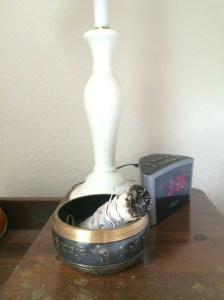
That evening, I burned sage stored inside my brass singing bowl from India, atop the nightstand in my new room. I stored my mala, recently bought from a holistic yoga studio in Berkeley, where a great friend from school now works, in a dish by the door along with several gems and other jewelry to remind me of the beauty in stillness and the strength of my roots. I keep an affirmation card from my dear cousin reading, “I am wise. I seek answers within myself,” in a visible place in the corner of the room. Running out in the rain to steal back my bolster (large pillow) from the car, I look forward to re-kindling a daily mediation practice with the help and encouragement of these symbolic reminders. I sit atop my bolster during my morning coffee and bring it into a quiet space to sit comfortably in meditation, allowing my knees to fall below my hips supporting my lower back. All of these are either active or passive rituals representing my intentions and motivating my endurance in an effort of blind trust that everything will be okay.

img_4259

While “passive rituals” include objects we might see or activate with subtle or sub-conscious awareness, “active rituals” encompass any process during which we set a conscious intention. This may be as simple as lighting a candle, burning incense, lighting sage, sitting in silence, listening to mantra music, or even writing thank you note’s or calling a dear friend who may benefit from your active attention. There are no limits to what can be conceived in these moments, cultivating creativity, focus, compassion and peace.

For the first time in my life, I’m not sure where I’m headed. But I whole-heartedly know (despite my nagging ego) that the journey is worth enduring, that it is worth the sacrifice, and that all I have to gain is more than I can presently imagine.

I’ve learned in truth that if you can imagine it, you can have it. Doors open when we set genuine intentions for ourselves. I never bought into this psychological logic more than now. Anyone can have anything they can put their mind to, because anything we can dream has the power to be gradually cultivated through conscious awareness, endurance and self-compassion. With the creation and proliferation of new thought patterns, it becomes easy to see how the object(s) of our desires are attainable through opportunities and options we may not have considered before.

I know there are many I cherish in my life right now who are enduring a process of healing from loss, betrayal, deception, or hurt. I besiege us all to remember that everything is impermanent. Nothing is forever. Periods of pain will subside, and ultimately the only guarantee is that our lives are what we make them.

So much love to those enduring loss. I send daily love your way. Slowly, slowly I too am recovering through ritual.

In the future, I plan to share a post on “yoga for healing” encompassing the physiological significance of specific asana and pranayama practices that provide a tangible method for processing and relinquishing grief, loss, and other forms of residual trauma.

Enduring love. Namaste,

Amy


Mantra Music to inspire:


Challenging Concepts of the "Western Yogi" Part III: Safe Spaces in Yoga

Part III: Safe Spaces in Yoga
By: Vivi Vallin, M.A.

I am currently in a yoga teacher training at a studio in East Los Angeles called People’s Yoga. They are the first yoga studio in this particular area of Los Angeles and are going to be celebrating their two-year anniversary in the coming weeks. People’s Yoga prides itself in making yoga accessible to the community of East Los Angeles. Classes are affordable, some are bilingual or in Spanish, there are classes for families to practice together, many of the instructors are people of color and the studio is accessible via public transportation. This year they offered their first 200-hour yoga teacher training. The others in my cohort are also people of color. All different backgrounds and ages but sharing the experience of what it is like to be a person of color who has been drawn to yoga on their own healing journey. As we learn about yoga together, we also share our experiences of feeling excluded, navigating being undocumented, being a queer person of color, how yoga is viewed by our families, and how we view injustices every day. We have a space in yoga to integrate our cultural and ethnic identities and experiences from that identity. This process is powerful.

On a personal level, I believe practicing yoga brings you closer and closer to your authentic self. Although yoga did not originate in Mexico, practicing yoga as a Mexican-American has brought me closer to my own culture’s healing practices, my roots, my history, and my family. I think this is because of yoga’s ability to cultivate self-awareness and self-love. In yoga, we embrace all parts of ourselves. From this space, I can see that a yoga practice brings individuals closer to who they really are. Each of us is unique. Our stories and experiences are unique. If we allow space to share and unite these stories, the experience of each of us will be richer and more full.

Black, white or brown (or however you identify) – we can all be united in our experiences of trauma, pain, sadness, joy, happiness, and gratitude. These are universal human emotions that link us together. We can heal together.  As we move toward this ideal, we still need to acknowledge that there is a need for safe spaces to heal for marginalized groups. It may look like a yoga studio that opens in East Los Angeles. It may look like a workshop about traditional Mexican healing practices. Each community should have the right to access safe spaces to provide wellness and healing, individually and together. Each community should have the right to choose the practices that will help them heal. Healing movements and leaders historically emerge from within their own community. In this case, as fellow brothers and sisters in color and among all throughout Los Angeles, our shared role is to respect and support this work for authentic and accurate cultural representation in any way we can.

BLACK YOGA TEACHERES ALLIANCE

When I heard about the Black Yoga Teachers Alliance (BYTA) I was excited and wanted to learn more about their work. The group was founded in 2008 and first began as a social media group. The goal was to create a safe space for teachers, students, practitioners, healers and enthusiasts to discuss yoga, share resources and create community. They wanted to create a place to explore the many paths and types of yoga, while also incorporating the authentic spirituality that black yoga teachers bring to the practice of yoga.

The BYTA provides their collective community with resources about teacher trainings, educational programs about yoga, scholarship opportunities and yoga publications. It also launched its first national initiative named Yoga as a Peace Practice: Redefining black lives and restoring peace and pride in our homes and communities. The initiative includes offering curriculum to yoga teachers so that they can take action by offering yoga, meditation practices and yoga based on lifestyle philosophies among those who are victims of violence (BYTA.com).

Since 2008, the group expanded and will be holding its first major retreat and conference in August 2016. The speakers being highlighted are black yoga instructors who have been leaders in this movement for a long time. The BYTA wants to celebrate and highlight these leaders that do not often get the recognition and space to share their wisdom and experience. The conference information describes that there will be an emphasis on the experience of being black in yoga and in this nation, as well as spaces to share and heal in community.

The Black Yoga Teacher Alliance currently has a Kickstarter Fundraiser organized by Jacoby Ballard of Third Root Community Center. The fundraiser aims to raise enough money to support 10 scholarships to black yogis who otherwise would not be able to attend the conference. A second goal of the campaign is to have 1000 white yogis donate to support the campaign. This would be a sign of support and send a powerful message that these types of safe spaces and events are important.

I donated to the BYTA scholarship fund because I support their efforts to create safe space for and to celebrate black yogis. They are not only sharing yoga but also leading the way with national initiatives that use the practice of yoga to engage with major issues such as violence and victims of violence, especially in black communities. I encourage those of you who are part of a yoga community to also support by donating to the scholarship fund, finding out more about the BYTA and/or attending the conference to learn more about their work first hand. Their efforts and contributions to the broader yoga community are valuable and are contributing to breaking stereotypes of exclusivity in mainstream yoga.


BYA logo


See what the Black Yoga Teachers Alliance is up to, get involved or donate here.
Photo Cred: BYTA.com

Midnight Glory

This week, I am preparing to graduate. That means it has been not only one, but two years in yoga since I started this venture in writing…

I have no words, and I have so many. But, the greatest piece of knowledge I’ve likely received is a broadened awareness of myself, and of the world. I no longer feel that I need to fit into a box. In fact, I am even more intent on creating my own – but, now with a sense of foundation and roots, from and through which I can really flourish (instead of flounder…)

I have learned that there are no ‘rules and norms’ that guide our lives and our rituals. Only the things we allow to affect us, do. Knowing this – and really, truly believing it – we can experience freedom from everything, and everyone. Freedom in decision-making, in self-validation, and even in self-nurturing (through practices like yoga, that teach us to care for ourselves).

There is no normal. Our world is made of so much difference, and yet we’re all so interconnected, and interdependent. A teacher once told me, “At the root of every issue is a lack of love.” By believing this, and bringing a willingness to openly share love, there can be a solution, to anything. It’s so silly, and extremely idealistic; and yet, in my experience, it is absolutely true. Love changes everything. If you bring sincere friendship, empathy and compassion into any type of environment, it will flourish. From hospitals to prisons, universities and rehab centers – love, it seems, cures all.

There are no norms, there are no rules. There is only you, and this; and ideally, love.

But, that part’s up to you. First to find in yourself, and then to unabashedly share.

You can.


In love,

Amy

Know Thyself

A huge, hindering theme of the past year (2015) has been, “know thyself.” Without religious context or forceful presentation, the advice or suggestion to better ‘know myself’ was prevalent; and perhaps unsurprisingly, came to a head in the intensely evocative, hazy midst of India. What I might now recall as recovering from a “deep depression,” (relative only in the realm of my own experience), was much less an awakening but a pervasive relief; a relinquishment of some terrible unidentifiable burden of the past. What was I carrying? Pain, fear, grief. I carried them all the way to India. But, they never made it back.

That’s the magic, and the “spirituality” of India. You don’t know what happening when it’s happening. You don’t always know your own pain, your own sadness or overwhelm, before, during or after. It’s a shadow of darkness we avoid like the plague, that contains all of our sadness, confusion, pain. Things you never even knew bothered you suddenly arise. Things you never wanted to remember. Things you usually can’t remember. It’s all buried in us, and is rediscovered and released through the practice of yoga. Yoga is a process of purging, of cleansing and purifying, that challenges our being and threatens immediate gain for the promise of a truer, happier, healthier, more prosperous “you” somewhere down the road. This is my path, as I’ve ridden the tsunami wave of my past year; likely one of the most difficult, and one of the most rewarding of my life. I can’t yet know completely what it all means and how it all ends, but I so welcome the year ahead.

And welcome the beacon that challenges me: KNOW THYSELF

On the first day of the new moon as a new year unfolds, I hope you might find inspiration through your own practice to seek renewal – whatever this means to you. As I’ve also been reminded before, ‘once you face the darkness, there is only light.’ (That means simple, straight-up happiness always. Imagine no mood swings.) Turns out, it’s attainable. But the road is hard as #*&$.

But so, so worth it.

KNOW THYSELF!

Embrace 2016 with open arms. And perhaps you’ll share my commitment to renewal through regular practice, learning, and well practiced self-love. (Manicures, massage, candles always, incense often…) Best. Year. Ever.

With so much love,

Amy

//

Photo Cred: Snapchat by (fellow Yoga Master) Whitney Cerullo on New Years Eve 2015. Judge as you must…This is me in a moment of real happiness. Surrounded by friends, hope and so much love. 🙂

No Escaping It: "I Am That"

Looking into the mirror at myself just earlier, I gasped aloud. Large black smudges under both eyes, stringy and frazzled hair, tired eyes and skin imperfections. But, before I knew it the girl in the mirror was smiling at me, and I felt the tension in my body let go. It was okay. I know her…

There’s no escaping it. I write and I write and I write. My fingers on the right start to feel crippled and numb, but it doesn’t stop me. I’m not sure what drives me. I’ve been after that answer for years. But, I know that my heart aches to know it. That my mind dreams about it. And that by giving my full self into everything I do, fostering love in myself and striving to understand the incomprehensible – this fills my heart and gives me more wealth and fulfillment than I’ve ever known.


2015-09-17 15.50.25-1
“I am THAT!” – Instagram
Looking into the mirror at myself just earlier, I gasped aloud. Large black smudges under both eyes, stringy and frazzled hair, tired eyes and skin imperfections. But, before I knew it the girl in the mirror was smiling at me, and I felt the tension in my body let go. It was okay. I know her…

“I am That” will sometimes pop into my mind while catching a glimpse of my own reflection. It’s a phrase often referenced in classical theological discourse and is even alluded to in the popular Hindi mantra: Om Namah Shivaya. I like its simplicity, and its resonance on some unknowable level. And so it’s stuck.

“I am That” has become an unexpected reassurance that I have not, until now, fully acknowledged. It arises from a place in me where I guess that intuition, pre-cognitive dreams, and strange meditative experiences come from. It’s not posed as a suggestion when it pops into my brain, but as a forceful assurance. There is no reason to worry. “I am That.”

I am so blessed – with education, good health, family and friends; I am so lucky to be born into a wonderful family who taught me how to be authentic in life above all else; I am so powerful for having made it this far, for having chased a dream and allowed myself to find love and be loved along the way. “I am That,” and that is ever changing. But, there are also parts of me that have never changed and will never change – and from that place, I’m glad to have a reminder that I am here, present, and ever-evolving. This means forgiving yourself, enjoying every moment, and loving with every ounce of yourself while you have the time, the energy, and the power to give. “I am That.” Something pure and forgiven. Innocent and all knowing. I am that.

It sounds crazy, like something you’d overhear two old ladies discuss after church. But really it just means allowing yourself to move on, rather than clinging and obsessing over past mistakes, embarrassing moments, or bad interviews. It means having the courage to be authentic, to wear what you want when you want, to go where you want when you want (if I hear one more person say: “I’m too fat for yoga”…) , to live compassionately, to always give the benefit of the doubt, to welcome your neighbors and befriend your enemies, to life in a way that represents you, that you’re proud of, and that enables you to give your time, resources or energy back to those in need.

I’m not reading from a textbook or quoting last night’s lecture. There is no specific way of going and no certain outcome. Each path is unique, and after a five year journey from Copley Square Bikram to LMU, I have learned that I know very, very little; except that: “I am That.” And, since life is so short, I strive to live as fully and as best as I can.

I am thankful to yoga for giving me many paths to choose – different schools, ideas, and ways of thinking to explore – and for giving me many tools – mantra, yoga /asana, meditation, mala beads, freeform expression. Some I learned through reading, but others through exploring and moving within my personal practice. Thank you for the ability to practice as I please, to move freely, and to eventually gain the power stop judging myself.

This is what it means to live in yoga (to me). Without any assignment to religious denomination, political party or economic status; anyone can be healthy, engaged, and happy – but it comes with a price. It demands opening your mind and giving in, or rather seriously “letting go.”

When I moved to Los Angeles two years ago, I had a strong ego and a very specific list of priorities. (And I was fucking killing it, if I do say so myself…) But, sometimes, when we allow things to ruin our plans the best things can finally happen to us.

******************************************

Today, I’m also pleased to launch AYearInYoga.com!!! Be sure to check out my new and improved (inter)face 😉

I have a while to go before I get it where I want it to be – including more classes, workshops, and events scheduled, and videos, techniques and practices to share! I am so appreciative of having you along for the journey! It inspires me to know that there are other strong, intelligent, courageous people (particularly women, woo woo!) who are willing to learn, strive and expand in the name of yoga. In the meantime, don’t forget to bookmark me, share with loved ones & friends, and check in every now and again to see what I’m up to!

Thank you, thank you, thank you.

Stay tuned! Sending love always,

xx Amy

// Photo Cred: Thank you Matt Annese for capturing so many amazing photo ops! @ Big Sur, Halloween 2015

No Escaping It: “I Am That”

Looking into the mirror at myself just earlier, I gasped aloud. Large black smudges under both eyes, stringy and frazzled hair, tired eyes and skin imperfections. But, before I knew it the girl in the mirror was smiling at me, and I felt the tension in my body let go. It was okay. I know her…

There’s no escaping it. I write and I write and I write. My fingers on the right start to feel crippled and numb, but it doesn’t stop me. I’m not sure what drives me. I’ve been after that answer for years. But, I know that my heart aches to know it. That my mind dreams about it. And that by giving my full self into everything I do, fostering love in myself and striving to understand the incomprehensible – this fills my heart and gives me more wealth and fulfillment than I’ve ever known.


2015-09-17 15.50.25-1
“I am THAT!” – Instagram
Looking into the mirror at myself just earlier, I gasped aloud. Large black smudges under both eyes, stringy and frazzled hair, tired eyes and skin imperfections. But, before I knew it the girl in the mirror was smiling at me, and I felt the tension in my body let go. It was okay. I know her…

“I am That” will sometimes pop into my mind while catching a glimpse of my own reflection. It’s a phrase often referenced in classical theological discourse and is even alluded to in the popular Hindi mantra: Om Namah Shivaya. I like its simplicity, and its resonance on some unknowable level. And so it’s stuck.

“I am That” has become an unexpected reassurance that I have not, until now, fully acknowledged. It arises from a place in me where I guess that intuition, pre-cognitive dreams, and strange meditative experiences come from. It’s not posed as a suggestion when it pops into my brain, but as a forceful assurance. There is no reason to worry. “I am That.”

I am so blessed – with education, good health, family and friends; I am so lucky to be born into a wonderful family who taught me how to be authentic in life above all else; I am so powerful for having made it this far, for having chased a dream and allowed myself to find love and be loved along the way. “I am That,” and that is ever changing. But, there are also parts of me that have never changed and will never change – and from that place, I’m glad to have a reminder that I am here, present, and ever-evolving. This means forgiving yourself, enjoying every moment, and loving with every ounce of yourself while you have the time, the energy, and the power to give. “I am That.” Something pure and forgiven. Innocent and all knowing. I am that.

It sounds crazy, like something you’d overhear two old ladies discuss after church. But really it just means allowing yourself to move on, rather than clinging and obsessing over past mistakes, embarrassing moments, or bad interviews. It means having the courage to be authentic, to wear what you want when you want, to go where you want when you want (if I hear one more person say: “I’m too fat for yoga”…) , to live compassionately, to always give the benefit of the doubt, to welcome your neighbors and befriend your enemies, to life in a way that represents you, that you’re proud of, and that enables you to give your time, resources or energy back to those in need.

I’m not reading from a textbook or quoting last night’s lecture. There is no specific way of going and no certain outcome. Each path is unique, and after a five year journey from Copley Square Bikram to LMU, I have learned that I know very, very little; except that: “I am That.” And, since life is so short, I strive to live as fully and as best as I can.

I am thankful to yoga for giving me many paths to choose – different schools, ideas, and ways of thinking to explore – and for giving me many tools – mantra, yoga /asana, meditation, mala beads, freeform expression. Some I learned through reading, but others through exploring and moving within my personal practice. Thank you for the ability to practice as I please, to move freely, and to eventually gain the power stop judging myself.

This is what it means to live in yoga (to me). Without any assignment to religious denomination, political party or economic status; anyone can be healthy, engaged, and happy – but it comes with a price. It demands opening your mind and giving in, or rather seriously “letting go.”

When I moved to Los Angeles two years ago, I had a strong ego and a very specific list of priorities. (And I was fucking killing it, if I do say so myself…) But, sometimes, when we allow things to ruin our plans the best things can finally happen to us.

******************************************

Today, I’m also pleased to launch AYearInYoga.com!!! Be sure to check out my new and improved (inter)face 😉

I have a while to go before I get it where I want it to be – including more classes, workshops, and events scheduled, and videos, techniques and practices to share! I am so appreciative of having you along for the journey! It inspires me to know that there are other strong, intelligent, courageous people (particularly women, woo woo!) who are willing to learn, strive and expand in the name of yoga. In the meantime, don’t forget to bookmark me, share with loved ones & friends, and check in every now and again to see what I’m up to!

Thank you, thank you, thank you.

Stay tuned! Sending love always,

xx Amy

// Photo Cred: Thank you Matt Annese for capturing so many amazing photo ops! @ Big Sur, Halloween 2015

Ommm, Whatcha' Say? Exploring the Benefits & Basic Physiology of Mantra

Japa yoga. Singing, chanting, recitation. Bhakti yoga, kirtan. Vibrational ecstasy, collective consciousness, energetic purification. Mantra.

It was never my intent to become a mantra celebrating yogini when I left my round-the-clock corporate job to promote individual growth and wellness through yoga. Where does mantra fit into all this? You mean the weird, indigenous, unintelligible ramblings put to India melodies and Bollywood films? Why would I need to do that?

Those were my thoughts on the first day of my 200 hour yoga teacher training, when I realized that mantra, or japa yoga, was substantially embedded in our eight-week program. Group chanting sessions for 30 minutes, or over an hour at a time in seated meditation; the experience stirred within me an unfamiliar sensation I can only explain as “energetic” or “vibrational” in a very tangible sense. Like recognizing the presence of static electricity manipulating our clothing or the tingling sensation when a hand or limb falls asleep, conversations concerning “energy” or the “subtle body” in yoga are generally referencing a quite tangible presence of an internal energy – comparable with an understanding of the nervous and endocrine systems in Western anatomy – that is roused through the processes of asana, pranayama and meditation, simply by sitting in stillness. Through this process, further catalyzed by one’s control and slowing down of the breath (particularly, the practice of elongating the exhale to twice the length of inhalation), one can feel an internal tingling sensation accompanied by a clear, yet thoughtless bliss. As generations and centuries of ancient texts support (including the oldest found texts in the world, from India as early as 1500 B.C., and the proliferation of “mindfulness” and yoga in contemporary Western society), there is something to be said for practicing this way. Perhaps even something fundamental, physiological, psychological and/or atomically energetic (thereby linking the study of quantum physics to yoga, as well) to be said about yoga, that we have yet to understand or discover as Westerners exploring this tradition.

This conversation is important because, after countless lectures and workshops suggesting the use of mantra for concentration during meditation and to fight anxiety and depression (a hereditary gene in our family), I finally gave in. After much initial resistance to the “eclecticism” or “unusualness” of the sounds and language of mantra, I finally gave way to an understanding of mantra as similar to a church hymn, an album of nature songs, and a global ritual traditions, all wrapped into one. How is that possible? For me, mantra reinforces an inexplicable notion of unity; because, although you may not understand the words, your body eventually feels or experiences the music in ways I never thought possible. It’s not “magical” or even “mystical” necessarily, but mantra inspires and opens one’s creative capacities to help embody feelings of love, compassion and unity, or “oneness.” This occurs through the vibrational, energetic genius of the Sanskrit language (similar to modern Hindi, as Latin is to English). Although Sanskrit it currently a “dead language,” primarily learned and referenced for textual translation (especially in Yoga Studies), the language and grammar itself is arranged to stimulate one’s energetic body (Anandamaya kosa), or in Western terms, mantra stimulates the atoms and molecules within our bodily system to provoke a range of responses on a deep, intrinsic level; often associated as a natural reaction of one’s nervous system. In this way, different mantras may manifest different feelings or sensations based on the language and grammar used, to stimulate your body’s system accordingly. While in India, we were graced with a lecture by Dr. Manju Jain, who currently serves as an international expert and resource in scientists’ exploration of the potential for mantra to heal incurable diseases and aid those with severe mental and physical diagnoses in a highly medical context.

My journey in mantra has been sloppy, inconsistent and hideously flat (referring to my own melodic attempts), but as I continue with renewed zeal and curiosity I better understand how mantra is also referred to as one’s “heart song.” During difficult and stressful times – recently, while cleaning tuna and mac and cheese out of a youngster’s hair, sitting in traffic, suffering through class (we all have our days…), or proactively warding off stress as I feel it building in my throat and stomach – it’s helpful in the moment to know that mantra is always with me. It’s a consistent place of centering, of calm, of peace. (Hey, why not make your favorite slow song your own personal mantra. It’s whatever works for you! Yoga is THE no judgment zone.) You see, when you’re recalling a mantra you can’t also be thinking – this is a physiological response, as your thoughts must cease in order to regain control of your breath (as simple as: inhale/exhale). And so, by interrupting our train of thought and briefly introducing a melody and vibration associated with happiness, calm, patience, and peace, I can better and more quickly draw out these same attributes in myself, for the benefit of myself and many, many unsuspecting others.

If you’d like, try reciting a mantra while holding onto a single bead of your mala. (Search for your local mystic bookstore (why not, right?) or check online, here and elsewhere!) Rotate through the beads to recite your daily/regular mantra, an auspicious 108 times. When you reach the final bead or tassel, it is custom to take a moment to thank the teachers who help you on your way, past and present. Cultivate gratitude, cultivate joy, cultivate love, and it will come right back to you. No kidding. I shit you not.

Google is a wealth of information on the ideas I’ve discussed here, as well as free You Tube videos and guides to different mantras you might explore. The key to choosing your own mantra is simply finding one that feels good and resonates with you, and then sticking to it. This means not switching to a different mantra or dropping off the practice altogether, but trying to recall your mantra in recitation as least once a day, while in seated meditation is ideal. Even 5 or 10 min a day will have a noticeable impact on your daily patience, attitude, and curiosity. Progress and experience only comes with practice.

Over time I’ve found myself opting out of some of my old guilty habits or stressful impulses (such as: overeating, getting angry, or feeling frustrated or stressed, to name a few), and instead have found some kind of solace and comfort in a familiar, happy song, that might just also alter my body and my brain to keep this feeling coming all day, everyday. Whatever mantra has begun for me, I look forward to exploring it further, and of course, sharing my journey with all of you.

Thanks for reading, for asking questions and for seeking out new ways of thinking during a very troubled time in our country and our world. Even in moments of perceived stress, grief and suffering, there is relaxation and happiness available to us. (Really, it’s true! Although, it takes time and practice…) Although mantra may not be the way for everyone, it’s just another “tool in your toolbox” for self-regulating your emotional and mental being, and finding calm and happiness today – I mean in this moment, right now. As other yogis have passed on to me, I am so grateful for the opportunity to share japa yoga with others.

Here is my current practice, which you might consider taking on yourself or adapting to your own style and vibration.

No matter your path, may you find happiness and be greeted with love all along the way! (It’s important to remember, we’re all in this together. There’s no harm in rooting for the other team; when we build community, it only enhances the experience.)

Peace, peace, peace.

Om Shanti Om,

Amy xx

————————————————-

Regular Practice & Resources:

(inhale)
(exhale): OM MANI PADME HUM
(inhale)
(exhale): OM MANI PADME HUM
(inhale)
(exhale): OM MANI PADME HUM

[to the melody of Deva Premal’s recitation, here)
*Start by sitting in a seated position and singing along just for the length of the song. Repeat, repeat, repeat (even when you don’t feel like it), repeat, repeat, repeat – and see what happens.

  • The same pattern can be applied to others:“Om” (Sacred Syllable, most fundamental sound/vibration of the body)
    “Ram” (Sacred Syllable and chakra seed sound, represents “God,” or generally “the Divine” in this context)
    “Om Shanti” (“Peace”)
    “Om Namah Shivaya Gurave” (“The spirit of all also lies within me” – loose personal translation)
    The Seven Chakra Seed Syllables (Bija Mantra): “Lam Vam Ram Yam Ham Om”
    Gayatri Mantra (See Google & You Tube video)
    Namokar Maha Mantra (See Google & You Tube video)
  • Artists to follow:Krishna Das (Mantra, Kirtan)
    Deva Primal (Mantra)
    Falguni (Pandora station, instrumental only)
    Maneesh De Moor (Nature/Instrumental only)
    Bon Iver (Not mantra, but my favorite Pandora station for at-home asana)Photo Cred: http://elinatrance.com/

Ommm, Whatcha’ Say? Exploring the Benefits & Basic Physiology of Mantra

Japa yoga. Singing, chanting, recitation. Bhakti yoga, kirtan. Vibrational ecstasy, collective consciousness, energetic purification. Mantra.

It was never my intent to become a mantra celebrating yogini when I left my round-the-clock corporate job to promote individual growth and wellness through yoga. Where does mantra fit into all this? You mean the weird, indigenous, unintelligible ramblings put to India melodies and Bollywood films? Why would I need to do that?

Those were my thoughts on the first day of my 200 hour yoga teacher training, when I realized that mantra, or japa yoga, was substantially embedded in our eight-week program. Group chanting sessions for 30 minutes, or over an hour at a time in seated meditation; the experience stirred within me an unfamiliar sensation I can only explain as “energetic” or “vibrational” in a very tangible sense. Like recognizing the presence of static electricity manipulating our clothing or the tingling sensation when a hand or limb falls asleep, conversations concerning “energy” or the “subtle body” in yoga are generally referencing a quite tangible presence of an internal energy – comparable with an understanding of the nervous and endocrine systems in Western anatomy – that is roused through the processes of asana, pranayama and meditation, simply by sitting in stillness. Through this process, further catalyzed by one’s control and slowing down of the breath (particularly, the practice of elongating the exhale to twice the length of inhalation), one can feel an internal tingling sensation accompanied by a clear, yet thoughtless bliss. As generations and centuries of ancient texts support (including the oldest found texts in the world, from India as early as 1500 B.C., and the proliferation of “mindfulness” and yoga in contemporary Western society), there is something to be said for practicing this way. Perhaps even something fundamental, physiological, psychological and/or atomically energetic (thereby linking the study of quantum physics to yoga, as well) to be said about yoga, that we have yet to understand or discover as Westerners exploring this tradition.

This conversation is important because, after countless lectures and workshops suggesting the use of mantra for concentration during meditation and to fight anxiety and depression (a hereditary gene in our family), I finally gave in. After much initial resistance to the “eclecticism” or “unusualness” of the sounds and language of mantra, I finally gave way to an understanding of mantra as similar to a church hymn, an album of nature songs, and a global ritual traditions, all wrapped into one. How is that possible? For me, mantra reinforces an inexplicable notion of unity; because, although you may not understand the words, your body eventually feels or experiences the music in ways I never thought possible. It’s not “magical” or even “mystical” necessarily, but mantra inspires and opens one’s creative capacities to help embody feelings of love, compassion and unity, or “oneness.” This occurs through the vibrational, energetic genius of the Sanskrit language (similar to modern Hindi, as Latin is to English). Although Sanskrit it currently a “dead language,” primarily learned and referenced for textual translation (especially in Yoga Studies), the language and grammar itself is arranged to stimulate one’s energetic body (Anandamaya kosa), or in Western terms, mantra stimulates the atoms and molecules within our bodily system to provoke a range of responses on a deep, intrinsic level; often associated as a natural reaction of one’s nervous system. In this way, different mantras may manifest different feelings or sensations based on the language and grammar used, to stimulate your body’s system accordingly. While in India, we were graced with a lecture by Dr. Manju Jain, who currently serves as an international expert and resource in scientists’ exploration of the potential for mantra to heal incurable diseases and aid those with severe mental and physical diagnoses in a highly medical context.

My journey in mantra has been sloppy, inconsistent and hideously flat (referring to my own melodic attempts), but as I continue with renewed zeal and curiosity I better understand how mantra is also referred to as one’s “heart song.” During difficult and stressful times – recently, while cleaning tuna and mac and cheese out of a youngster’s hair, sitting in traffic, suffering through class (we all have our days…), or proactively warding off stress as I feel it building in my throat and stomach – it’s helpful in the moment to know that mantra is always with me. It’s a consistent place of centering, of calm, of peace. (Hey, why not make your favorite slow song your own personal mantra. It’s whatever works for you! Yoga is THE no judgment zone.) You see, when you’re recalling a mantra you can’t also be thinking – this is a physiological response, as your thoughts must cease in order to regain control of your breath (as simple as: inhale/exhale). And so, by interrupting our train of thought and briefly introducing a melody and vibration associated with happiness, calm, patience, and peace, I can better and more quickly draw out these same attributes in myself, for the benefit of myself and many, many unsuspecting others.

If you’d like, try reciting a mantra while holding onto a single bead of your mala. (Search for your local mystic bookstore (why not, right?) or check online, here and elsewhere!) Rotate through the beads to recite your daily/regular mantra, an auspicious 108 times. When you reach the final bead or tassel, it is custom to take a moment to thank the teachers who help you on your way, past and present. Cultivate gratitude, cultivate joy, cultivate love, and it will come right back to you. No kidding. I shit you not.

Google is a wealth of information on the ideas I’ve discussed here, as well as free You Tube videos and guides to different mantras you might explore. The key to choosing your own mantra is simply finding one that feels good and resonates with you, and then sticking to it. This means not switching to a different mantra or dropping off the practice altogether, but trying to recall your mantra in recitation as least once a day, while in seated meditation is ideal. Even 5 or 10 min a day will have a noticeable impact on your daily patience, attitude, and curiosity. Progress and experience only comes with practice.

Over time I’ve found myself opting out of some of my old guilty habits or stressful impulses (such as: overeating, getting angry, or feeling frustrated or stressed, to name a few), and instead have found some kind of solace and comfort in a familiar, happy song, that might just also alter my body and my brain to keep this feeling coming all day, everyday. Whatever mantra has begun for me, I look forward to exploring it further, and of course, sharing my journey with all of you.

Thanks for reading, for asking questions and for seeking out new ways of thinking during a very troubled time in our country and our world. Even in moments of perceived stress, grief and suffering, there is relaxation and happiness available to us. (Really, it’s true! Although, it takes time and practice…) Although mantra may not be the way for everyone, it’s just another “tool in your toolbox” for self-regulating your emotional and mental being, and finding calm and happiness today – I mean in this moment, right now. As other yogis have passed on to me, I am so grateful for the opportunity to share japa yoga with others.

Here is my current practice, which you might consider taking on yourself or adapting to your own style and vibration.

No matter your path, may you find happiness and be greeted with love all along the way! (It’s important to remember, we’re all in this together. There’s no harm in rooting for the other team; when we build community, it only enhances the experience.)

Peace, peace, peace.

Om Shanti Om,

Amy xx

————————————————-

Regular Practice & Resources:

(inhale)
(exhale): OM MANI PADME HUM
(inhale)
(exhale): OM MANI PADME HUM
(inhale)
(exhale): OM MANI PADME HUM

[to the melody of Deva Premal’s recitation, here)
*Start by sitting in a seated position and singing along just for the length of the song. Repeat, repeat, repeat (even when you don’t feel like it), repeat, repeat, repeat – and see what happens.

  • The same pattern can be applied to others:“Om” (Sacred Syllable, most fundamental sound/vibration of the body)
    “Ram” (Sacred Syllable and chakra seed sound, represents “God,” or generally “the Divine” in this context)
    “Om Shanti” (“Peace”)
    “Om Namah Shivaya Gurave” (“The spirit of all also lies within me” – loose personal translation)
    The Seven Chakra Seed Syllables (Bija Mantra): “Lam Vam Ram Yam Ham Om”
    Gayatri Mantra (See Google & You Tube video)
    Namokar Maha Mantra (See Google & You Tube video)
  • Artists to follow:Krishna Das (Mantra, Kirtan)
    Deva Primal (Mantra)
    Falguni (Pandora station, instrumental only)
    Maneesh De Moor (Nature/Instrumental only)
    Bon Iver (Not mantra, but my favorite Pandora station for at-home asana)Photo Cred: http://elinatrance.com/

A Changing Tide

“I’m sorry I haven’t written,” seems to be a theme of my posts lately. So, as often as I think of writing, I don’t want you to think that you’ve been forgotten. I wish I could even give a reason, but other than fairly consistent writer’s block and a fleeting awareness of some sort of tension, of being in the eye of the storm in the midst of change, I got nothing.

While it has been over a year of mental, mindful, psychological, and spiritual metamorphosis, in a constant awareness of change, the year ahead promises to be one of materialization; but not without hard labor. I feel like I’m shifting – into adulthood, into independence, into my relationship, and all the wonderfully complicated things that go along with all those rites of passage. And, at the same time, I’m actually shifting. I am noticing the way I once behaved or phrasing I once used, no longer seems to fit me right in the moment. The style of my clothes over the past year has evolved, and become cubbies full of mediocre thrift store finds, yoga apparel, authentic India kirtas and remnant college t-shirts. But what will I be when I finally surpass my self-instated, grad school budget thrift store mandate? Will I still shop at Ann Taylor Loft, Express and American Eagle? (I think AE is taboo after 20, but their jeggings are genius.) But, who is this person I’m growing into? Who will that be? Will I like her? What can I do to help shape her, the future me?

All we can do is surround ourselves with the best of what we find in the world, and hope that a little bit rubs off on us.

A bout of high anxiety lately has reared its ugly head, just in time to disturb my peace of mind on a regular basis. There are so many things to keep track of these days; so many things to do and loved ones to tend to. When it all starts to spin, as minds sometimes do, I recently find myself gently putting my hand on my heart, and just feeling my heart beat. It’s a simple practice that brings me back to the moment. To where I’m situated in the room, wherever I am. And it reminds me, of my aliveness. As individuals, we’re prone to errors, complex, fragile, and very much alive. After this practice, you might find as I often do, that you move forward with a different perspective. A lighter, more grounded perspective. (This is a practice of mindfulness).

As my perspective evolves, I’m finding the content I’d like to post is as well. This means the possibility of guest posts, more creative prose, and the potential of more well-intentioned, but real discourse. My hope at this moment, as it always has been, is to share what “yoga” (broadly, or “yoga studies”) has taught me as a variety of tools to help make daily life easier, happier, and lighter. It doesn’t mean subscribing to a religion, political party, or an activist group. Yoga is free and you can call it whatever you want: hatha, vinyasa, bikram, kripalu, hot yoga, meditation, mantra, free movement/dancing, prayer, asana/yoga classes, kirtan, moving, walking, or eating meditation, for instance. Or, just placing your hand on your chest and practicing mindfulness by observing your heartbeat, and listening to your breath. Or, just closing your eyes and listening to the ocean, hearing the birds over head, and allowing yourself to feel a part of Nature for that single moment. Or, just catching a wave, going for a run, hiking through a national park or going through an asana class – any of these can be your yoga; when you practice mindfulness and your awareness turns inward (i.e. you become aware of your thoughts) as a result.

For all the definitions of yoga I have given over the past year, I also want to clarify that I have likely too casually adopted the Indian popular norm of: “Yes! But, also no.” Yoga, for me, and as it’s represented through yoga studies, includes and encompasses many, many things in the realm of psychology, experiential physics philosophy, language, physicality, subtle anatomy and beyond. Yoga is very much still a mystery. It’s large, it’s all encompassing, and yet it’s very specific, carefully articulated, and traditionally austere. In a modern Western context, yoga means “asana” or the physical practice of yoga. Yoga has been so widely popularized, that it has essentially claimed itself the name with it’s own meaning of “yoga” as asana (& of course, Lulu Lemon). Yoga in India, yoga in Tibet, yoga in Thailand, Sri Lanka, and Russia may be very different depending on religion, sect or lineage (i.e. Buddhism, Jainism, Hinduism, Islam, Muslim, natural healers and indigenous populations, to name a few). Yet, they all share an experiential or internal component that we, in the West, entirely lack. Possibly the first self-proclaimed American yogis were Ralph Waldo Emerson and Henry David Thoreau, as the Transcendental movement closely parallels and directly incorporates key Hindu yogic literature (i.e. Bhagavad Gita, Upanisads, Samkhya Karmika). Yet, Transcendentalists have little mention in society today in connection to yoga. Not to say this is wrong or inappropriate; cultural appropriations occur organically and are a reflection of contemporary societal norms. And, we’re ever evolving.

How will yoga look in the West in twenty years? Fifty years? Will I still be practicing? Teaching? Studying? I look forward to finding out (not too soon!), but hope I might help promote a “middle road” concept of yoga that is all encompassing, personal and creative, that can serve as a moment of optimistic rejuvenation in your day and mine, every day. For thousands of years, these practices have been used for centering, for finding peace and balance (among other things). Why not now, during such a troubling time in our world, wouldn’t we want to find a more peaceful way of being personally, for ourselves and others.

I hope you’ll stay on as my creative reinforcement and encouragement through this crazy journey – and my hope is that I might say something that you find helpful in your own evolution. As Jack Johnson once said, “We’re Better Together.”

Spread the love!

TGIF (Almost), xx
Amy

Photo: Taken at sunset on September 12, 2015 – San Onofre Bluffs, CA