Living Yoga: A Tribute to India

Preparing myself for India, I anticipated change. Particularly, I imagined a life-changing, entirely radical moment of clarity. One that snaps you back down to Earth exactly where you need to be at that very moment. A transformational moment. Samyag drsti.*

But, of course, what we get is rarely what we want, and what we want is rarely what we really need. For me, India was an amazing experience. I learned so much about the world, Jainism and Indian culture, and even more about myself – my strengths and limitations. I learned that compassion can and should be inclusive toward all living things, even and especially Nature. I learned that I do well with heat and humidity, but am considerably bad at managing bugs and dirty streets (not entirely new knowledge). I learned a lot about my privilege as a caucasian American, not from a workshop or a round table discussion, but first-hand gazing out the car window into the desperate, withered faces of starving women and children in the streets. I learned that in the midst of chaos and hell (whatever that may be for you), it is still possible to smile, to shed light, to lend kindness, and to have faith. I learned that despite my studies and efforts in yoga and meditation, I still struggle to maintain peace in the chaos. In fact, I still have a long way to go.

India was stealthy in her approach, overwhelming my senses with new sights, scents, and sounds while my mind was consumed by an intensive course itinerary of lectures, temple visits and reading, reading, reading (six books in three weeks warrants the repetition). We spent our first two weeks at an ashram in New Delhi where we were greeted with warm smiles, tea & biscuits, and an impressive schedule of lectures and puja ceremonies for our full immersion in Jainist tradition. In contrast, our third week was marked by long, bumpy bus rides, too much Limica soda (for my unending “Delhi belly”) and countless hours gazing out at the expanse of Indian countryside in sleepless, silent reflection. There was so much to process, to take in, to debrief that I allowed my mind to wander. I found, and often still find, that my mind is consumed by incessant questions into the “why” for all of this – past, present and future: How did I get here? What are my goals? How can people live in these dire conditions and still embody such contentment and happiness? What can I learn from them? Is yoga the answer? What can I do to help? Am I doing enough? What is that man smiling about? Does he have a family he loves? Does he bear the responsibility to support them? What does he do? Where are they? I hope they’re smiling, too…**

I came back from India with many more questions than answers. Yet I’ve noticed (and am grateful) that, over the past year and particularly since my return, I’ve become more mindful and free to ask questions, to consider difference, and to explore new places with equanimity. The more open I allow my mind to become, questioning the basic ideas and norms I have always taken for granted, the more questions and freedom arise. So a year after I began this endeavor to chronicle my year in yoga, I feel in many ways that I know much less now than when I started. However discouraging it may sometimes feel, any Indian guru will tell you: Admitting you know nothing is the first step to true wisdom.

What I found in India was not samyag drsti, but instead was as much an experience of internalization, as it was an outward excursion. It was a passive process; my mind like a camera capturing each moment as it came with mindful awareness, acknowledging each moment’s value and relentless brevity. Practicing yoga for me in India wasn’t predominantly physical asana, but was a conscious effort in self-compassion and non-judgment as I sought balance between pushing beyond my limits and caring for myself. As I like to see it, India was the perfect culmination to a long and taxing process of change, accompanied and instigated by a newly emerging, intensive year in yoga studies. Learning, living and practicing yoga from and among dedicated yogis has undoubtedly changed me for the better by opening my eyes to all I still have left to learn: about myself, my connection to others, to the Earth and to the world around me.

In 21st Century Yoga: Culture, Politics & Practice (a recommended, easy read!), Chelsea Roff shares a short essay on her nearly lethal battle with anorexia and her experience with yoga. She says with beautiful concision:

“For so long, I’d come to my mat to run away from myself. Now I came to connect. I had to reconnect in order to thrive.”

For over six years, while indulging in and learning from yoga communities across two cities and three continents, yoga is my constant. Its purpose and form in my life is ever evolving, and yet it remains unconditional and devotedly focused on revealing my best self to the world, even and especially when I’ve given up on myself.

Sometimes my mat is my hideaway, and other times it’s my own slice of heaven, a sun-soaked temple on my bedroom floor. At times it’s a complicated relationship (when I find myself avoiding my mat, afraid of what I might face there), but it is always consistent, welcoming and one of deep, penetrating compassion. From this place, I’ve grown and continue on knowing that whatever I face in the future I can withstand with contentment and kindness in my heart. India reminded me of this fact, and of the importance of remaining humble and eternally eager to learn. To care for ourselves, others and the world around us, to live each day and each moment purposefully in seeking love and connection, this is living in yoga.

May you find a few moments of solitude today and everyday.

In love,

Amy

——-

*Translated literally from Sanskrit as “right insight.”
**Unfortunately, with a busy schedule in India I fell away from my regular meditation practice. ‘Sitting,’ though, is just the practice of observing your own incessant (and often disjoint) thoughts as they arise non-judgmentally and, over a period of time and daily practice, learning that you can control and quiet your own mind (and thereby reduce anxiety, stress, and signs of depression at their onset). I wonder how my trip to India might have been different if I had prioritized my practice…I won’t waste any valuable time or brain space mulling that over (it’s in the past!), but I know that I’m a brighter, better person when I sit for 10 min a day. (It has to be consistent/daily for your brain to catch on – Check out more on neuroplasticity here.) The free app Headspace is a great resource.

To India…

On Monday, I’m off to India (for the month of July!).

I’m sorry it’s been a while – too long – since I’ve written. If you can believe it, I’ve had more stories and ideas to share than ever; but somehow I’ve lacked the right words, and the clarity. Not much has changed since then, except now I’m off to India! Despite the obvious excitement of my impending adventure, I’m not sure I’ve ever felt so raw, so humbled, or so small – even defeated – before in my life. Of course, I know every experience serves you. In some way, I even wonder if there’s no such thing as wasted time, or bad decisions; but just time, and decisions. And, as we accumulate experiences, we grow and form as a result of these experiences and our own personal reactions out in the big, big world. Well, either way, my world is about the get a lot bigger.

But for now I’m here, currently in Weymouth, Massachusetts with my best girl friends from college – laughing, drinking wine, and catching up on old and new times. On Monday I will board a plane and soon find myself in the over-crowded, noisy, chaotic streets of New Delhi, sharing the road with sweaty cows, mopeds and taxi cabs. Wednesday morning, my first in India, I’ll join classmates on the rooftop of our temporary home, a Jainist monastery, for pre-dawn asana, hopefully as we allow the thick grey smog to kiss our skin with warm embrace. Because, we’re in India. And as for all of India’s other crazy, challenging, unpredictable surprises, oh I know you’re coming. And I’m ready for you.

Too many guilty-pleasure readings of “Eat, Pray, Love” have taught me:

India doesn’t give you what you want, it gives you what you need.

This was my source of reflection this morning when I was finally able to find the time (and energy) to practice for the first time in weeks. [It’s amazing how tight your hips become after two months of travel and no asana.
Remember to keep your Pigeon Pose on hand! (Also note to self)]

From my practice this morning, with a bit of irony and a lot of surrender: 

To India, I go with little time to think – post-finals and a busy wedding season – I’m jumping in with both feet.

To India, because there’s no real choice, but most of all because there could be no other answer.

To India: please treat me well and share all of your richness. I am open, and ready as ever to receive all I have to learn.

I plan to dive into India as a course of study in Jainism (a sect of Buddhism known for its commitment to ahimsa, or universal non-violence), but also as a self-retreat. I surrender to indulge in asana, meditation and mantra; immerse myself in lecture and reading; and lose myself in ancient temples, Puja ceremonies, and the loving company of my cohort. I hope my trip will also include luscious afternoon sessions of day dreaming, journal writing and blog posting, but I’ll make no promises. Ultimately, India gives us what we need anyway. So, who am I to get in the way?

Friends and family on the East Coast: Thank you all so much for the unconditional welcome and warmth over the past few months. On my journey through graduate school – as well as through much, much more – our time together has meant the world. You all serve as a reminder of my roots, but also of who and what I aspire to become. I have so much gratitude for having so many smart, courageous, thoughtful and humble people in my life. Thanks for all you do, and you have my permission to show yourself a little love in my absence. (Had my first massage yesterday – Thanks Jill! – and I’m not looking back!) I’ll be sending more love your way!

To all: There will always be more to come, as long as you’ll have me. In the meantime, make a few moments to get your yoga on! (Or guided meditation, mantra, surf, or creative outlet of your choice) 😉

Bon Voyage,

Amy

My Hymn to Wisdom: Surrender (+ Excerpt)

Longer than I’d like has passed since my last note! This month has been quickly gobbled away by an upcoming Editorial deadline for Worldviews (my first edited issue was published this week & is available to read online), and my first [15-page] paper due in my [boss’] class, Yoga Philosophy: Text & Practice. Despite my scattered priorities, I was able to write what I felt was a kick-ass paper – Even if it meant checking a bit of my sanity. (Shout out to my bf and roomie, Matt, for handling me with love and grace!)

Overall, my lesson from the past several weeks has been: Surrender. In those moments when everything seems to be exploding in my face. When I’m moving so fast that I’m tripping over myself. When I can’t keep my eyes open, but I know I have to keep on going. In those moments – we all have our own versions – I’ve learned to just surrender. What this means physically (aka ‘in my body’), is just to stop. Pause. Inhale deeply. And, exhale deeply. Now that I’ve stopped: Is the world still moving? Are the walls crumbling around me? No. Well, then I guess I didn’t have to hurry as much as I thought I did. And then, I surrender. I either suck it up and keep on going, if that’s what I’m feeling. Or, I suck it up and go to bed, if that’s what I’m really needing. Either way: I surrender. It’s not worth the hassle of a meltdown, or a freakout. The world will keep on turning, either way. (Pass or fail, good or bad, finished or not…it all, always works out.)

My essay for Dr. Chris Chapple’s class focused on my personal interpretation of a hymn from the Rg Veda. My inspiration was a beautiful poem embedded within the ancient text, which divulges the essence and evolution of humanity through an individual’s own self-expression of the spoken word (or Vac). You could say this hymn spoke to me on several levels (the rhetorician, the advocate, the academic…), but I think its resonance on a purely human level makes it worth sharing. What’s more, inspired by our cohort’s recognition of National Eating Disorders Awareness Month by hosting the Day of Play Yoga Festival this Saturday Feb 28th at LMU (@ 1pm — details below), I thought I would, and should, share part of my personal interpretation of the hymn, explaining how I continually find strength and surrender in yoga.

You can find the Hymn to Wisdom (Rg Veda) below, along with a brief overview of the Rg Veda and an excerpt of my personal application of the hymn to my own life. From my corner to yours…

Excerpt: The ‘Right Path’ of Vac: An Exegesis Review of the Rg Veda 10.71, “Hymn to Wisdom,” Feb. 15, 2015

Introduction: Context & Meaning

The significance and impact of the Rg Veda, a foundational text of yoga and Indian philosophy dating back to 1500 B.C., is most evident through its longevity and its undying relevance to contemporary life. The Rg Veda is one of four major texts that together form the foundation of Vedic philosophy. The Rg Veda’s inclusion of sacrifices and hymns to guide readers’ successful completion of ancient rituals demonstrates its historical value; however, arguably even more significant is the text’s meaning and relevance for contemporary readers (who, notably, are not likely reading for literal reenactment). The complexities of life, love, relationships, and the human condition, among other topics, are divulged in poetic simplicity across the pages of the Rg Veda, particularly throughout its series of over 1,000 hymns.

Nine families are credited with writing the hymns, which brings our attention to the plurality of hands, minds, and thereby, perspectives at work in its creation. The majority of authors of the Rg Veda were poets and seers, or those advanced on the path toward enlightenment, often said to tote psychic abilities or magic powers (siddhis). Similarly, brahmans, as referenced in the particular hymn I will examine here, are representative of the highest priestly caste or social class in Vedic society. “Brahman” is also frequently used throughout late Vedic literature to reference the divine aspect residing within all living things, which I interpret as equal to one’s “soul.” Veda, in and of itself, is literally translated to mean “knowledge” in Sanskrit. Through what is likely the oldest philosophical text of this depth (even pre-dating Plato in ancient Greece), contemporary readers are able to find new resonance and wisdom to guide them through the most complex philosophical conundrums spanning the existence of humanity.

The power and complexity of human expression, as well as its interpersonal and social implications, are explicitly explored in Rg Veda 10.71, Hymn to Wisdom:

When men, Brhaspati [Lord of Speech], by name-giving
Brought forth the first sounds of Vac,
That which was excellent in them, which was pure,
Secrets hidden deep, through love was brought to light. 

When man created language with wisdom,
As if winnowing cornflour through a sieve,
Friends acknowledged the signs of friendship,
And their speech retained its touch.

They followed the path of Vac through sacrifice [ritual],
Which they discovered hidden within the seers [wise men].
They drew her out, distributing her in every place,
Vac, which Seven Singers her tones and harmonies sing.

Many a man who sees does not see Vac,
Many a man who hears does not hear her.
But to another she reveals her beauty
Like a radiant bride yielding to her husband.

Who forsakes a friend, having known friendship,
He never had a part or a share of Vac.
Even though he hears her, he hears in vain;
For he knows nothing of her right path.

.

  1. One man recites verses,
    Another chants hymn Sakvari measure.
    The brahman talks of existence, and yet
    Another sets the norms for the sacrifice.1

Personal Application

As a successful graduate from a private university in Boston, I quickly secured a job out of college with an impressive title, and had loving friends and family who supported me unconditionally. But, I was very unhappy. What right did I have to be unhappy? And yet, I couldn’t deny it, seemingly without cause. Despite my decision to seek guidance from a nutritionist and weekly meetings with a therapist, my eating habits became increasingly disruptive and unhealthy as a result of my unhappiness. My therapist informed me that I was classified as having ‘disordered eating,’ characterized as being on the verge of an eating disorder, but not (yet) having fully taken the plunge. When she asked me why I didn’t [take the plunge], I hesitated. Truthfully, I wasn’t quite sure. “I guess, I couldn’t do that to my body,” I responded. “Or to myself.” My therapist suggested that I was a “psychological prodigy,” given my ability to self-analyze and discern unhealthy thought patterns to choose my course of action, or “right path,” accordingly. When I didn’t gain what I’d hoped from my sessions with her – I still didn’t know what was ‘wrong’ with me – I ended them after six months. Soon after, I moved to California, in search of whatever it was I was missing. Today, my daily rift with depression is gone. I eat whatever I want without fear or anxiety. I am the healthiest I have ever been without the stress or self-loathing that characterize disordered eating, or an exercise obsession. And, most importantly, I am the happiest I have ever been.

You would think this is the end of the story; but in truth, it depends on which story we’re telling. Yes, my struggle has subsided to reveal a happy ending: I am healthy, I am happy, and I have conquered (at least a few of) my demons. But the real catalyst for this positive transformation wasn’t any event in singularity. Rather, it was learning to consistently listen to and cultivate my own intuition or Vac, and to leverage this wisdom in guiding my actions and learning self-love. This is an instance of how surrendering and harmonizing with my inner guiding principle proved to remedy a source of suffering in my life. However, this is just one instance and one moment in my life, while realizing Vac [as real peace] requires cultivating inner harmony throughout a lifetime. And so, in truth, my story continues…

*This is not to suggest, by any means, that this is an easy feat, or that yoga is the only or best way to address disordered eating, depression or an eating disorder. These are just some of my personal thoughts and observations. And, of course, when these types of thoughts do arise, it’s a continuous battle – not to be discounted. But, learning to control your own thoughts, to cultivate positive thinking, to practice yoga (of the body and mind), in my experience, is a wonderful place to start.

With love, Amy

Day of Play Yoga Festival
Sat / Feb 28 / 1p-5p
Sunken Gardens, Loyola Marymount University

Day of Play will bring together Yoga, music, movement, and discussion in order to cultivate awareness, self-care, a supportive community, and positive feelings about one’s body. This event is donation based and open to the public. Activities include a group Vinyasa Yoga class, AcroYoga, Yoga Slacklining, vendor booths, food trucks, a discussion panel, and a mindful sound bath meditation.

For more information please visit: http://www.gofundme.com/kjtxzo.

  1. deNicolas, Antonio (1976). Meditations Through the Rg Veda: Four-Dimensional Man. Stony Brook, NY: Nicolas Hays Ltd.

Arm Yourself (with Crazy, Strong Asanas)

“Summer’s coming!”

“Spring break, wedding season, and bikini season are right around the corner,” they say. Well, of course, these (rarely helpful) reminders often succeed in turning our attention to our day planners and our post-hiberation bodies. If you’re like me, then your inner monologue usually follows, “So, how much time do I have?” (Time enough to fit in one more weekend of Ben & Jerry’s and red wine indulgence, I hope!)

We can’t avoid all the reminders, and we can’t always hate them either. It’s important – all year round – to evaluate how we’re treating our bodies. But, instead of fueling a love-hate relationship with our bodies by feeling the need to suddenly ‘kick it into shape,’ could it be better (and healthier) to check in with our bodies on our own accord, in an effort to ‘take care’ of ourselves? The holidays bring an equally welcome and dreaded break in our regular schedules and eating habits, and the stress – and cold – of the season eggs on our urge to put on the pounds. (Literally, biologically, our bodies crave the extra fat for added warmth in the colder weather! My favorite excuse for reaching for a few extra Tollhouse cookies on a frigid night…)

Checking in with ourselves, as I discussed in a different context in “No Regrets: A Guide to Managing the Chaos,” is all it takes to stay healthy and happy on a daily, weekly, monthly and seasonal basis. Every day, checking in allows us to notice how our bodies are feeling, what our minds are up to, and consequently, how one might be negatively influencing the other.

For example, recently, I realized that my busy busy mind had been neglecting some physical discomfort and ailments that really deserved closer attention – so, I scheduled a doctor’s appointment. After taking the time to be more present to my body, I also began to notice how my headaches and other symptoms were affecting my focus, and thereby making me cranky and irritable. Not getting enough rest at night (8 hours or more, most nights each week) was also contributing to my negative attitude and my overall mindset. These are examples of how the body and mind are in sync at a very fundamental level, which ultimately affects our day-to-day comfort and productivity. By giving both my mind and my body the attention they deserve, as you would ‘take care’ or check in with a good friend or family member on a consistent basis, you’ll notice it’s much easier to be and stay healthy and happy for as long as you’re willing to stay present.

As I’ve said before and am often reminded, it’s already in you. Don’t bother looking at magazine covers with pictures of a body they’re telling you you should have this summer. Instead, check in with your own body, and treat it well; and you will undoubtedly be the happiest, healthiest, and sexiest you this summer, and always. Physical fitness can and should mean checking in with our body and what it’s really craving, (extra cookies are always okay to have sometimes; and despite your regular gym routine, maybe your body is craving a run outside or an exercise class this week). By paying attention to what the body really needs to be flawlessly in sync with our mental health and well-being, we can find balance and fitness that’s easily sustainable – if it’s approached as a welcome lifestyle shift, rather than a ‘quick’ fix.’ By listening more closely to what we already know (like that voice that tells me when I’m full, before I make the decision to pick up another cookie anyway), we can be our happiest and best selves without the high anxiety and the love-hate relationship. We’ll just keep the love part…

There’s nothing wrong with wanting to look your best when it’s part of wanting to be your best. As much as yoga helps to manage daily mental chaos – of should’s and shouldn’t’s, temptations and remorse – by providing steadiness and clarity with regular practice, yoga also has its physical benefits. For me: I crave healthier, lighter foods because I have a greater awareness of how different foods impact my physical and mental well-being (and equally how I impact my food, through my footprint on the environment). I also am slowly but surely getting into the best shape of my life, effortlessly. Because, I return to my mat for benefits beyond a few push-ups; simply because I’m better (and certainly a better friend, daughter and girlfriend) when I do.

Since I’ve already introduced a few well-rounded basic asanas for home practice in “Happy Holidays! Your Asana Cheatsheet,” I wanted to share a few basic postures that specifically target arms – an area that caused my college girlfriends and I much anguish, as seemingly always “the last part to tone!” – so you can feel confident whatever the new season brings, without needing to master handstand or flying lizard pose to do it.

So…let’s do it.

—————————————————————————-

ARM YOURSELF with Crazy, Strong Asanas:

All the poses I’ve included below are for beginners, unless noted otherwise. Any beginner posture can be made more challenging by either holding it longer (anywhere from 30 seconds to 5 minutes) or by adding modifications which require additional strength building, as I’ve noted below. My daily practice is a fluid (ever-changing) combination of these postures, which I’ve built upon over time to further challenge myself and engage new muscles in the body. Through repetition, we gain muscle memory – so as we practice more and more frequently, learning to engage our muscles in new ways, our bodies naturally start using these muscles more in our daily lives. For instance, bending over, you might find you engage new muscles in your core, or you might not notice. But over time, your body will change, as it becomes more engaged, stronger, and healthier. This heightened awareness and efficiency of our physical body is called body clairvoyance.

The sequences below are basic techniques that will, at face value, promote greater arm strength and stability. With further practice, however, these postures can also become a full body work-out, enabling you to begin to engage your muscles in new ways and stimulate greater all-day awareness for all-over strength building.

As always, be careful and present in your practice by listening to your body. Every body’s different and, as I’ve learned more and more throughout my studies, not every body is able to do every pose. Don’t judge yourself for what you can or cannot do today, just be present in acknowledging where you are, and set a goal for yourself of where you’d like to go from here. With patience and determination (aka repetition), the form and strength of the posture will come and you’ll be able to embody more and more of the cues I’ve included here. (But likely not at first, so go easy on yourself!)

Click the posture name below for step-by-step instructions and check out my full body cues for an added challenge. Enjoy, and let it flow! 😉

Down Dog Vinyasa Flow

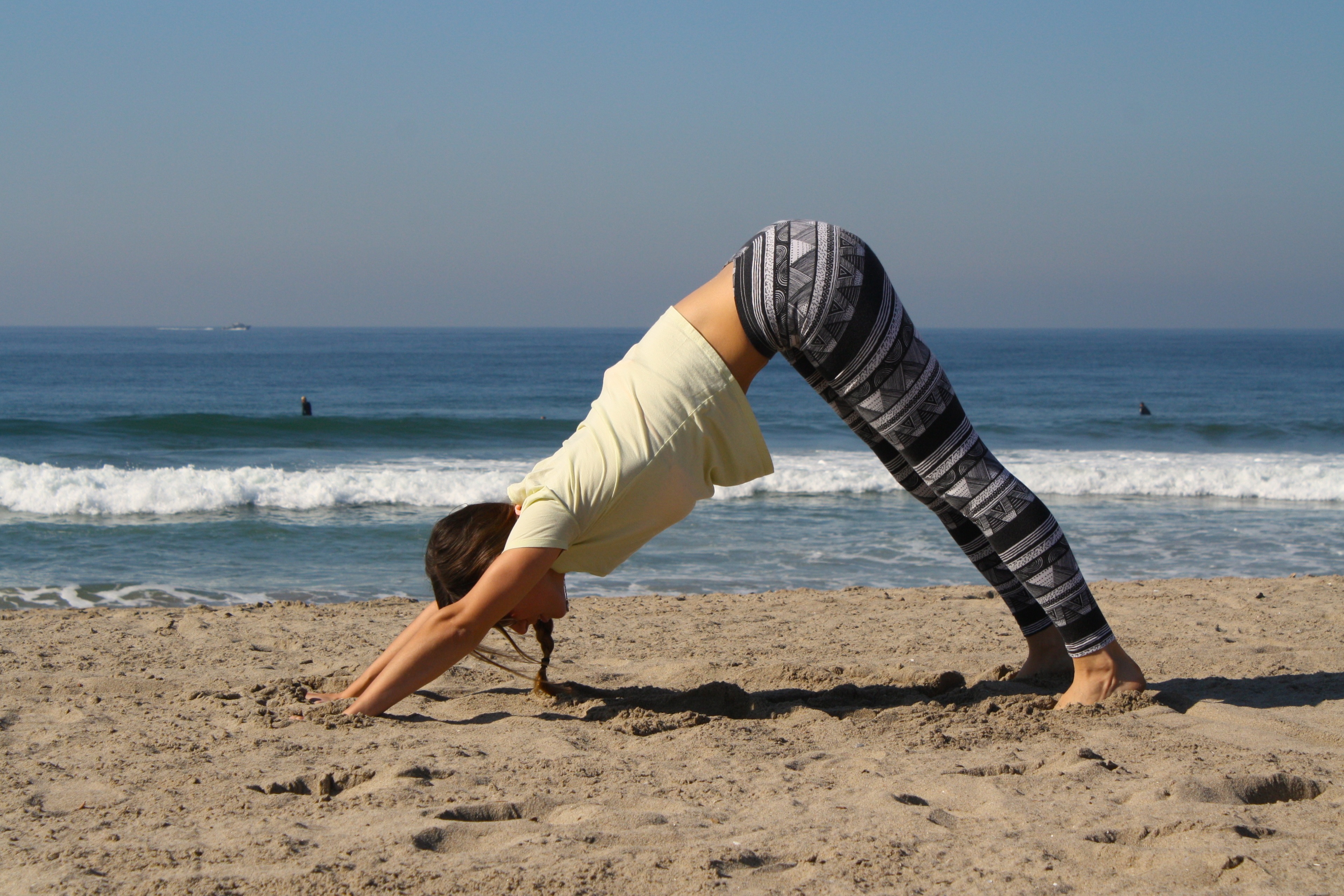
Downward-facing dog
-Widen the fingers of each hand apart from one another, and press the palms firmly into the ground. (This means there should be no gap between the floor and your fingers, particularly where your ring finger meets the palm of each hand.)
– Lift your hips up and press back through your arms, engaging your triceps and keeping a micro (small) bend at the below. Then, gently straighten your knees and engage the backs of your legs (your hamstrings) to lower your heels closer to the ground. Once this is accomplished, you can press firmly through your heels, with equal force pressing through the hands, to engage the calves and enjoy a rock solid down dog. (Go ahead and try me, tsunami – I ‘ain’t budging!)

Beach Feb 2015.7

High Plank
– Lowering into plank from down dog, extend from your wrist through your shoulder without lifting out of your shoulder socket, by ensuring your arm/the head of the humerus rests securely in the shoulder socket.
– Holding this position, lower your hips and engage your core to maintain a straight spine.
– Flex your feet and push your heels away from you, to lengthen from your hips through your heels. This way, you’re engaging and lifting from the legs away from the ground and away from your upper body.
– Check back in to straighten your spine and engage your upper and lower body muscles, planting firmly into the floor and lengthening away from it in equal opposition for full body strengthening.

Beach Feb 2015.26

Chaturanga Dandasana
– Slowly lower from high plank to chaturanga by first bending at the elbows and focusing on drawing the elbows in against the sides of the body as you lower. (This is a great example of listening to your body, as some bodies may need to modify by moving the elbows slightly away given their unique skeletal structure.)
– Engage the core, flex your feet and push through the heels to engage your hamstrings and lengthen the legs away from the hips. Set your gaze slightly in front of you to straighten your neck and cervical vertebrae for a straight spine.
– As you build arm strength, you will be able to lower more slowly, hold this posture, and even push back up into high plank for a yogi push-up. Using your breath to guide this movement makes it much easier, by pressing up on a strong, deep inhalation and slowly lowering down with a deep exhale. (Trust me, it helps a lot.)

Beach Feb 2015.4

Vasisthasana/Side Plank (with advanced modifications)
– The secret to holding this posture is core strength. Lift your hips away from the ground and lengthen the spine. Flex your bum and hamstrings, and lift your lower body up while pushing away through the feet.
– Widen your fingers and press firmly through the hand grounded into the floor. (Remember, the ring finger rule!) Once you’ve found this stability, draw your other arm up and lengthen away from the body, gently pulling your torso in opposite directions. (To start, it’s helpful to rest your arm on your hip to lift into the posture and work towards lengthening through the fingertips, only once you’re firmly grounded and comfortable in the basic posture.)
– *This posture has recently been scientifically proven to reverse sclerosis by practicing for 15 sec.  or more per day on the side with the spinal curvature.

Beach Feb 2015.8

– Once you’ve mastered side plank in it’s conventional form (above), begin to play with movement and test your strength and stability by trying these variations:
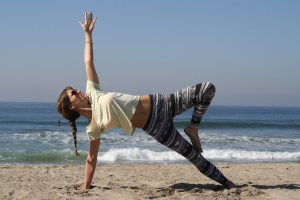
Beach Feb 2015.10

– Remember to utilize your core by lifting from the hips for stability, and flex the foot using the heel to guide movement of your free leg while strongly engaging the leg muscles. You may rest the foot above or below the knee to hold this posture, but do not rest your foot or put any pressure directly on your inner knee in this posture. 
– Maintaining the opposite force of pressing down and drawing up through the fingers and wrist is also key to maintaining upper body power and stability in this posture.
– Head and neck positioning is really unimportant in this posture, as long as you’re comfortable and not straining or holding tension in these places. Gazing up and through the finger tips is a popular choice for an added balancing challenge.

Beach Feb 2015.11

– Fully engage your leg and slowly reach your foot up and away from your body through the heel, while maintaining upper body stability.

One-armed dog push-up’s
– Lower from downward-facing dog into a position similar to high plank (except here, it’s okay if your bum sticks up in the air a bit). Lift one foot off the ground and lengthen your leg away from you by flexing the foot and lengthening through the heel.
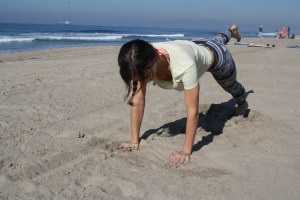
Beach Feb 2015.13

– Bend at the elbows, and draw your arms alongside your body (for stability). Lower the forehead towards the ground while lengthening your leg further away from your body through the heel.
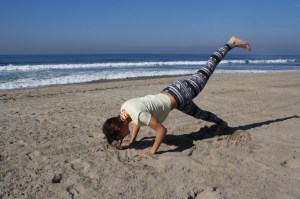
Beach Feb 2015.15

– Lower fully down in an upper body chaturanga with your forehead on the floor and your leg still raised and pushing away from the body through the heel.
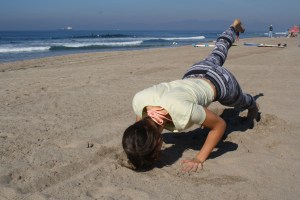
Beach Feb 2015.14

– Raise back up, pressing firmly through the hands on a deep inhalation, keeping the elbows slightly bent and held tightly alongside the body with leg raised. (Returning to original ‘one-armed dog’ posture)
– Repeat 10, 20, 30+ times, switch legs and completed on the opposite side. (In a recent workshop, we were asked to do 50 of these on each side, in unison. There was a 60+ year old woman beside me who killed it. Time to give it a try?)

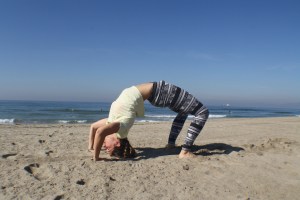
Intermediate/Advanced: Upward Bow or Wheel Pose Push-up’s
– For intermediate to advanced practitioners only, this posture becomes much easier once a solid foundation of arm strength is gained.
– First, lay on your back with your knees bent and your feet firmly planted on the floor. Bending your elbows and pressing your palms into the ground behind your head, push firmly into wheel pose while engaging the core to stabilize the spine. (See link above for more detailed instructions.)
Beach Feb 2015.20

– Find a comfortable position in wheel pose by walking your feet in towards your hands and always keeping a micro bend in your elbows as well as your knees. (Did you catch it? I’m missing my micro bend below! This creates instability and undo pressure at the joints which can cause bone degradation and nerve damage over time. So keep that bend!)

Beach Feb 2015.21

– Bend your elbows and gently lower the top (crown) of your head to the floor. Just like in chaturanga, be sure to draw the elbows in toward the body rather than letting them splay out and away, to maintain stability of your joints.
– Once your head is planted on the floor, push firmly through the feet and lift the hips up through the core. Move your hands slightly back (1 inch) towards your head, allowing brief and gentle pressure to rest on the crown of the head (*advanced practitioners only*), and press back up firmly through the hands into wheel pose, for an inverted yogi push up!
– For beginner and intermediate practitioners who want to give it a try, keep your hands firmly on the ground at all times and lower the head down to the floor before lifting back up for a safer, modified version of the push up.

Beach Feb 2015.22

Resting Postures* (These are counter postures designed to stretch your muscles in gentle opposition to the work you’ve already done. Feel free to sprinkle these in between your more intense postures, but definitely include them during your post-practice cool down – that is, before you take your well-earned, luxurious Savasana!)

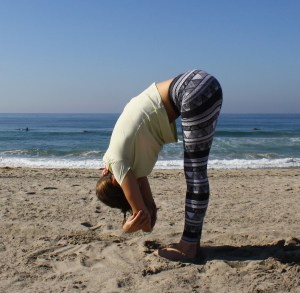
Relaxed Standing Forward Fold
– Grab onto the elbows and release the head and neck to fully relax the neck and spine.
– Press firmly through the feet and legs, but keep a micro bend in your knee to alleviate undo pressure to your joints.
– Gently hang here, releasing any remaining tension in your upper body and allowing your autonomic nervous system to kick in, sending ‘feel good,’ relaxation-inducing hormones to your brain. (This happens anytime you lower your head below your heart. Hence, why EMT’s have patients lower their head between their legs following an accident.)
Beach Feb 2015.17

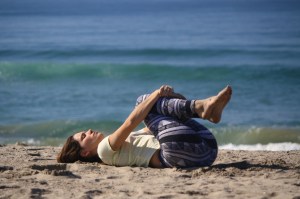
Knees to Chest Pose
– Gently wrap the arms around the knees, drawing the knees into the chest. Grab onto your fingers, wrists, or elbows, whatever is most comfortable for you. Hug your knees in and rest here (remembering to maintain your deep breathing).
– Hold for 30 seconds – 1 min., with or without rolling gently side to side, if this feels good to help loosen up tight hips.
Beach Feb 2015.24

Reclining Bound Angle Pose
– Bring the soles of your feet together, and allow your knees to relax towards the floor and your hips to gently open. If you feel any tension or discomfort in your knees, move your feet further away from your body (1 foot away, or more) until you find a comfortable position.
– Allow your arms and shoulders to relax, turning your palms upward. Draw your arms alongside your body, place them farther away or let them rest above your head; whatever is most comfortable for you in the moment.

Beach Feb 2015.23

Namaste ❤

Photo Credit: A big thanks to my photographer, Matt Annese! Check out more of his work here.

Living your Truth (the true grassroots movement)

Every conversation, and every challenge brings us clarity. In our individual process, our unique life, we’re all creating our own story. And at times, I know I get all too anxious to know how the story ends…

But, of course, this is just wishing time away. Valuable, irretrievable time, which in culmination builds our lives. And I imagine one day, not too far away, I’ll be wishing for more.

This insight drives me to incorporate, but not always rely on my heart, as well as my head in decision-making. Because, if we’re only here a short time, it’s reasonable to hope that we make the most of it. So we can look back at our lives lived, our own story, with a full heart – and no regrets.

There are many ways to go about this, and no wrong way. But, there is your way. A concept I’m particularly interested in – which is a theme of the ancient texts and textbooks we’ve been reading in school – is that of individual “duty,” or as I’ve come to understand it as, one’s unique “purpose.”

In Chapter 2 of the Bhagavad Gita (written in approximately 300 C.E), Krishna (the eighth worldly incarnation of the god, Vishnu) imparts to the great warrior Arjuna before he enters into battle: “Now, if you will not undertake/ This righteous war,/ Thereupon, having avoided your own duty and glory,/ You shall incur evil…Your right is to action [duty] alone.”

Many centuries later, in the 19th century C.E. Ralph Waldo Emerson (a Harvard graduate) founded the Transcendentalist movement here In the United States. In his ground breaking essay, Self Reliance, he belabors the significance of individual authenticity for the benefit of society, to evoke and unleash one’s own genius (more here); ultimately, in my favorite line he states simply: “But do your work and I shall know you.”

In the 20th century, Mahatma Ghandi (or the “great soul” in Sanskrit) had the courage to voice his beliefs and to publicly advocate for the liberation of India from British rule. He is credited with the nation’s success, and yet the U.S. – not India – was the first to recognize his honor and integrity as an individual force for empowerment. Ghandi credits his courage to God (or his higher power), and simply shared with all who inquired that it was his duty, his purpose on this Earth to serve out this work. (Bob Dylan used the same allusion to “duty” to describe his experience as a musician and songwriter, as that of a conduit; receiving messages to share with the world from and as part of something bigger.) Ghandi read the 2nd chapter of the Bhagavad Gita every morning, and cited it for motivating his voice and leading his service for the sake of humanity throughout his life.

Not long after, Martin Luther King Jr. led the Civil Rights movement in the U.S. Today, we celebrate his work annually, and recognize his name as synonymous with efforts for justice and peace. MLK too read Chapter 2 of the Bhagavad Gita regularly, and specifically revered it as his source of inspiration, in conjunction with the Bible, in motivating his work.

Nelson Mandela served as South Africa’s first black chief executive (President) and first democratically elected individual in the early 1990’s. Prior, he served 27 years in prison for standing up for his beliefs to end the apartheid and embrace racial equality, justice and peace. Mandela also credited the Bhagavad Gita for inspiring and motivating his service throughout his life, and up until his recent passing in 2013.

Well, maybe it’s our turn…to believe in something bigger.

I have a dream that yoga as a philosophy and a worldview is a source for empowerment. That it is undeniably and inextricably connected to individual, societal and global politics as a vested belief system and lifestyle (with a physical practice to aid in this process), representative at its core of truth, justice and peace; that it has the power to inspire people to their fullest potential by motivating them to speak and live by their own Truth (and thereby, also enjoy life more fully). Inspired by a higher purpose, if not a higher power, yoga is nondenominational and nontheistic. It doesn’t require prescribing to Hinduism, Buddhism, Christianity, or any religion at all. For instance, my higher power is the Universe: a force I believe to be greater than myself, which – as the sun and the moon guide our existence – provides comfort, predictability, and an opportunity for fulfillment of purpose for each and every creature that lives within it.

Purpose, truth, duty. It’s heavy, for sure. But yet, we see the Earth degrading beneath and around us, and the large majority of the world’s population suffering in ways we in the U.S. could never imagine, if only in our worst nightmares. This is life. This is it. And, we create it – past and future. We are responsible for it, and for how our individual behaviors impact the greater whole, the entirety of the human race, and the world around us.

This realization is scary, and perhaps the most daunting task that can and will ever be set before us. (And so, we see many of today’s politicians turning a blind eye.) But again, what’s most important to recognize is: we create it. We control it; what will remain for future generations and the course of our own lives. All we need to do, as individuals (perhaps the best and greatest grassroots movement) is to live truthfully and cultivate a real personal sense of compassion and peace; and others (even the most unlikely among us) will follow. According to a December 2012 study, over 20 million Americans practice yoga regularly – and the number continues to grow. What if all of these people united their practice* as a way to explore and ultimately live out their Truth, their “duty” – while losing weight and reducing stress at the same time. [Rupert Murdoch and Oprah Winfrey reportedly meditate every day…anything is possible.] * (yoga = “yoke” or “union”)

I still strive for clarity of my own purpose, my own duty. And I understand this is a life long journey, and that we may never fully realize the fruits of our labor during our time on Earth (but we can plant the seeds…) The biggest, and most challenging part of this process is trust. To trust that if you are a good person and you are open to new possibilities, that the right one’s will find you, and soon you will see clearly your purpose, and your duty – for your own happiness, for the prosperity of those you love, and thereby for the betterment of the greater whole, the human race, and Mother Earth.

I believe it, because great men (and unspoken women) before me believed it. And through this belief, they accomplished what no one else before them was able to do. By simply changing their own lives, they changed their nation and the world.

Trust. For the betterment of our nation, for the safety and prosperity of future generations, for the love of life and in gratitude for all we’ve been given, I urge you to listen and trust in your own authenticity. (That voice inside you that tells you what’s right and what’s wrong – even if it goes against what other people are doing, or thinking, or even saying…) We all innately want to be great: Mahatma, “great souls.” All we need to do is stay open and trust (according to the great’s before us, practicing yoga regularly makes this much easier, even effortless and blissful); because the world is broken, and every voice can and should be a voice of reason, a role model to bring about hope in our own small way. By always learning, growing, and living our own Truth –  we can all be that voice.

With love and in honor of those who paved the path before us, to venture into our own authenticity and our own genius. There is always a light.

I hope you might join me (in your own way) in committing to using your lifetime to explore and relinquish your own: Let your light shine!

Namaste,
Amy

Photo Credit: Alex’s Photo Blog from Jama Masjid, Old Delhi, India (2011)

No Regrets: A Guide to Managing the Chaos

I’ve experienced quite a shift in the past few weeks. And from what I’ve heard from family, and especially friends – going through the same grad school grind or 40-hour funk – the feeling is mutual. Perhaps the New Year holiday isn’t such a pointless occasion. Maybe, something actually does happen worth celebrating; a shift into greater consciousness. Or, as it’s more likely be familiar as, a new perspective. Suddenly, we’re all asking: Where am I going? What am I doing this for? Is this really where I want to be?

A new year will do that to you. Just when you think you have it all figured out, and you’re in full-out holiday 2014 turn up mode. Routine strikes again, and we find ourselves asking: Why? Why do I do the things I do? Is this really what I want?

Doubts inevitably start sweeping in. And then you have a choice – continue doing what you’re doing, or change it. Well, unfortunately I’ve (pretty much always) opted for the path of most resistance. Change it. Or change something. Because, if you’re noticing there’s an issue – how can you go forward with it any other way?

After spending a good part of my holiday ‘break’ formulating my plan for change, I realized that all of my commitments (work, school, research) are important to me, and worth going after. There’s nothing I want to, or can change, at this point in time. And, I’ve also learned bailing isn’t always the answer. There’s always something to be learned and gained, even from the most difficult situations. Then, I came to an interesting thought: You can’t muscle through it. You can only breath through it.

I’d been pushing and pushing, and putting my head down and hoping for ‘the end.’ (Whatever that means…) I was muscling through it, and hoping that would be enough. But of course, my strategy didn’t sustain and despite my efforts, I couldn’t see the end of the tunnel. But, even in the worst situations, there’s always a light; a way to make it better for yourself. I’d been trying to muscle through it when I really needed to just stop and breath.

Distinguishing these moments, when you’re running out of gas and it’s time to switch gears, is the secret. It’s everything. Because, if you can keep your self in tact, you can do anything you want to do without feeling mysteriously (and overwhelmingly) exhausted, or stressed, or angry. For me, allowing myself to have downtime; to take care of myself (who knew a home manicure could feel so amazing?) and in turn, devoting myself back to the hustle; to stay true to the commitments I’ve already made, and be present to all the things I’m looking forward to this year. It’s an ongoing balance and it takes work. But, most importantly, this means ‘checking in’ (or as somatic psychologists call it: a body scan) – every day, as often as you can. How am I feeling? Am I thirsty or hungry? Tired or getting sick? Am I agitated or stressed? Am I angry or irritable? What can I do to take care of myself right now?

We’re used to – and good at – putting things off. Especially, when it comes to self-care. The last priority on our “To Do lists,” often are the items that involve taking care of ourselves. But, what good are we really after we reach our breaking point? I know when I was working a corporate job, this came before lunchtime. Last semester, it came even sooner. So naturally, you start to wonder: Why am I doing this?

I found it helpful to consider why I’d started instead. School or work is tough sometimes, sure. But it must be that the reasons why we’re there in the first place are far more worthy of consideration – the long-term vision, rather than the day-to-day grind. Now that the honeymoon period has ended, what’s your motivation?

Only you can answer that, and it’s for no one else to judge. It’s your life, and you should make it yours. No matter what position you find yourself in, there can always be a reason to get you through (especially, the tougher times) – be it personal, professional; trials, tribulations; learning, growing, sharing. If you allow yourself to believe there is a purpose for this place in this time, then you allow a feeling of forward movement and fulfillment to supersede. And if you check in with yourself, and put yourself first (for the benefit of everything and everyone that comes after), there’s only joy.

Whether you decide to muscle through it, or breath through it – only an attitude, a perspective changes simply by changing your focus. And, you control it. (Imagine that, in this crazy, scary world of ours…You ultimately have control.)

Like many I know, I’m off to a very busy and daunting 2015; but I’m optimistic. I’m taking one day at a time, and trying my best to be present when and where I am, in each moment. If these events, and people, jobs and classes are important enough to be part of my life, then I owe it to myself to be present for them. (Also, you can be sure this way: you’ll have no regrets.) We can choose when and how, and if we want to change. But ultimately, it’s all a matter of perspective.

Wishing you all the very best things a new year can bring, and all the joy that can possibly come along with it.

No Regrets,

Amy

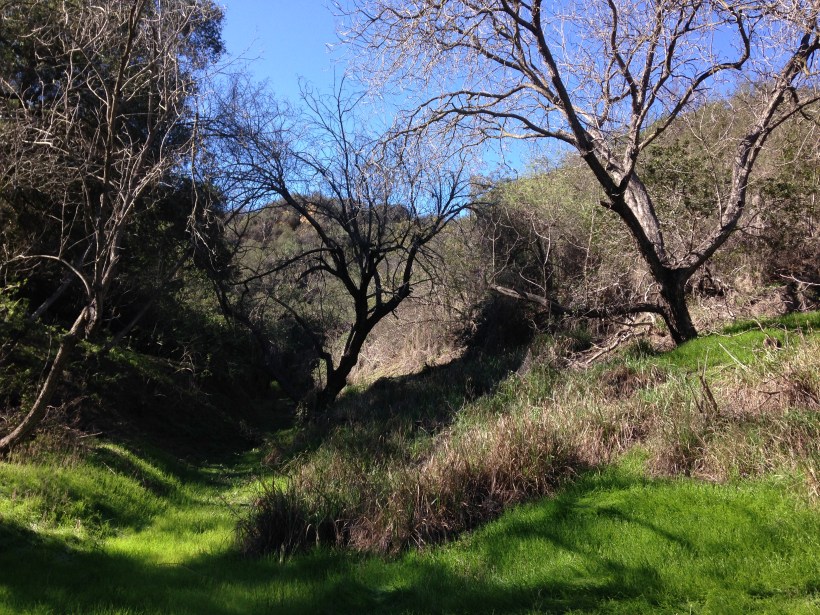
Personal Photo: Meditation Retreat @ Benedict Canyon, Los Angeles, CA (January 17, 2015)

New Years Revelation

It’s New Years resolution time. A time I remember greeting with promise, hope and great expectations, this year, seems a bit more daunting. It might be that I’m growing older – which was no more apparent than while suffering the day-long consequences of enjoying one drink too many at a holiday party last week (my 21-year-old liver is no more…) Or, it might be circumstantial – following my first semester in grad school, I already find myself searching for the light at the end of the tunnel. (While I won’t say it’s all darkness ahead, I will say I can’t yet see the light…)

Of course, it could also be that my year as a yogi has changed my perspective.

In the midst of the holiday season and a particularly stressful time in my life, I’ve been seriously craving some clarity and some reprieve, which has led me to consider how my mindset is impacted by dwelling on the choices I’ve made in the past and on my anxiety for the future. As you’ve likely heard before, the practice of yoga is about bringing your awareness into the present. I recently read in James Fowler’s “The Present Moment” that the practice of meditation can even be simply defined as an act of “love for the present moment,” (as well as for the love of Truth, of Beauty and of Goodness – such a beautiful sentiment, I’ve recently incorporated into my practice/daily intention setting). And Yoga Journal recently shared that the key to happiness is to stop planning for our ideal future, and to shift our focus on living today, in this moment.

As these seeds were planted in the back of my mind, the time was right – and ripe – for a revelation. And sure enough, as often happens during my daily practice [of asana and meditation], a single thought swept through me and helped assuage my fears and anxieties for the coming year. Just like that…Not a resolution, but a New Years Revelation:

You have everything you need.

Soaking in the peace of mind that comes along with this resonance, I realized I need a re-prioritization this coming year – Not a ‘quick fix’ solution, or yet another brilliant addition to my busy schedule, as I often associate with a resolution. I already have it all, but my current mindset consumed by back-peddling and negativity isn’t serving me, or allowing for all the Truth, Beauty and Goodness of the present moment to shine through, to really enjoy it. Although I usually avoid getting too personal (because after-all, A Year in Yoga is all about you!), I hope that sharing more of my revelation with all of you might help plant the seed to inspire your own, for a happier, brighter, more content and gratitude-filled year ahead…So here it goes ❤

 My Priority List for 2015:

  1. Self-care. Much of my work in Yoga Studies thus far has centered around healing and trauma, and what I’ve come to learn is that everyone is healing from some sort of trauma (big or small) – and it’s not our job or our right to evaluate how deep, how harsh, or how justified someone else’s trauma, or journey is. I can’t be any good at my job, in my relationships, or even in my yoga practice, without taking care of myself first. (A lesson I can attest, I’ve learned the hard way.) For me, this means allowing myself time and space. Time to breath in between an all too hectic schedule, even if this means telling someone else you’re unavailable. (Sorry, I’ve got a date with myself tonight!) And space: a few moments of solitude, a clean environment, and at least an hour a day when I’m totally unplugged. Create your own rules, or don’t. Whatever it takes to give yourself the attention you need to heal from whatever hurt you’re holding onto; to rejuvenate, to flourish. You’re no good to anybody, until you’re good to yourself; and life is, along with many other [beautiful, wonderous] things, a process of healing.
  1. Love. I have to admit, this is a new list-topper for me. I’ve always loved the idea of love, but I’ve never wanted to make it a priority. It’s simply too scary. The moment you open yourself up to love, you create space for rejection and loneliness. It’s much easier to be alone. Much easier, but empty. And certainly no less lonely. This kind of love doesn’t have to be with a significant other, it can be for a family member, a best friend, even a furry companion – but it is that pitfall, head over heels, unconditional, crazy-expressive-passionate kind of love; that fills your heart until tears well up in joy, and makes you equally as vulnerable to hurt and despair at its loss. If you’re lucky enough to have experienced this kind of love, you’ll likely also agree that it’s simply this feeling that makes life worth living. It gets you out of bed in the morning, keeps you going when you’re running on fumes, and picks you up when you (inevitably) trip over your own feet and fall on your face. While yogis aim to embody detachment, this kind of love is the only exception. To love whole-heartedly and steadfastly, to love all living things this way is a yogi’s primary goal. Because only by loving this way can we achieve happiness, and can we find peace, in our lives and for others. I am so very blessed to have an abundance of love in my life. Really, what else is there to want? But putting our own ambition, or other priorities ahead of love means abusing it. It’s a two-way street. Let the love in your life come first and guide you, and you will have a life full of love – and therefore, at its very core, of happiness and peace.
  1. Stability. Of course, even with love and self-care, we all need stability in our lives to do anything more to function in society. (Consider: Maslow’s Hierarchy of Needs) Having grown up blessed with a strong foundation of stability, I ventured out over the past several years for a taste of challenge, of hardship (though not explicitly so at the time). I had something to prove, to myself. If I wanted to serve populations who had less than me, then I felt I needed to know what that really meant – and even what that felt like. Studying abroad in a third world country, working full-time for minimum wage, and immersing myself in homeless, low-income and prison populations; these choices have undoubtedly shaped my life. I say so with full recognition of how privileged I am to have made these choices – sprinkled after and in between my private college education, graduate coursework, well-paid jobs and refused opportunities. But what I’ve learned, however difficult at times, has been invaluable. Stability to me, represents a strong support system and enough financial resources to provide a home, pay the bills, and put food on the table (which varies in feasibility based on location and skill-set). When one of these areas is lacking, our whole being is at risk. The love and self-care we’ve worked so hard to cultivate is threatened, and we’re unable to do much more than run in place, and just “get by.” Evaluate what makes you feel stable; what’s your springboard for growth? And be so grateful for it. Nurture it. Cultivate it. Cherish it. This is also living with present awareness for all that we already have, and a goal of mine for the coming year.
  1. Be. And the rest will come. I can spend today, tomorrow and next year conjuring up my next project, worrying about my final exam, mulling over my past mistakes, and yearning for the light at the end of the tunnel. But at what cost? Too often stress and anxiety overshadows our ability to experience, enjoy and live in the present. By living this way, we risk losing a sense of ourselves and of those we love. When we finally achieve whatever it is we’re after, or perhaps just get tired of the chase, who will be there with us? What kind of shape will we be in – our physical bodies and our mental well-being – when we get there? Will we really be able to enjoy it, or will we already have our eye on the next prize ahead – an even bigger house, a more expensive car, a promotion, another degree? What about right now? Wasn’t there a moment when we dreamed of being right here? Relish it. We’ve all worked hard and learned tough lessons, jumped over hurdles and slayed dragons to be here – and here we are. We’ve worked so hard to be right here. So, we better enjoy it – You never know what tomorrow will bring.

Instead of thinking about what you should add to your life in 2015, I encourage you to consider all you already have. And challenge yourself to have your own New Years Revelation. To re-prioritize what really matters to you, at this point in your life, and allow that to be your mantra and your intention for the coming year. And strive to just be with it.

Sending boundless love and well wishes for a safe and very merry new year to you and yours. Cheers to all that 2015 will bring!

The light in me honors the light in you.

Namaste,

Amy

Photo: Throwback to New Years 2012 with my BFF Ashley at Lansdowne Pub Fenway Park in Boston. Thank you, Ashley for being there through it ALL and for always letting your light shine – & for always encouraging and inspiring me to do the same ❤

Happy Holidays! (Your Asana Cheatsheet)

Wishing all a very happy holidays this season!

As we look forward to food, family, and fun over the next couple days, I wanted to offer a few quick and very easy asana postures for an energy boost and peace of mind in the midst of what can be a very busy and stressful time.

Here are a few of my favorite postures that I practice regularly and often incorporate into my classes. They can be practiced in sequence or on their own, whenever (and wherever) you have a couple minutes to spare. Accompany each with slow, deep breathing and – if you like – while repeating the mantra: “Love of the Present Moment” (or whatever phrase resonates most with you. Others might be: Let Go; Peace; Love; or Om Namah Shivaya translated as “I am Shiva,” meaning “I am the light” ^^ link to my favorite rendition by Steve Gold)

Whether practiced before bed, in the kitchen between cooking prep, or on the living room rug – I hope these postures will bring you peace and grounding (self-care) to help you cherish every moment spent with loved ones this holiday.

Happy Holidays from my corner to yours xx

Amy

Holiday Asana Cheatsheet
*Click posture name for in-depth instruction and benefits from;
*All are safe & easy to practice for all body types;
*Practice each for as little as 30 seconds, or combine and hold for up to a 30-45 min. personal practice

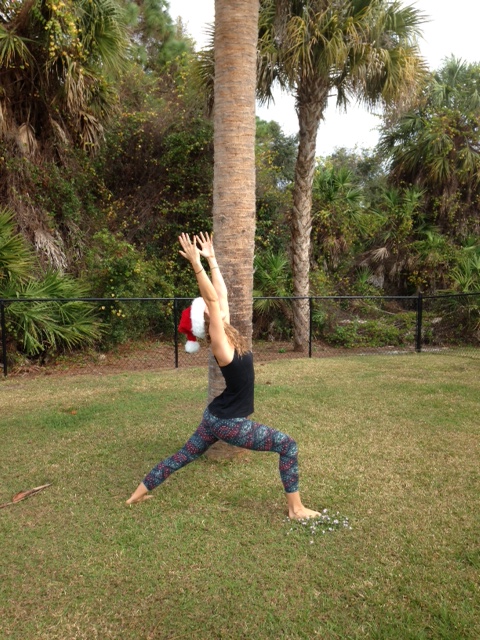
Warrior I with backbend/Virabhadrasana I
*Heart opener, gentle backbend, promotes energy & circulation; great for when you feel you need to ‘get moving’
(hold 30 sec. – 1 min. each side)

Crescent Lunge with Backbend

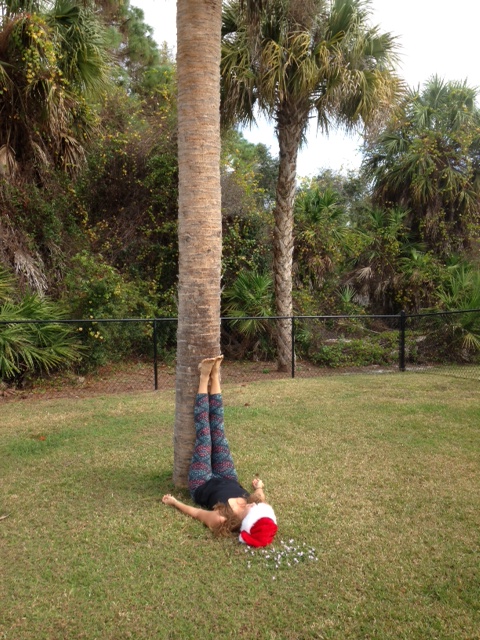
Legs-Up-the-Wall Pose/Viparita Karani
*Detoxifying, boosts your immune system, stimulates your circulatory system, strengthens your diaphragm/respiratory system (An inversion a day keeps the doctor away!
Hold anywhere from 30 sec. to 5 or 10 minutes)

image-2

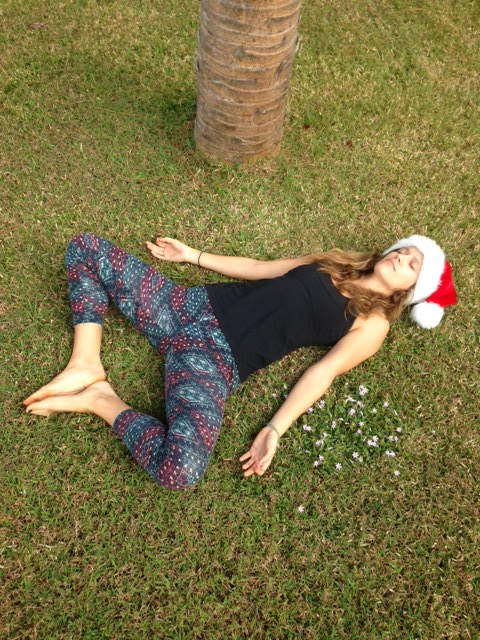
Reclining Bound Angle Pose/Supta Baddha Konasana
*Hip opener, releases tension, stimulates respiratory system through thoracic breathing – expand rib cage with inhale, spine neutralizer (hold 2 min. or up to 5-10 min.)

image-3

Easy Pose/Sukhasana
*Meditative posture, straight spine and shoulders back, abdomen engaged to support your torso, neutral position. (If you like: Engage in slow, deep breathing with an elongated exhalation (2x inhale) and introduce your mantra here. Hold 5 to 10 min. or as long as you’d like. This is an easy introduction to a regular meditation practice.)

image-4

**BONUS: (My favorite, if you’re up for a challenge!)**

Lord of the Dance Pose/Natarajasana
*Balancing posture, hip opener, core/strength building (Hold for 30 sec. to 1 min. on each side. Be sure to find a drishti, or stationary visual point about 4 feet in front of you to lock your gaze and help maintain balance.)

image-6

Xx Cheers! xX

Reality Check: When Life Gives You Lemons (+ Recipe)

As 2014 comes to a close I find myself reflecting on the past three months and my first semester in Yoga Studies, and a resounding lesson – or key takeaway persists:

Reality Check #1 (since I lost count long ago, we have to start somewhere):

When life gives you lemons, you still have to squeeze your own [damn] lemonade.

Ultimately, life is what you make it. You can be lucky, work hard, and be at the right place at the right time – but where you go from there is entirely up to you. It’s how you interact with others, what imprint you leave on the room (and the world) after you leave it; who you influence, the choices you make and how you are. That, is also your karma. It’s your footprint, and your fingerprint. It’s uniquely you and a lasting impression. How deeply do you love? How fully do you live? These are choices, as much as they are inherent to you.

Sometimes you have to really bust it to get through, and other times it’s easier. For better or for worse, in speaking for myself, I’ve made the decisions I’ve made to land me in this very moment, right where I belong. (Really, what benefit is there in believing otherwise?) There’s something to learn from difficult times and a way to grow in painful times, that will just make you stronger down the road. And in turn, it’s important to remember there’s always something to give in times of success and prosperity, time to lend to old friends or family when things finally seem to slow down. We all have all of these moments – the good and the bad. Embrace them for what they are, but don’t let them rule you. And know it’s how you react that makes you who you are, and how the world knows you. Less so what you wear, where you work (“what you do”) or what you look like. And much more, how you love.

Our choices – mine and yours – are responsible for what happens next. They’re an expression of ourselves, our individuality, that’s more bold than wearing a crop top and hot-pants. Because, when you make a new friend or find a new relationship, it’s not about what they’re thinking as much as what they’re feeling. That rush you get from a great conversation with a stranger, because they listened, and stopped to focus their attention on you. That’s an impression, that’s an air, a compassion, a reputation. That’s who are you, and that’s your karma.

So, [in other words] my takeaway this year is: When you find yourself in the right place at the right time, you have a responsibility to act. Don’t wait for the world to do it for you or for life to get a bit easier first…You are brilliant and capable, or you wouldn’t have found yourself where you’re standing. (With gratitude!) When you find yourself in a position that just feels right – which may sometimes, tragically contradict what “makes sense” – you can rest assured that if you move forward, you won’t regret. Take every opportunity like it’s yours, like it’s the only one, and like it was meant for you; because, it was – because our choices dictate who we are.

I’m making the commitment to take on 2015 like it’s all mine for the taking. Always: Go get ‘em – in whatever you decide to do. And remember, it’s already in you, you just have to let it shine…

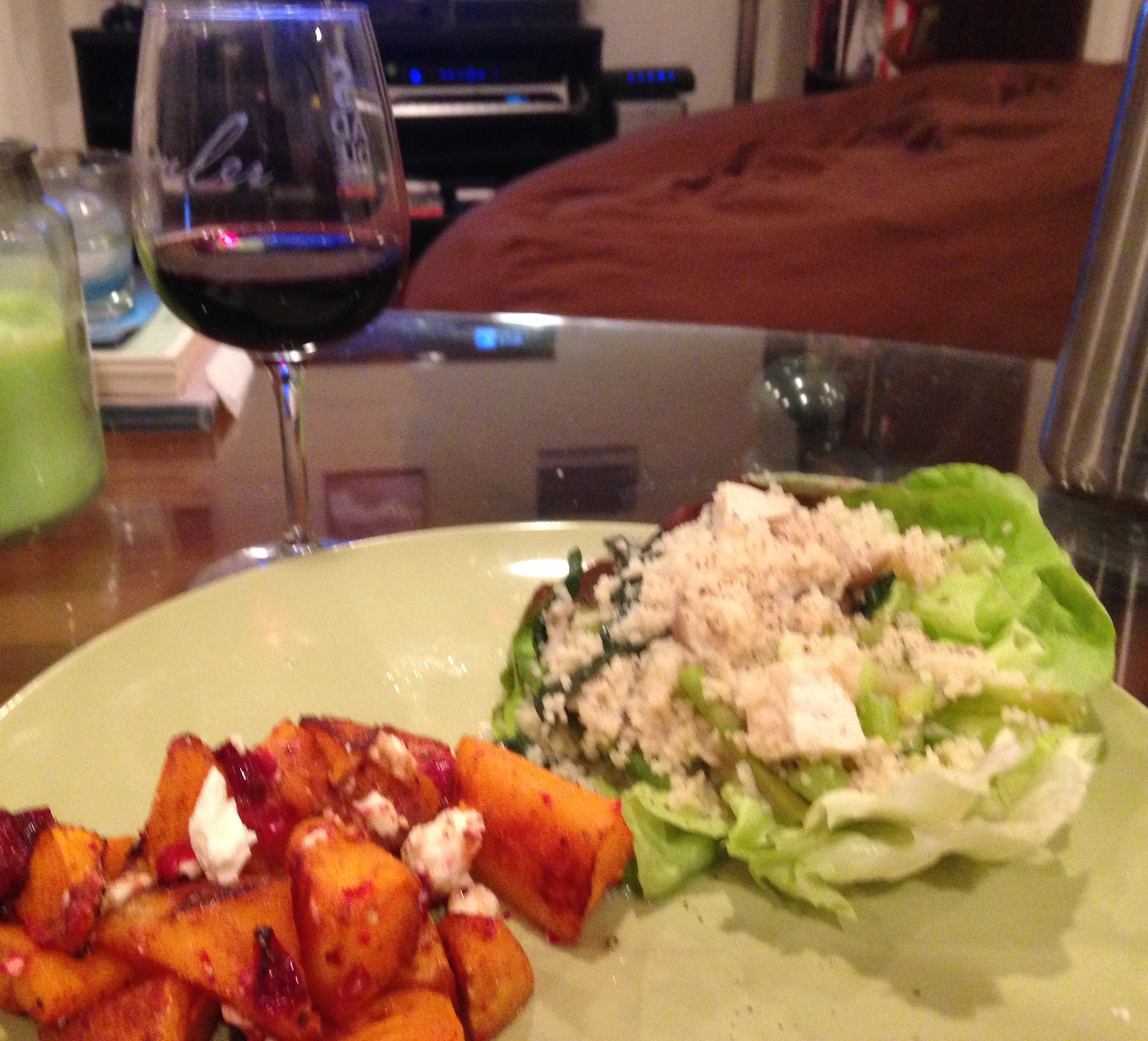
A little autumn inspiration to fuel your fire (both your internal fire & your agni, or the fire in your belly) 😉 I had all the ingredients in my cabinets and got the rest (along with this recipe) from my CSA, Farm Fresh to You. Eat with the seasons! (Your body will thank you…) And don’t fear, all this goodness is also readily available at your local supermarket.

butternut squash

Honey-Roasted Butternut Squash (with Cranberries & Feta)

* I served with whole wheat couscous, extra veggies and tofu + garlic, butter (we use, Melt), sea salt, pepper & red wine!

Ingredients:

-1 butternut squash, peeled and chopped (or acorn, spaghetti squash, or your seasonal favorite!)

– Olive oil (or your oil of choice, coconut oil in this combo is delicious)

– Salt, pepper, garlic (crushed or minced – so cheap at Trader Joe’s! – or garlic powder works just fine)

– 2 cups of fresh cranberries

– Honey, to taste (2-3 tablespoons average)

– ¼ cup crumbled feta cheese

– Ground cinnamon, to taste

– Fresh parsley (optional)

  1. Pre-heat oven to 400 F. Drizzle baking sheet (or glass baking pan) lightly with olive oil.
  1. Cube squash or cut how you’d prefer in approx. 1-2 inch pieces. Lightly drizzle olive oil and sprinkle a light layer of salt, pepper, and garlic over squash, to taste.
  1. Roast at 400 F for 25 minutes on center rack. Then, add cranberries to roasting pan.
  1. Return dish to oven for 10-15 minutes, or until the cranberries begin to soften and burst open.
  1. Remove from oven, add a sprinkle of cinnamon (~ ¼ teaspoon) along with feta and honey, to taste. Garnish with parsley (for “ooh lala” factor).
  1. Enjoy with others or on your own! I enjoyed my leftovers 😉


Bon Appetit and well wishes for an abundance of warmth and light [in your life and your heart] this season ❤
Amy

Give in to Comfort (+ Recipe)

O’ tidings of comfort and joy! Comfort and joy… I’ve never stopped to consider these lyrics before, but giving a nod to a holiday classic, I’d have to say that word choice here is key. Tidings of comfort can allude to many things, such as that of family, of warmth – both physical (hanging fireside with hot cocoa) and emotional (open hearts and widespread generosity), of abundant food and ideally of relaxation. To feed yourself [and others], to love yourself [and others], to celebrate love, life and gratitude for all that you have. For an old church hymn, they’ve covered a lot of ground. (Good work, ye merry gentlemen!)

Of course, like any good celebration, the holidays come with their fair share of temptations and frustrations (and did I mention, expectations?). So, if you’re like me, the pre-Thanksgiving time is marked by a bit of anxiety. Excitement for a season of family and friends [with their respective social outings and get togethers], and a looming hope that you don’t get too carried away – with your holiday shopping, long-nights out and working overtime, heated dinner-table discussions with relatives, or double chocolate fudge [martini] indulgence. How do we walk the fine line between indulging in the comfort of the season and not over-indulging? It’s a difficult balance made much simpler by approaching the season with mindfulness – remembering that indulgence foremost means caring for yourself.

Here are a few things to keep in mind as you look forward to the comfort and joy of the holiday season! (And to relieve any lingering anxiety over all the goodness yet to come…)

Bubble baths. To me, bubble baths are the ultimate form of indulgence. For you, it may be something else – perhaps reading a book or having a glass of wine by the fireplace (actually, I change my answer…) Take time during your time off this holiday season to indulge the way you want to. Too often in the past, I’ve felt the holidays have come and gone without allowing myself any time to relax. But I’m giving you permission – you can even put it in your calendar! – to make time for yourself, as often as you can, to indulge this holiday. (I’m talking bubble baths, candles, home facials and red wine…) You’ll be just as grateful come January, when you return to your routine feeling rested and rejuvenated 😉

Taste everything. As I’ve said before: Food is love! And you deserve only the best. But, of course, the best includes Gramma’s seasonal batch of double chocolate fudge and late-night pizza with high school friends. Don’t deny yourself a single thing this holiday, but do allow yourself [in most cases] just a taste. (Don’t panic – for me, this translates as one piece of fudge or 1-2 slices of pizza. Make it as realistic as it is delicious.) Ultimately, you have control over how much of what ends up on your plate. Start off with a taste of everything you want – one or two spoonfuls (use your judgment) – and then pick the thing (or two) you liked the most and go back for more! For dessert, go for that big ol’ slice of pie – but be kind to your body, pick just one (big) or two (small) things. And if you’re feeling bummed about missing out on a second piece of pie or that other tasty treat in the back, take one home for tomorrow or split with a friend. (I sometimes have to remind myself, there will be many more chocolate chip cookies in my future. No need to eat them all now!) Allow yourself to indulge in all the comfort of the season, while remembering to care for yourself foremost. This is key to avoiding next-day belly aches and painful hangovers at the holidays – and throughout the year, tried and true!

Stay Well. A lot goes on during the holiday season, you could even say it’s gained a reputation for stirring the pot. High emotions – of grief and loss, of being over-worked and exhausted, of frustration and anger, of fears and expectations for the coming year – often associated with the season are compounded by high stress, a natural derivative of the holidays. Acknowledge this, and even excuse yourself in advance. If and when things do come up, let them and then let them go. Take care of yourself and care for others. Greet stress  with as much compassion as you can muster. Remember that over-indulging in one thing, won’t relieve the burden of another. Give yourself the courtesy of acknowledging what you’re feeling as it comes up, and then take a step back and check out the big picture (“I’m really exhausted from being so busy.” Or, “I just miss my family, a lot.”) Then, from that place, decide how you’ll react. Take a nap, cook dinner for a friend, call a loved one, or hit a yoga class; indulge in a way that’s constructive and that won’t further aggravate yourself or others. Give yourself some love, and stay well.

Coincidently, these three are also a recipe for joy. I didn’t fully understand the meaning of joy, nor did I take much interest, until I challenged myself to follow these steps to the best of my ability, everyday (about a year ago this holiday). Since then, my constant belly aches have gone away, stress has become more manageable, I get sick less, I feel better, and I eat everything I want (but usually, just a taste). Caring for yourself is foremost. Once you can sustain a healthy balance of giving unto others (i.e. work, friends & family) and giving in to comfort – there is only joy. (Although, I’ll be the first to say this is an ongoing process, it’s certainly a commitment worth making to yourself, and for others.)

Live well and be well! ‘Tis the season of comfort & joy! I’m looking forward to spending quality time with friends and family in the coming weeks and wish you all of the comfort and joy that this season brings!

————————————————————————————————————

As the weather gets cooler – and the urge to curl up on the couch gets stronger – I thought I’d share a recipe to put aside for your next night at home. Just keep a box of Annie’s handy and add other goodies as you see fit! Bon appetit…

This is a favorite variation to spruce up my favorite comfort food. I encourage you to add, subtract and modify to make it as delectable for you.

Veggie Bomb [Buffalo] Mac n’ Cheese
(Makes enough for two, or one with leftovers!)

Ingredients:

  • 1 Box Annie’s Mac n’ Cheese (I love the “white shells,” but you can use any brand or variety you like. I’d recommend sticking with organic or whole wheat, if possible.)
  • Buffalo Sauce (Franks or any variety. Hot sauce works, too!)
  • Almond milk (or soy or organic dairy. I wouldn’t recommend using coconut milk here, as it’s consistency isn’t ideal for the “n’ cheese” to follow)
  • Kale and/or Spinach (or any dark leafy green in your fridge)
  • Celery, 4 stalks chopped
  • Consider adding: chopped tomato, red, green or hot peppers, onion or broccoli, as desired

Protein, optional:

  • Tofu (firm, cut into cubes), boneless chicken (thin tenders are easiest) or chicken sausage

Directions:

  • Cook pasta according to box. Chop celery and put aside.
  • In a frying pan, layer the bottom with buffalo sauce (no oil necessary, but optional) and allow protein to cook in sauce. Tofu can be heated 5-10 minutes; chicken may take longer or can be pre-cooked. Add celery to frying pan and let simmer.
  • Once pasta is cooked to taste and before draining water, turn off stove and stir in leafy greens as desired. (The hot water in the pot will cook up the greens without overcooking the pasta. If you forget and drain accidentally, that’s all right – just add greens to frying pan with celery.)
  • Drain water, add milk n’ cheese, stir and let sit a minute or two for sauce to thicken.
  • Combine all ingredients and enjoy!

Also – if you’re in need of any ideas for your Thanksgiving potluck, I’ll be cooking up some California Oatmeal Cookies with cranberries and dark chocolate chips 😉

Stay Well ❤

Amy

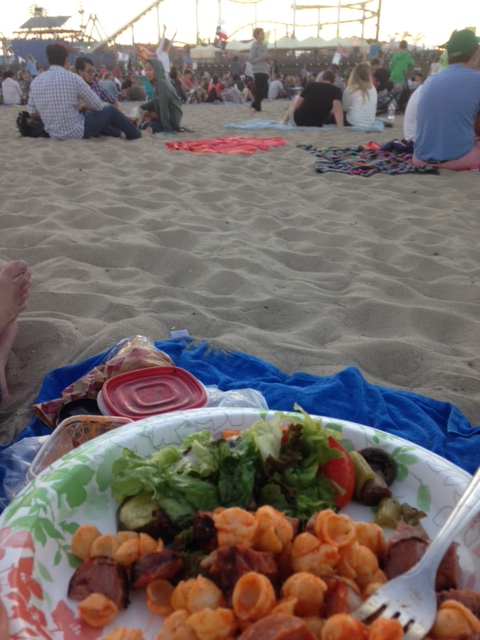
Personal Photo: Santa Monica Pier summer concert series, circa 2013