Getting Intimate

Over the weekend, I was surprised to find myself completely immersed in a five-hour training on yoga, sex and intimacy. My confusion was justified – The title of the workshop was “Yoga is Peace.” Where did I go wrong (or, wonderfully right)?

Mark Whitwell is a famous yoga teacher (I use this phrase reluctantly, but if anyone deserves the title, he does) and writer who studied for twenty years under Sri T. Krishnamacharya, the guru (or teacher) graciously credited with introducing yoga to Europe, Asia, and the Americas within the past century. (Should your interest in yoga meaning and philosophy grow, his work is a great place to start…)

Mark began by introducing himself to the class and proclaiming emphatically:

“YOGA IS… [wait for it]…DIRECT intimacy…with reality.”

He followed: “Forget any other definition you’ve ever heard. This is Truth.”

Mark’s “no bullshit” approach to teaching struck a chord. Perhaps too tight of chord, as he later added in the words of his teacher, Sri Krishnamacharya: “Yoga is not information gathering.” (Tell this to the girl working 24/7 in yoga studies.) What he means by this, of course, is simply: It’s already in you. So, focus your attention there.

Regarding sex, intimacy and yoga, we can go back to Mark’s definition of yoga generally as “direct intimacy with reality.” But, what does this really mean? He elaborated throughout his lecture that, from this view, our purpose on this planet is to have intimacy with life; that means with yourself, your partner, your community, and more abstractly, with your reality. In other words: Are you engaged, are you open? Are you a good friend, a loving partner, a “yes” person? Do you serve others in your community, do you love the work that you do? We all prioritize our own reality differently, and where and when we choose to get intimate. But, as Mark suggests, shouldn’t it be that when the day is done we can stand back and see ourselves reflected back to us (ideally with love and admiration) in all aspects of our life? If we desire to hold a purpose, as individuals and humans, shouldn’t it be to live life this way? (In this light?)

Yoga is direct intimacy with reality, with life. In this way, we can practice yoga everyday, in every aspect of our lives, by allowing ourselves to get intimate in our interactions with others and with ourselves.

As for sex: Mark shared his own observation that, as the churches continue to empty throughout America and Europe (Germany, in particular), the explicitness and vulgarity of sex in the media and social discourse continues to worsen. He digressed: “Everybody’s talking about it, and nobody’s having it.”

In my own classes, reluctant attention has recently focused on the realities of the over-sexualization of youth, and women and girls generally, in society. How prevalent are images of young girls (teens & twenties) in their underwear – or without – throughout the media? (Are you as tired of the viral Kim Kardashian as I am?) But giving this issue our sincere attention requires an uncomfortable shift of reality, and so many – including myself – do their best to stay quiet and turn the other way. There’s no need to revisit the profound implications that over-sexualization have on women and girls throughout the country, and the world. Eating disorders, body dysmorphia, body image obsession, insecurities, anxiety, inadequacies, sex trafficking and even hate crimes targeted at nonconforming homosexual individuals – all catalyzed by an extreme prevalence of “sex” in society, distorting the reality that sex [and sexuality] is intimacy – not an ego trip. Having the capacity to love and be intimate with another person is a gift, and an expression of equal exchange. It’s personal, it’s impactful, and it’s the basis of humanity. It’s easy, with the Victoria’s Secret fashion show fast approaching, to forget that this is reality. 

Mark’s parallel to the international vacancy of churches is meant to emphasize the necessity of individual spiritual life for the proliferation of humanity. He even goes so far as to say that the world depends on it. I take spirituality in my own heart to mean the active cultivation of a greater consciousness, founded in love and compassion towards oneself, one another, and our shared global community (the Earth and humanity). My church is my yoga mat. But no matter your definition or your vehicle, Mark attests that exploring your own sense of self and your own true nature is to experience intimacy, and promote creativity and creation. And, to experience direct intimacy with reality [in this way] is yoga – with, or without asana. (Although he and I highly encourage a daily home practice as a guaranteed vehicle toward exactly that. If you’re looking to create a home practice but aren’t sure where to start, contact me for help creating your own personal practice.)

In the midst of a non-stop graduate school schedule, the holiday season, and occasionally being all too aware of worldwide struggle and despair (sometimes all-to-close to home), I’ve found it helpful to go back to the notion that our purpose is intimacy. We can forget the rest. Because, if you can be intimate with life by being authentic, kind and present in every moment of your day, you’re contributing to the world in the best possible way. And, inevitably the goodness of the world will come back to you, more easily and with greater pleasure than you ever imagined. I guess, you could say in this way: Yoga is Peace.

Exploring your own comfortable definition of spirituality and creating a routine to express yourself through this light (be it yoga, attending church, simply sitting in quiet or your own personal practice) is the key to experiencing direct intimacy with life. And while it’s true – you get what you give – ultimately, getting intimate is what really makes life worth living.

Sending love and well wishes to your corner now & always,

Amy

Personal Photo: Playa Vista, CA

It’s Your Year

Last week, I discussed yoga as a process of becoming.

This past weekend, I was exposed to exactly the sort of setting where you would expect the winds of change to come sweeping through: Off the Mat, Into the World’s 4-Day Advanced Leadership Training in Ojai, CA – of all places, my favorite place.

It was there that I felt very aware of a newness to myself, my being. Who is this girl, so lucky to be attending this workshop in this beautiful place? Who has such a strong, intuitive (asana) practice? Who speaks so confidently of her experiences in politics and global affairs, which have prepared her for this discussion in social justice yoga? Sometimes our process of becoming isn’t so pretty – and more likely than not, you won’t even know it’s happening. It’s darkness; it’s bitterness, fear, angst, and frustration. But in the inevitable moments of light that follow, you can look back on yourself and how far you’ve come, and realize gratefully that that whole time, you were just becoming.

Today I changed the name of my blog (and Facebook page) to “A Year in Yoga.” I did this because it’s never really been about “my year,” as I created it of and for all of you. I created this blog as part of a greater vision – for peace (inside and out), for justice (in the form of our own tolerance, acceptance and harmony), for empowerment (in understanding our own unique capabilities, our gifts, and finding the strength to live in that light). I have been so moved and inspired by the many women – and few men – who have reached out in response to my posts over the past three months, and shared a bit of their process with me.

It is important that the name reflects the fullness of this collective effort; to cultivate greater virtue in our lives is “A Year in Yoga.”

I was moved – or rather, moved myself – into the yoga community, in search of conversations surrounding the difficult questions: How do we stop the fighting? The destruction? The war, the hurt, the suffering? If it is innate in us to care for one another, at least when residing in close proximity, how can we work towards extending this sense of responsibility and compassion to the global community? To come from a place of love and to admit you are a work in progress is to live in yoga. No asana required. (Despite our Western spin, yoga is not the same as asana, or physical yoga postures. Simply living life truthfully, with compassion, patience and mindfulness, is living in yoga.)

We are all always in a perpetual state of change, growth and evolution, although we rarely realize. Approaching life with this awareness has its perks. Nonjudgment of yourself and others (ahimsa) is a practice which requires conscious cultivation, but ultimately takes the pressure off; allowing us to be more patient and easy on ourselves, and to have greater empathy toward others in acknowledgement of whatever war they’re fighting (or challenges they’re facing) themselves. This means acknowledging that you and I are both enduring similar, however very distinct, journeys toward becoming whomever or whatever we are intended or going to be. Here, we can relax in knowing that we can’t have all the answers.

Imagine what it would mean for families, for communities, for countries, for the environment, for your children (present or future), if everyone in the world approached life with nonjudgment and compassion toward themselves and others. You and I can’t change the world, but (a much larger, global) we can. We starts in communities, with individuals. All over the world, people are increasing their awareness and acknowledgement of the necessity for sustainability, for the preservation of our Earth, for future generations. Every yoga practitioner, protest attendee, business owner, community leader and politician who supports this cause, is a single “I.” I urge you to consider how you’re contributing to the inevitable change, growth and evolution that is becoming all around us, and in you. It doesn’t have to be here or there, right wing or left wing, working or upper class – you are individual, and your process is different from theirs or mine. But bringing a greater consciousness, or mindfulness to your daily life – to be present in acknowledging the impact of our daily choices and accepting responsibility for the effects of our actions and thoughts – is what the world desperately needs. The world needs you and me, because if not us, then who?

You’ve inspired me with your stories of success and struggle, because however personal and distinct from my own, I too feel the heaviness life sometimes brings and don’t want anyone to ever have to stand in it alone. This is empathy. This is peace, however small. And (despite the cliché), it starts with you. It really does.

I dedicate this venture forward, to you. It’s your year (in yoga, or however you choose to live it). And it’s time to start asking, “Who am I becoming?”

Be present, and you’ll know. I look forward to seeing all that flourishes.

Unconditionally here,

Amy

It's Your Year

Last week, I discussed yoga as a process of becoming.

This past weekend, I was exposed to exactly the sort of setting where you would expect the winds of change to come sweeping through: Off the Mat, Into the World’s 4-Day Advanced Leadership Training in Ojai, CA – of all places, my favorite place.

It was there that I felt very aware of a newness to myself, my being. Who is this girl, so lucky to be attending this workshop in this beautiful place? Who has such a strong, intuitive (asana) practice? Who speaks so confidently of her experiences in politics and global affairs, which have prepared her for this discussion in social justice yoga? Sometimes our process of becoming isn’t so pretty – and more likely than not, you won’t even know it’s happening. It’s darkness; it’s bitterness, fear, angst, and frustration. But in the inevitable moments of light that follow, you can look back on yourself and how far you’ve come, and realize gratefully that that whole time, you were just becoming.

Today I changed the name of my blog (and Facebook page) to “A Year in Yoga.” I did this because it’s never really been about “my year,” as I created it of and for all of you. I created this blog as part of a greater vision – for peace (inside and out), for justice (in the form of our own tolerance, acceptance and harmony), for empowerment (in understanding our own unique capabilities, our gifts, and finding the strength to live in that light). I have been so moved and inspired by the many women – and few men – who have reached out in response to my posts over the past three months, and shared a bit of their process with me.

It is important that the name reflects the fullness of this collective effort; to cultivate greater virtue in our lives is “A Year in Yoga.”

I was moved – or rather, moved myself – into the yoga community, in search of conversations surrounding the difficult questions: How do we stop the fighting? The destruction? The war, the hurt, the suffering? If it is innate in us to care for one another, at least when residing in close proximity, how can we work towards extending this sense of responsibility and compassion to the global community? To come from a place of love and to admit you are a work in progress is to live in yoga. No asana required. (Despite our Western spin, yoga is not the same as asana, or physical yoga postures. Simply living life truthfully, with compassion, patience and mindfulness, is living in yoga.)

We are all always in a perpetual state of change, growth and evolution, although we rarely realize. Approaching life with this awareness has its perks. Nonjudgment of yourself and others (ahimsa) is a practice which requires conscious cultivation, but ultimately takes the pressure off; allowing us to be more patient and easy on ourselves, and to have greater empathy toward others in acknowledgement of whatever war they’re fighting (or challenges they’re facing) themselves. This means acknowledging that you and I are both enduring similar, however very distinct, journeys toward becoming whomever or whatever we are intended or going to be. Here, we can relax in knowing that we can’t have all the answers.

Imagine what it would mean for families, for communities, for countries, for the environment, for your children (present or future), if everyone in the world approached life with nonjudgment and compassion toward themselves and others. You and I can’t change the world, but (a much larger, global) we can. We starts in communities, with individuals. All over the world, people are increasing their awareness and acknowledgement of the necessity for sustainability, for the preservation of our Earth, for future generations. Every yoga practitioner, protest attendee, business owner, community leader and politician who supports this cause, is a single “I.” I urge you to consider how you’re contributing to the inevitable change, growth and evolution that is becoming all around us, and in you. It doesn’t have to be here or there, right wing or left wing, working or upper class – you are individual, and your process is different from theirs or mine. But bringing a greater consciousness, or mindfulness to your daily life – to be present in acknowledging the impact of our daily choices and accepting responsibility for the effects of our actions and thoughts – is what the world desperately needs. The world needs you and me, because if not us, then who?

You’ve inspired me with your stories of success and struggle, because however personal and distinct from my own, I too feel the heaviness life sometimes brings and don’t want anyone to ever have to stand in it alone. This is empathy. This is peace, however small. And (despite the cliché), it starts with you. It really does.

I dedicate this venture forward, to you. It’s your year (in yoga, or however you choose to live it). And it’s time to start asking, “Who am I becoming?”

Be present, and you’ll know. I look forward to seeing all that flourishes.

Unconditionally here,

Amy

The Missing Link: Yoga & Neuroscience

This weekend, I found the “missing link.” As part of LMU’s Masters in Yoga Studies curriculum, there is a pre/co-requisite to enroll in one of several certificate programs. I was excited to enroll in the pilot year of “Yoga, Mindfulness and Social Change,” which features renowned speakers from all over the country with varying expertise within the field. This weekend’s topic was “Yoga & Neuroscience,” and although I’ve always been intrigued (perhaps hereditarily) by psychology and sociology, I was taken aback and truly blown away by the evidence modern neuroscience provides of the true benefits of yoga.

As you might remember, my hope and mission in this program is to discern the socioeconomic benefits of yoga, within a global context. This interest came about through years of courses and hands-on experience in sociology, communications, media relations, cultural studies and international affairs, through which I developed a deep-seated interest in what makes people think the way they do – both as individuals, and as a collective society. Academically speaking, my pursuit is an exploration of individual ideological formation (aka consciousness), as well as of institutionalized methodologies of ideological pervasion. While in college, I was blessed with unique opportunities: to study the pervasion of local culture through public and mainstream media in Australia; to explore (and publish a manuscript on) gender disparity in Latin America as it relates to pervading machismo attitudes and state-controlled transmission of democratic ideals (see “About Me”); and, after college, to work for several years in politics and government affairs for non-profit and private, small and large organizations – to better understand what makes us and others, especially those in “power,” think the way they do. And, (surprisingly to me as well) this journey has led me to yoga studies. Mounting evidence supports my personal belief that yoga, over all other modalities, has the greatest potential to positively reform individual and collective ideology – thereby helping us live happily and helping communities live peacefully, everywhere. Imagine that.

This weekend, I attended two five-hour lectures on “Yoga & Neuroscience” by leading neuroscientists in consciousness formation (see “Lecture Credit” below), and soon found that scientific evidence already supports that yoga, meditation and mindfulness practices stimulate and even grow the part of the brain responsible for processing feelings of compassion, empathy, altruism, interconnectedness and happiness – otherwise known as the “neocortex.” Specifically, I learned that practices such as yoga and meditation, as well as Tai Chi and nature activities, help stimulate the brain’s neuroplasticity, or its capability to grow and reshape itself through the movement and connection of neurons. (More simply, neuroplasticity states that the brain is not a fixed form, but is in fact adaptable.) As a result, these practices in particular have been proven to expand and increase activation of the neocortex and overall brain capacity, as well as physically enlarge areas that promote feelings of empathy, compassion and altruism – collectively called our “emphatic response.”

However nice this all sounds, it may feel a bit displaced, as our society currently embodies a paradigm – or pervading ideology – which disproportionately emphasizes the “reptilian” brain, or the part of the brain responsible for primal instincts, basic survival needs, ego and competition, rather than cooperation. Many practitioners and professionals (and scientists) who have been imparted with this knowledge also believe that we [the human race] are in the midst of an evolutionary shift towards global cooperation. More candidly, they articulate a resounding belief that mankind must either learn to cooperate and live harmoniously with one another and with Nature, or fall victim to the harsh realities of disconnectivity and competition (i.e. global warming) for generations to come. As such, we notice widespread discontentment and rebellion in the form of protests, political stalemate and corruption, and civil war around the world and in the States, at levels unprecedented since the last major paradigm shift occurred in the 17th century (following the Industrial Revolution). It’s worthy to note my own belief on this issue is still evolving as I gather more information, and I encourage you also to ask the hard questions and think critically about this and all information you hear about the future of our planet. But, I do believe strongly in the agency and power of individuals to incite change in themselves, and in the world around them; be it on Capitol Hill, in the classroom, or on their yoga mat. And I hope to continue to explore the empirical evidence available now, and that yet to be discovered, which enables us to better understand how yoga, meditation and mindfulness practices benefit you and me, and (why not…) the rest of the world.

On that note, I’d like to dedicate a thought (or several) in recognition and gratitude of Mother Nature and the vast resources and opportunities she provides us: as humans, as Westerners, as yogis, as wilderness explorers, or from whatever perspective most resonates with you. It can be something as simple as a sunset, or as vast as the algorithms of consciousness and science we seek to understand. In solidarity, give thanks!

Peace – Shalom – Om Shanti,

Amy

Videos to Watch:

The Empathic Civilisation (10 minutes: 30 seconds)

How Meditation Works: For Beginners (2 minutes: 50 seconds)

Lecture Credit:

Dr. Jay Kumar (9/27/14)

Dr. Louis Cozolino (9/28/14)

Photo Credit:

Sunrise in the Outback, Alice Springs, Australia (Personal Photo, July 2009)

The Missing Link: Yoga & Neuroscience

This weekend, I found the “missing link.” As part of LMU’s Masters in Yoga Studies curriculum, there is a pre/co-requisite to enroll in one of several certificate programs. I was excited to enroll in the pilot year of “Yoga, Mindfulness and Social Change,” which features renowned speakers from all over the country with varying expertise within the field. This weekend’s topic was “Yoga & Neuroscience,” and although I’ve always been intrigued (perhaps hereditarily) by psychology and sociology, I was taken aback and truly blown away by the evidence modern neuroscience provides of the true benefits of yoga.

As you might remember, my hope and mission in this program is to discern the socioeconomic benefits of yoga, within a global context. This interest came about through years of courses and hands-on experience in sociology, communications, media relations, cultural studies and international affairs, through which I developed a deep-seated interest in what makes people think the way they do – both as individuals, and as a collective society. Academically speaking, my pursuit is an exploration of individual ideological formation (aka consciousness), as well as of institutionalized methodologies of ideological pervasion. While in college, I was blessed with unique opportunities: to study the pervasion of local culture through public and mainstream media in Australia; to explore (and publish a manuscript on) gender disparity in Latin America as it relates to pervading machismo attitudes and state-controlled transmission of democratic ideals (see “About Me”); and, after college, to work for several years in politics and government affairs for non-profit and private, small and large organizations – to better understand what makes us and others, especially those in “power,” think the way they do. And, (surprisingly to me as well) this journey has led me to yoga studies. Mounting evidence supports my personal belief that yoga, over all other modalities, has the greatest potential to positively reform individual and collective ideology – thereby helping us live happily and helping communities live peacefully, everywhere. Imagine that.

This weekend, I attended two five-hour lectures on “Yoga & Neuroscience” by leading neuroscientists in consciousness formation (see “Lecture Credit” below), and soon found that scientific evidence already supports that yoga, meditation and mindfulness practices stimulate and even grow the part of the brain responsible for processing feelings of compassion, empathy, altruism, interconnectedness and happiness – otherwise known as the “neocortex.” Specifically, I learned that practices such as yoga and meditation, as well as Tai Chi and nature activities, help stimulate the brain’s neuroplasticity, or its capability to grow and reshape itself through the movement and connection of neurons. (More simply, neuroplasticity states that the brain is not a fixed form, but is in fact adaptable.) As a result, these practices in particular have been proven to expand and increase activation of the neocortex and overall brain capacity, as well as physically enlarge areas that promote feelings of empathy, compassion and altruism – collectively called our “emphatic response.”

However nice this all sounds, it may feel a bit displaced, as our society currently embodies a paradigm – or pervading ideology – which disproportionately emphasizes the “reptilian” brain, or the part of the brain responsible for primal instincts, basic survival needs, ego and competition, rather than cooperation. Many practitioners and professionals (and scientists) who have been imparted with this knowledge also believe that we [the human race] are in the midst of an evolutionary shift towards global cooperation. More candidly, they articulate a resounding belief that mankind must either learn to cooperate and live harmoniously with one another and with Nature, or fall victim to the harsh realities of disconnectivity and competition (i.e. global warming) for generations to come. As such, we notice widespread discontentment and rebellion in the form of protests, political stalemate and corruption, and civil war around the world and in the States, at levels unprecedented since the last major paradigm shift occurred in the 17th century (following the Industrial Revolution). It’s worthy to note my own belief on this issue is still evolving as I gather more information, and I encourage you also to ask the hard questions and think critically about this and all information you hear about the future of our planet. But, I do believe strongly in the agency and power of individuals to incite change in themselves, and in the world around them; be it on Capitol Hill, in the classroom, or on their yoga mat. And I hope to continue to explore the empirical evidence available now, and that yet to be discovered, which enables us to better understand how yoga, meditation and mindfulness practices benefit you and me, and (why not…) the rest of the world.

On that note, I’d like to dedicate a thought (or several) in recognition and gratitude of Mother Nature and the vast resources and opportunities she provides us: as humans, as Westerners, as yogis, as wilderness explorers, or from whatever perspective most resonates with you. It can be something as simple as a sunset, or as vast as the algorithms of consciousness and science we seek to understand. In solidarity, give thanks!

Peace – Shalom – Om Shanti,

Amy

Videos to Watch:

The Empathic Civilisation (10 minutes: 30 seconds)

How Meditation Works: For Beginners (2 minutes: 50 seconds)

Lecture Credit:

Dr. Jay Kumar (9/27/14)

Dr. Louis Cozolino (9/28/14)

Photo Credit:

Sunrise in the Outback, Alice Springs, Australia (Personal Photo, July 2009)

Work Hard, Play Hard.

In my previous posts, I’ve talked about the importance and “beauty” of finding yoga on your mat – particularly in those moments when you find your “yoga high” and perhaps even experience a state of pratyahara (withdrawal of the senses, as awareness draws inward). We treasure these moments, because they are so few, and reconcile with ourselves that they can only be fleeting. But – ah ha! – what if it were possible to live in yoga, even when you’re off the mat?

If you haven’t heard the phrase “living in yoga” before, please allow me to introduce you. Living in yoga does not mean living in a perpetual state of pratyahara, perpetually withdrawn from the outside world – though some, very traditional yogis choose this path of renunciation. Rather, it means applying basic yogic principles (revisiting the eight limbs = yoga’s “code of ethics”) and practicing yoga as “the science of the mind” on a daily basis, by carefully observing your own thoughts and choosing your words (and thoughts) with care and intention. How nice of a notion. Of course, we know that though yoga is sweet, life is not that simple. So, often times, the “living” part gets in the way.

This week, I can certainly relate to the feeling of having to surrender to life – in this case: my schedule. I love school. I love yoga. Grad school for yoga? Sign me up! But somehow in the midst of two weeks of non-stop events/classes/studying (all of my waking hours) my enthusiasm waned, and life took over. And suddenly, it wasn’t so fun anymore.

In talking to fellow classmates and checking in with friends who are building their own professional careers (from event planning, to accounting, sales and yoga!), I began to notice a theme: Surrender to our schedules – to life – in a non-stop whirlwind of meetings, parties, and events all designed to achieve balance (to some degree) and overall success. These are great goals to aspire to, even admirable. But wouldn’t it be nice if we could get there without feeling like we’ve lost control along the way, and that our lives are driving us? When do we get to stop running and just enjoy? (And don’t say: retirement. Although that should be enjoyable too!)

Living in yoga, your schedule remains the same and your obligations and deadlines are just as urgent. But, instead you commit to living more fully in everything you do and allow yourself to stop and smell the roses – today (no waiting)! This is as lovely as it is challenging, because living in yoga also means devoting greater consciousness to your daily life. By being aware and observing your own thoughts and actions throughout the day, you aspire to live in the present moment with compassion and authenticity. This means, allowing yourself to take one thing at a time. And not only do it, but enjoy it.

This also means making a concerted effort to make time for you, to do what you love – even, and especially, in the midst of chaos. (The picture above was taken this past weekend when I showed my close friend, Laura, my all-time favorite spot* during her first-ever trip to California!) There is nothing more cherished – or important – than memory-making…

As my boyfriend ran out of the house to work this morning, we reviewed our schedules for the day, both with a looming fatigue already at 8:00am. (Whenever you think you have the craziest day ahead, there is someone with one even crazier…) But together, we reached the conclusion: “Well, you can only be one place at a time.” All you can do is the best you can, where you are – and do your best to enjoy it!

In my morning meditation today, I set the intention to bring awareness to the present moment as I go forward into the weekend and coming week, so that I can relax and enjoy all that’s in front of me instead of feeling bound and overburdened. This, like anything, takes practice. But is there anything more worthy of working towards? Being present means listening actively, expressing gratitude, sharing your ideas confidently, and enjoying life – as it is, how it is, right in this very moment. This is, at its simplest, living in yoga.

There are only so many hours in the day. You can only do one thing at a time. So, just do what you can. And enjoy it!

Gives new (& better) meaning to: “Work Hard, Play Hard.” Go forth, and play!

Namaste,

Amy

*photo taken at my favorite peak on Foothill Trail in Ojai, CA

Be Bold, Be Beautiful

Entering into the “world of yoga” can be intimidating. Especially in Los Angeles and especially in your mid-20’s, there’s a lot of pressure to achieve a certain standard. To add to this pressure, I’ve primarily developed my personal practice and knowledge of yoga by teaching myself at home.

In grad school right now, we’re learning in detail about the different types of guru-student relationships – characterized by one-on-one mentorship from a “teacher,” in this sense, spiritually focused – that are so essential to understanding and developing a personal yoga practice, in keeping with yoga’s historical and traditional integrity. However, the reality is that the rapid growth in popularity of yoga among Westerners today (especially in the States) has largely diminished concern for consistency in the traditional practice of yoga, simply out of necessity. In the interest of “reaching” as many people as possible, yoga teachers and studios aim to pack their [increasingly, hot] rooms to capacity. This leaves many intermediate yogis who have grown to feel and appreciate the deeper benefits of yoga, lacking the classically acclaimed direction and guidance necessary from a “teacher” to enable their development from intermediate to advanced; or, more specifically, to harness the full benefits of yoga in the truest sense, enabling cultivation of utmost strength, happiness and longevity.

I acknowledge and respect that not everyone who is interested in yoga seeks or expects any psychological or spiritual benefit. (I started with Bikram, remember?) But for those who have recognized a shift in thinking since beginning their practice, or might in the future, it’s natural to yearn for greater nourishment – perhaps, a teacher training – to explore the full scope of your evolving practice. While Westerners continue to sort through this puzzle of adapting traditional Eastern practices into modern Western society (big things to come from my wonderful peers at LMU!), it’s important to keep in mind for your personal practice, the integrity and real purpose of yoga – and not to let the pressure get to you.

If you’ve “followed” any yogis on Instagram lately, you’re likely familiar with the pressure I’m talking about. The intimidation factor that has made its mark on yoga in the West emphasizing achievement in yoga as equivalent to obtaining physical strength and a glamorous physique. (I recently saw the winner of an Instagram yoga contest posted a picture of herself in wheel pose, perfectly toned, in her bra and panties…) So, in order to be credible in the “yoga world,” you need to be able to stand on my hands, touch your feet to your head, and jump through a ring of fire (naked)? Props to those girls (& guys), but I’m not sure that’s for me, and if I’m a beginner, this might make me think yoga’s not for me. Sometimes, like many others I know, I’ve put down my phone after an intense scrolling session and decided: “I’ll just practice later.” I lost my yearning in a wave of feeling that my practice was inferior; this, of course, being the antithesis of the very virtues we’re trying to cultivate in yoga: of confidence, of feminine power (shakti) and of unconditional love.

However, those images are only one perspective on “beauty” and honestly, though they are beautiful, I think they’re overplayed. Where’s the color, the fun, the creativity, the authenticity that truly characterize yoga? Have you ever laid in child’s pose and allowed your breath to takeover, losing sense for a brief moment of your long “To Do” list, and with it, the arguments and disappointments of the day? Finding this kind of calm in an otherwise hectic day of work and errands; that is truly beautiful. And the ease and accessibility of this posture – that anyone, anywhere, of any age, race, or orientation, can achieve this benefit (or, “yoga high”) in child’s pose – That is beautiful.

All this to say, whether in your yoga practice or out in the world, you should feel free to be, do and live as you are and where you are, today. This is your life, and there is no right way. That applies to your yoga asanas, Instagram posts, professional trajectory and personal interactions. There is a healthy way, a kind way, and an authentic way – but not a right one. Don’t let others’ standards (with their fancy handstands or boardroom presentations) make you think any differently about yourself, and what you could or should do to succeed, and to be valued. You are valuable, and your contribution is already great, whether you realize it or not – as long as it comes from a place that is genuine. Thinking boldly in this way, nothing can stop you. And more likely than not, you’ll be surprised by just how much you can do. Sometimes, I’ve learned, we are our own best teacher.

Next time you practice, whether in a class, in your bedroom, or in front of your television, remember that there’s more to yoga than handstands and that there’s more to you than meets the eye. And allow this awareness to inspire you, in all aspects of your life.

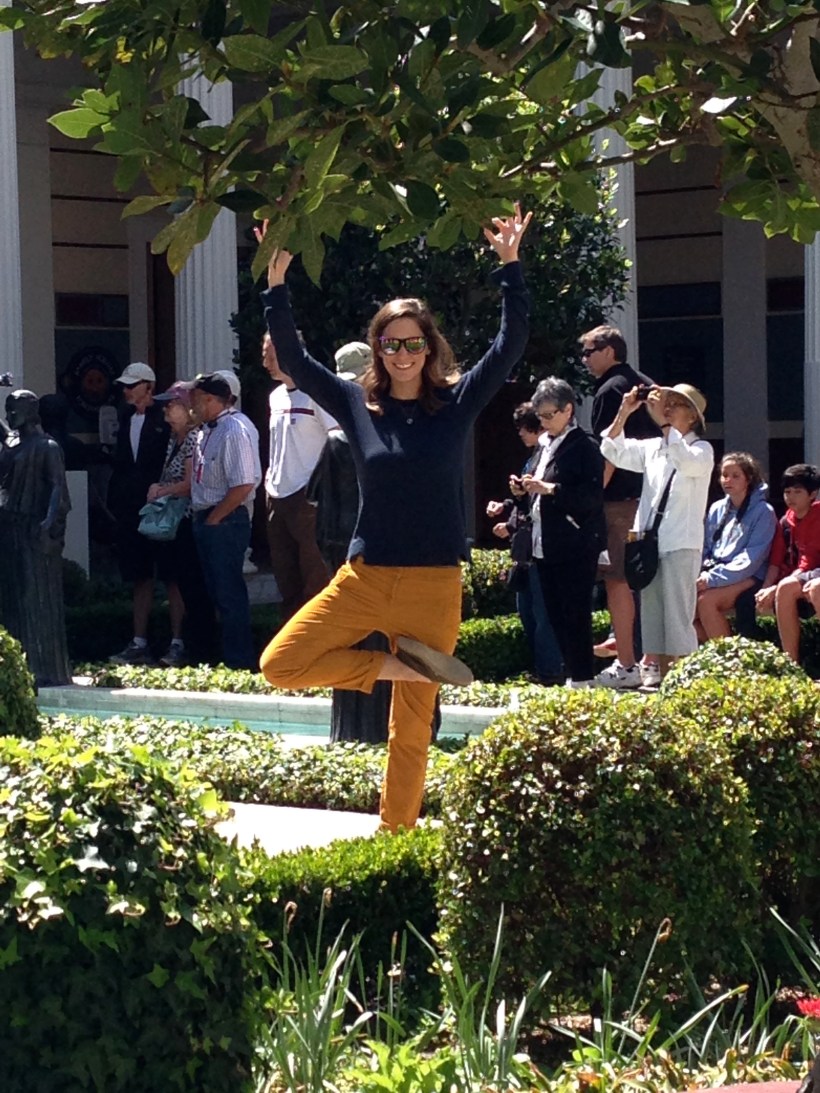
I also challenge you to post a picture of yourself on Instagram, Facebook or Twitter in your favorite, simple yoga posture (mine is tree pose – above!) as a friendly reminder to everyone out there that there is real beauty in simplicity. You just have to be willing to change your perspective. 

Be bold, be beautiful Xx

Amy

Clean Eating Connoisseur (+ Recipe)

Once a week I receive a large package on my doorstep in the middle of the night. Like Christmas elves of organic produce, the local farm folk tip toe to my stoop and leave a box full of crisp, yummy delights hand-picked just for me! (I guess Santa’s preoccupied with the late-summer harvest.)

I rant and rave about my weekly produce deliveries to anyone who will listen – not only because it does feel like Christmas every Thursday! – but mostly because these deliveries are what effortlessly pushed me over from being a Lean Cuisine-loving, perpetual dieter to a self-proclaimed, clean eating connoisseur! They took all the guess-work and effort out of buying produce (which for a novice can feel very overwhelming), and now – a year later – I’m comfortable hitting the produce aisle for what’s ripe and in-season, including fruits and veggies I’d never tried or heard of before.

But the best part is that it gets you cooking. Being in transition has meant constantly looking for cheap and easy meals – so I’m adamant about not letting things go to waste. As a result, I’ve been cooking up a storm (to my boyfriend’s delight) making asian stir frys, veggie pastas, and colorful summer salads until my heart’s content. Becoming comfortable in the kitchen is all about practice, and experimentation. I’ve never been one for following a recipe to the T (sorry, Gramma), but believe that if I’m going to cook with what little time and money I have, it better be quick, easy and delicious. The same outcome can be achieved by hitting your local grocery store, farmer’s market, or registering for your own weekly, biweekly or monthly produce deliveries.* (Click here to find CSA deliveries near you – See below for more info.) Always try your best to find what’s fresh and “in season.” A farmer’s market is a great place to learn, and have fun while you’re at it!

Don’t overwhelm yourself. Go ahead and grab your favorite fruits and veggies, but also try one or two things that are new to your kitchen each time you hit the store. (My seasonal favorites lately have been heirloom tomatoes, eggplant, watermelon, and the ever-delicious fresh mint and basil.) Once home, consider what is already in your cabinets and what old or new creation you might cook up. A quick Google search (or my personal favorite: all recipes.com) will give you guidelines, times and temperatures to bring your creation to life. But don’t feel obligated to follow it exactly. You can add things you like, subtract things you don’t like, and replace comparable items with what you have at home. Don’t stress – so what is it’s not a five-star feast? It’s still healthy and delicious! And as you go, you’ll learn what works and what doesn’t, creating your own personal arsenal of 20-minute meals that feed your body, mind and soul.

A favorite meal I recently added to my home cooking arsenal is what I call an “Eggplant Bake.” Straight forward and simple, it takes little to no preparation and allows you to put a delicious, but often befuddling, seasonal vegetable to use: the eggplant. Here’s my own take on the dish, which runs a little longer at 35-45 minutes with prep time. (But remember, cooking can also be a meditative process – Take the time out for you, to be and live well!) Feel free to try it out, and make it your own…

Eggplant Bake (feeds 2-4, with leftovers)

Ingredients:

  • 1 eggplant
  • 2-3 tomatoes (depending on size, use your judgement)
  • greens of your choice (spinach, kale, arugula, swiss chard – oh my!)
  • cheese of your choice (I used parmesan and fresh mozzarella)
  • olive oil
  • basil, oregano, and/or italian seasoning; salt & pepper

*To make this meal more filling, consider adding a quick & easy whole grain like couscous, whole wheat pasta, or brown rice (Uncle Ben’s is ready in 90 seconds!). If you have a bit longer to cook, try a heartier grain like barley, quinoa or farro – Mmmm!

Instructions:

1. Preheat oven to 400 degrees. Add and spread 1-2 tablespoons of olive oil in baking dish. (Can also use cooking spray, but olive oil makes your heart healthy – why skip out on the extra goodness?)

2. Slice tomato and eggplant in 1/2 inch rounds (no need to peel!) and place a single layer of eggplant in baking dish. Place a small handful of greens on top of each round and cover with tomato slice.

3. Add cheese – Don’t be stingy, but be mindful. Add seasoning and additional olive oil (sparingly) as desired.

4. Bake for 30 minutes. Switch to “broil” and bake an additional 5 minutes. (It takes a bit of extra time, but I promise it’s worth it.)

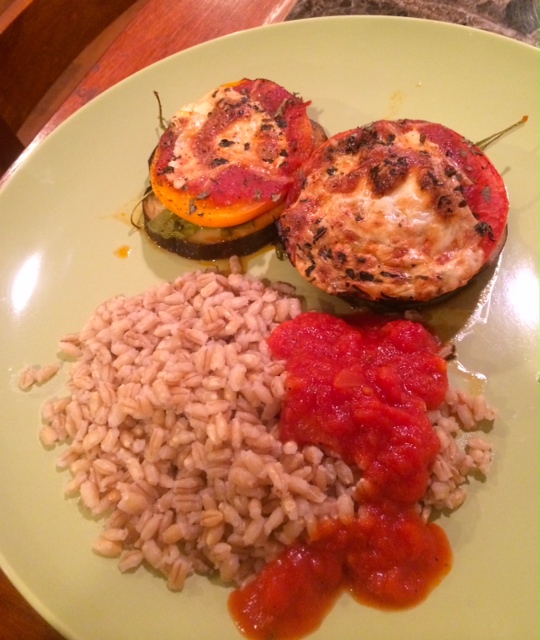
5. Enjoy! My final product is depicted above. I’d love to see yours!

Note: Dish is best served when you enjoy the process, and pair with wine and friends. Remember, food is love. 


Bon Appetite xx

Amy


*A bit more about Community Supported Agriculture (CSA):

Investing in weekly, biweekly, or monthly produce deliveries can be a fun and affordable way to jumpstart your new hobby of cooking up your own “clean eating” creations. (I pay $25/box and still grab protein (beans, tofu, chicken) and a few favorite items at the store – This way I spend less than $200/month on groceries! And eat damn well.) Often times, you can even choose what arrives in your box. Not a carrot fan? No problem, swap in potatoes or peppers instead!

Check online if there is a CSA group in your area. These are the folks, or “elves,” that coordinate with local farms to deliver fresh, delectable, and affordable produce to your door. This way, you’ll also know where it came from, how it was grown (often, organic), and even who’s growing it! To find out if there’s a CSA near you, click here.

As an example, this week my box looks like this:

  • 1 lb. Heirloom Tomatoes
  • 4 Barlett Pears
  • 1 Cantaloupe Melon
  • 1 bunch Celery
  • 1/2 lb. Gypsy Peppers
  • 1 bunch Red Chard (luscious greens!)
  • 1 bag Red Grapes
  • 2 Yellow Nectarines

Mmm, can’t wait to dive in! Happy eating 🙂


Losing Patience: Even Yogis Get Mean

Reporting back on my first week of grad school (in Yoga Studies): I learned a lot last week. In fact, I think I mentioned a few too many times that I’ve felt like my head might explode, in the most wonderful way possible. But the most challenging aspect of my week wasn’t the classes or my new assistantship, or even balancing my personal life. (I’ve got the logged hours and post-picnic hangover to prove it.) No, my biggest challenge by far has been: keeping my patience.

Patience. It seems like an obvious concept, but it can have different meanings in different contexts; and this past week, it’s taken on a few. There was my most recent frustration, when I couldn’t find the recycling bin in my friend’s building (…anywhere!) so I finally threw the bag of bottles down the trash shoot. (I’m still so sorry about that.) But patience could also refer to being polite with the operator after waiting “on hold” for fifteen minutes; listening to a friend’s story all the way through without interrupting; or letting your dog enjoy the outdoors instead of rushing her to hurry and “do her business” (guilty, guilty, guilty). Everyone has those moments of falling off the wagon and not making the best decision they could have, or should have made. Even yogis get mean. And for me, yesterday was one of those days.

One of those days where it’s not one thing in particular that seems “wrong,” it’s everything. Nothing sits well, nothing feels right, and no matter what you do or try to do, it’s wrong, stupid or counterproductive. But, lucky for me, an important part of a consistent yoga practice is being aware and observing your own thoughts. And eventually I realized that everything felt so wrong, because I was wrong. I was setting the bar impossibly high for myself during my first week of grad school and the busiest weekend of the semester (eight hour lectures Saturday & Sunday). But yesterday, I wanted to go to the Labor Day picnic. I wanted to spend time with my boyfriend, read 100 pages for class, write a two page summary, practice three hours of Sanskrit, go grocery shopping, meditate in the morning and do my usual asana practice. Totally feasible, I swear. Really.

And I did (most of) it. By all outside accounts, it was a great, very productive, really fun day. And in many ways, it was. (I even got a bit of a tan!) But I still ended the evening feeling frustrated – and inevitably, exhausted. Even after succeeding in checking off my “To Do” list, the list just got longer. And in my haste to “get it all done,” I hadn’t allowed myself to relax and be present and missed out on quality time with the people I love when I finally had the time to spare. My lack of empathy and patience with myself directly impacted the quality of my experience and my interactions with others. But rather than continue to beat myself up about it – as I may have done in the past – I’m instating some patience, pronto. I remind myself: You’re human, and you have a lot on your plate. You have to go easy on yourself. With any new transition, there’s an adjustment period. You need to give yourself time to adjust. 

Before I recently found myself in a constant state of transition, I found a constant state of kindness, having trained myself to think this way – with sincerity and patience – more regularly. Unfortunately, life happens, and enduring transition can make maintaining any type of consistency difficult. But today is the start to my second week of grad school, and I am deliberately (and publicly) setting the intention to always defer to kindness. Not only because it will make my week that much better (and trust me, it will) but because I know that, with practice, I can regain that steady peace of mind and live again in kindness – on the regular.

I encourage you to set an intention this week. For patience, for kindness, or for whatever you need most, because we are all, always in transition. And if we want to succeed and get the most out of life (and I hope we all do!), then we’ve got to be kind to ourselves, and to others. May as well start today.

Namaste (I honor the truth – and kindness – in you),

Amy


P.S. I haven’t forgotten the recipe(s). Stay tuned!

The Science of Sitting

When you hear the word “meditation,” what do you imagine? A group of Buddhist monks in temple, chanting and burning incense. A flashback to Woodstock with a field full of hippies sitting silently, listening intently to their guru (or spiritual teacher). Or, if you’re a bit more familiar, you might imagine an individual much like yourself sitting perfectly erect with each thumb and pointer finger touching together in the quintessential “Om mudra.” All of these images are valid representations of meditation. But if you’re like me, these vague portrayals are hardly enough to motivate you to adopt a daily practice, or to spend $200 on a five series class explaining what the point of all this is anyway. Experimenting on your own, or trying out a few YouTube tutorials is an option. But if you’ve tried, you’ve likely found that after two minutes – which feels more like twenty – your mind is in a million places, you’re restless, achy, and aggravated. Enter the oh so popular excuse – and one I’ve previously exhausted myself:

 “I can’t sit still long enough/my mind is too busy/I don’t have enough time to meditate!”

Well perhaps, it might be helpful to know the “why” first. You know meditation is good for you. The highly popularized benefits of relaxation and mental clarity are certainly enticing enough. And even corporate leaders like Oprah Winfrey and Rupert Murdoch vouch that meditation is useful for stress management and good decision-making. (Check it out here.) But how do you get there? And what is this all about, really? The answers to these questions have helped motivate my meditation practice and changed my perspective on yoga. Here’s what they don’t tell you, that I hope will help you along the way…

Yoga is an ancient practice, arguably dating back to 300 B.C., which has been passed down throughout history by way of individual, one on one instruction with a guru. Yoga’s classical definition is simply “the science of the mind” consisting of eight limbs of yoga intended to guide your path to enlightenment, or self-realization. The third of these eight limbs is “asana,” or a series of physical sequenced postures generally referred to as “yoga.” Ancient yogic texts insist that the other seven limbs are the most important steps to experiencing the full benefits of yoga. However, asana practice is intended to prepare you for the process of self-analysis and centeredness, by helping us clear the mind and prepare the body for long periods of stillness. (Savasana, anyone?)

When you leave a yoga class, you’ve likely felt what I fondly refer to as the yoga high. It’s a mental and physical buzz, or internal vibration, which leaves us feeling clear-headed, relaxed, and (relatively) stress-free. A former boss of mine who occasionally practiced yoga, used to joke: “If you want anything from me, just ask me after yoga class!” What you’re experiencing is a meditative state, and when you practice more frequently, this sensation lasts longer. While few ever complain about their post-practice buzz, this is also the reason why yoga is often associated with free-loving cluelessness and detachment from reality, which threatens its credibility and relevance as a useful everyday practice. (Revisit 1960’s Woodstock for a moment, and you’ll see what I mean.)

Although I’m not a scientist, I believe learning the mechanics of what’s happening during meditation is key to understanding, and thereby motivating our practice. My method of learning has always been: don’t ask me to do something until I fully understand why I’m doing it. (Sorry Mr. Murphy, the Pythagorean theorem just wasn’t happening…) But if you’ve ever wondered “why meditation?,” learning a bit of the science behind the practice is a great place to start.

Looking to science, specifically quantum physics, we know that all solid objects are composed of molecules, or a group of atoms which are uniquely formed to create physical matter and are perpetually in a state of subtle movement. Through meditation and asana practice, we are stimulating the vibration of our own molecular composition. When thinking of yoga, it might be helpful to think of body, mind, and spirit, and consider “spirit” to be the energy inherent to your molecular composition. Asana practice and conscious breath work (or pranayama) get this energy moving. Simultaneously, you are clearing the mind of restless thoughts by focusing your full attention on your breath and bodily alignment. (If you’ve tried Triangle pose for any length of time, you know that this process alone is a feat! Don’t get frustrated, you’re not alone. Practice makes perfect!) And while stretching deeply into postures like Warrior II or Pigeon pose, you are preparing your body to sit comfortably in meditation, a.k.a. Criss-cross applesauce or Lotus pose. Once these three things – body, mind and “spirit” – are in sync, then you experience real yoga and the benefits of the practice begin to take shape. In fact, the word “yoga” means “union” in Sanskrit, and represents this very process of convergence.

So, in understanding the why, we shouldn’t be concerned with quantum physics on our mats. Rather, applying the “why” to your practice is as simple as remembering your last yoga high and striving to reach it again and again. Then, try sitting in this stillness. Over time, you will learn to get there faster and stay there longer – using asana (physical practice), pranayama (conscious breathing), and even mantra (chanting) as different means to get you there. There is no right or wrong way, and every day will be different. But by playing with these techniques (have fun!) and challenging yourself to return to focus on your breath or alignment, the true benefits of yoga will unfold for you. Why? Because the science is there.

And I’m always here to answer your questions along the way.

Sending you good vibes! xx

Amy