Happy Holidays! (Your Asana Cheatsheet)

Wishing all a very happy holidays this season!

As we look forward to food, family, and fun over the next couple days, I wanted to offer a few quick and very easy asana postures for an energy boost and peace of mind in the midst of what can be a very busy and stressful time.

Here are a few of my favorite postures that I practice regularly and often incorporate into my classes. They can be practiced in sequence or on their own, whenever (and wherever) you have a couple minutes to spare. Accompany each with slow, deep breathing and – if you like – while repeating the mantra: “Love of the Present Moment” (or whatever phrase resonates most with you. Others might be: Let Go; Peace; Love; or Om Namah Shivaya translated as “I am Shiva,” meaning “I am the light” ^^ link to my favorite rendition by Steve Gold)

Whether practiced before bed, in the kitchen between cooking prep, or on the living room rug – I hope these postures will bring you peace and grounding (self-care) to help you cherish every moment spent with loved ones this holiday.

Happy Holidays from my corner to yours xx

Amy

Holiday Asana Cheatsheet
*Click posture name for in-depth instruction and benefits from;
*All are safe & easy to practice for all body types;
*Practice each for as little as 30 seconds, or combine and hold for up to a 30-45 min. personal practice

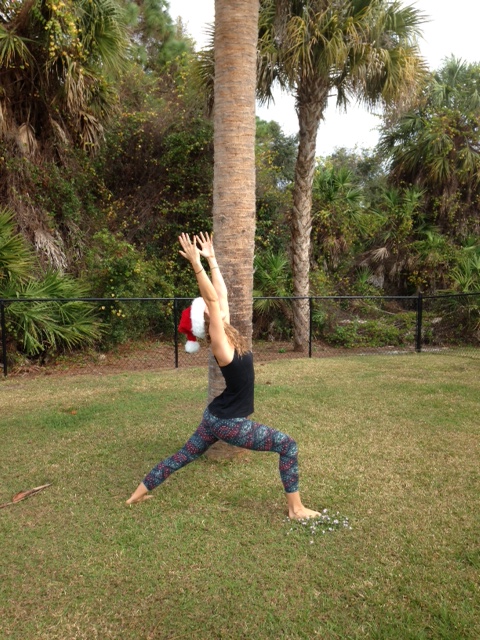
Warrior I with backbend/Virabhadrasana I
*Heart opener, gentle backbend, promotes energy & circulation; great for when you feel you need to ‘get moving’
(hold 30 sec. – 1 min. each side)

Crescent Lunge with Backbend

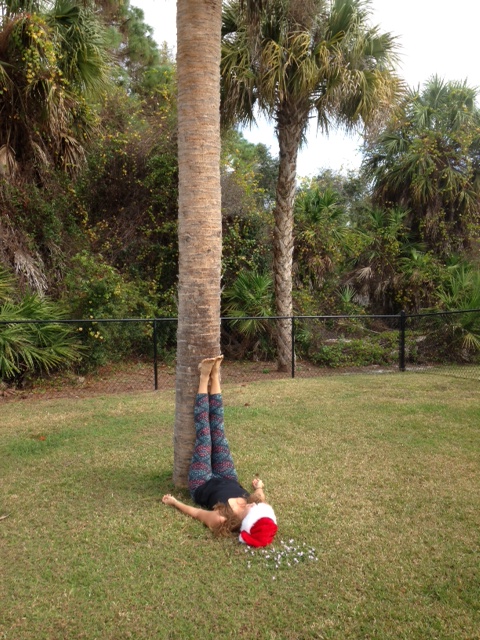
Legs-Up-the-Wall Pose/Viparita Karani
*Detoxifying, boosts your immune system, stimulates your circulatory system, strengthens your diaphragm/respiratory system (An inversion a day keeps the doctor away!
Hold anywhere from 30 sec. to 5 or 10 minutes)

image-2

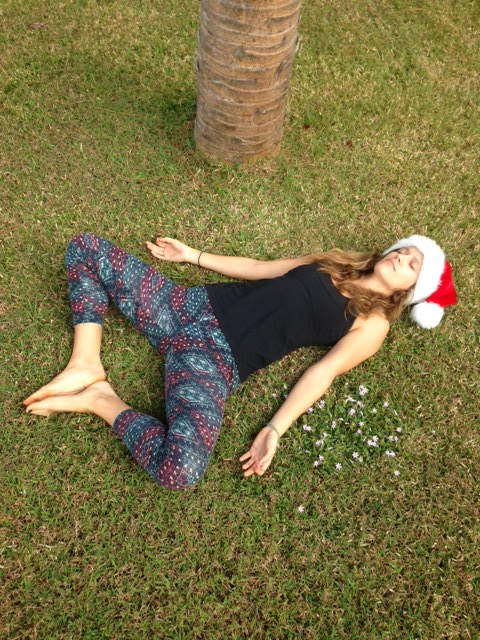
Reclining Bound Angle Pose/Supta Baddha Konasana
*Hip opener, releases tension, stimulates respiratory system through thoracic breathing – expand rib cage with inhale, spine neutralizer (hold 2 min. or up to 5-10 min.)

image-3

Easy Pose/Sukhasana
*Meditative posture, straight spine and shoulders back, abdomen engaged to support your torso, neutral position. (If you like: Engage in slow, deep breathing with an elongated exhalation (2x inhale) and introduce your mantra here. Hold 5 to 10 min. or as long as you’d like. This is an easy introduction to a regular meditation practice.)

image-4

**BONUS: (My favorite, if you’re up for a challenge!)**

Lord of the Dance Pose/Natarajasana
*Balancing posture, hip opener, core/strength building (Hold for 30 sec. to 1 min. on each side. Be sure to find a drishti, or stationary visual point about 4 feet in front of you to lock your gaze and help maintain balance.)

image-6

Xx Cheers! xX

Reality Check: When Life Gives You Lemons (+ Recipe)

As 2014 comes to a close I find myself reflecting on the past three months and my first semester in Yoga Studies, and a resounding lesson – or key takeaway persists:

Reality Check #1 (since I lost count long ago, we have to start somewhere):

When life gives you lemons, you still have to squeeze your own [damn] lemonade.

Ultimately, life is what you make it. You can be lucky, work hard, and be at the right place at the right time – but where you go from there is entirely up to you. It’s how you interact with others, what imprint you leave on the room (and the world) after you leave it; who you influence, the choices you make and how you are. That, is also your karma. It’s your footprint, and your fingerprint. It’s uniquely you and a lasting impression. How deeply do you love? How fully do you live? These are choices, as much as they are inherent to you.

Sometimes you have to really bust it to get through, and other times it’s easier. For better or for worse, in speaking for myself, I’ve made the decisions I’ve made to land me in this very moment, right where I belong. (Really, what benefit is there in believing otherwise?) There’s something to learn from difficult times and a way to grow in painful times, that will just make you stronger down the road. And in turn, it’s important to remember there’s always something to give in times of success and prosperity, time to lend to old friends or family when things finally seem to slow down. We all have all of these moments – the good and the bad. Embrace them for what they are, but don’t let them rule you. And know it’s how you react that makes you who you are, and how the world knows you. Less so what you wear, where you work (“what you do”) or what you look like. And much more, how you love.

Our choices – mine and yours – are responsible for what happens next. They’re an expression of ourselves, our individuality, that’s more bold than wearing a crop top and hot-pants. Because, when you make a new friend or find a new relationship, it’s not about what they’re thinking as much as what they’re feeling. That rush you get from a great conversation with a stranger, because they listened, and stopped to focus their attention on you. That’s an impression, that’s an air, a compassion, a reputation. That’s who are you, and that’s your karma.

So, [in other words] my takeaway this year is: When you find yourself in the right place at the right time, you have a responsibility to act. Don’t wait for the world to do it for you or for life to get a bit easier first…You are brilliant and capable, or you wouldn’t have found yourself where you’re standing. (With gratitude!) When you find yourself in a position that just feels right – which may sometimes, tragically contradict what “makes sense” – you can rest assured that if you move forward, you won’t regret. Take every opportunity like it’s yours, like it’s the only one, and like it was meant for you; because, it was – because our choices dictate who we are.

I’m making the commitment to take on 2015 like it’s all mine for the taking. Always: Go get ‘em – in whatever you decide to do. And remember, it’s already in you, you just have to let it shine…

A little autumn inspiration to fuel your fire (both your internal fire & your agni, or the fire in your belly) 😉 I had all the ingredients in my cabinets and got the rest (along with this recipe) from my CSA, Farm Fresh to You. Eat with the seasons! (Your body will thank you…) And don’t fear, all this goodness is also readily available at your local supermarket.

butternut squash

Honey-Roasted Butternut Squash (with Cranberries & Feta)

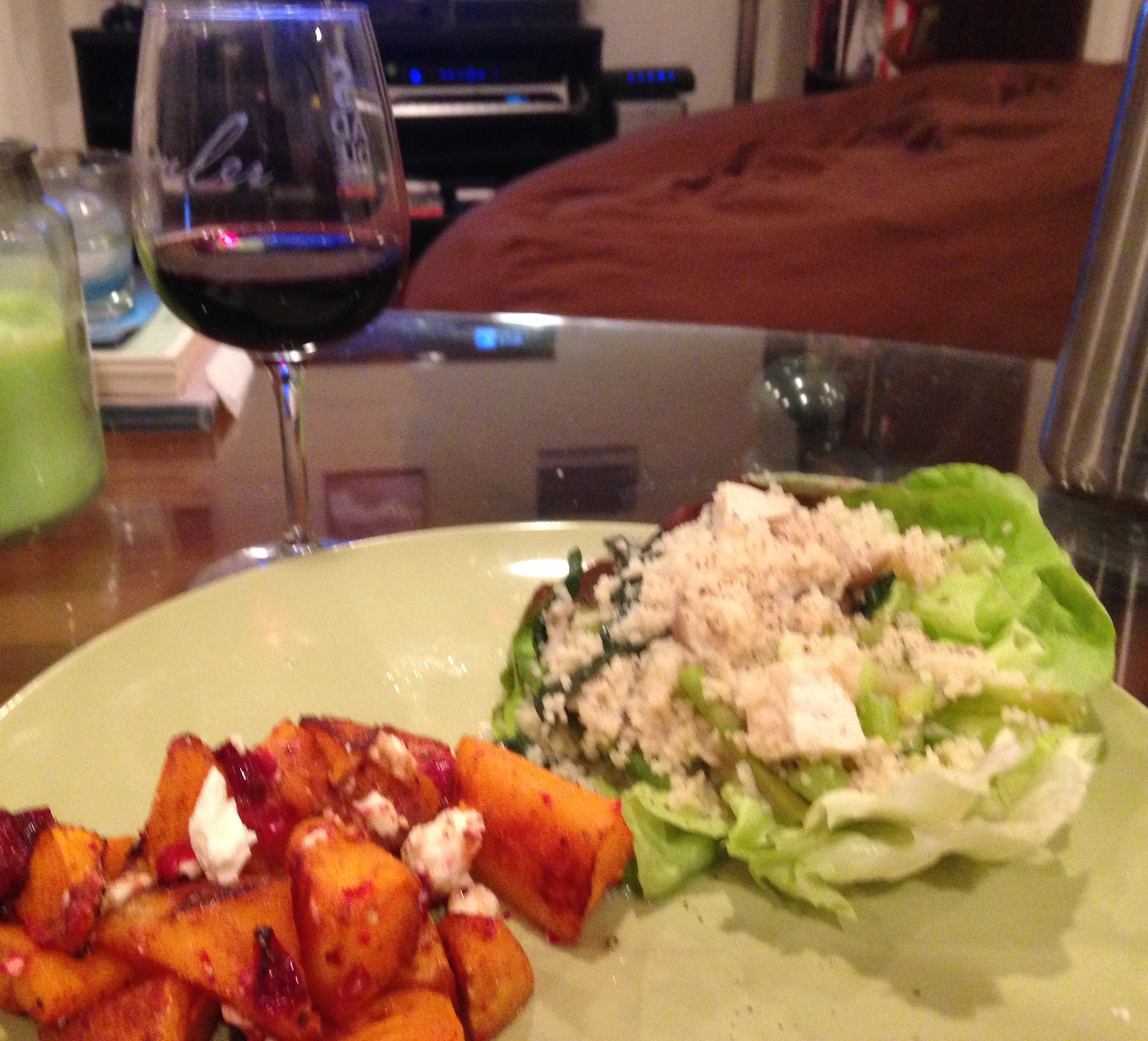
* I served with whole wheat couscous, extra veggies and tofu + garlic, butter (we use, Melt), sea salt, pepper & red wine!

Ingredients:

-1 butternut squash, peeled and chopped (or acorn, spaghetti squash, or your seasonal favorite!)

– Olive oil (or your oil of choice, coconut oil in this combo is delicious)

– Salt, pepper, garlic (crushed or minced – so cheap at Trader Joe’s! – or garlic powder works just fine)

– 2 cups of fresh cranberries

– Honey, to taste (2-3 tablespoons average)

– ¼ cup crumbled feta cheese

– Ground cinnamon, to taste

– Fresh parsley (optional)

  1. Pre-heat oven to 400 F. Drizzle baking sheet (or glass baking pan) lightly with olive oil.
  1. Cube squash or cut how you’d prefer in approx. 1-2 inch pieces. Lightly drizzle olive oil and sprinkle a light layer of salt, pepper, and garlic over squash, to taste.
  1. Roast at 400 F for 25 minutes on center rack. Then, add cranberries to roasting pan.
  1. Return dish to oven for 10-15 minutes, or until the cranberries begin to soften and burst open.
  1. Remove from oven, add a sprinkle of cinnamon (~ ¼ teaspoon) along with feta and honey, to taste. Garnish with parsley (for “ooh lala” factor).
  1. Enjoy with others or on your own! I enjoyed my leftovers 😉


Bon Appetit and well wishes for an abundance of warmth and light [in your life and your heart] this season ❤
Amy

Getting Intimate

Over the weekend, I was surprised to find myself completely immersed in a five-hour training on yoga, sex and intimacy. My confusion was justified – The title of the workshop was “Yoga is Peace.” Where did I go wrong (or, wonderfully right)?

Mark Whitwell is a famous yoga teacher (I use this phrase reluctantly, but if anyone deserves the title, he does) and writer who studied for twenty years under Sri T. Krishnamacharya, the guru (or teacher) graciously credited with introducing yoga to Europe, Asia, and the Americas within the past century. (Should your interest in yoga meaning and philosophy grow, his work is a great place to start…)

Mark began by introducing himself to the class and proclaiming emphatically:

“YOGA IS… [wait for it]…DIRECT intimacy…with reality.”

He followed: “Forget any other definition you’ve ever heard. This is Truth.”

Mark’s “no bullshit” approach to teaching struck a chord. Perhaps too tight of chord, as he later added in the words of his teacher, Sri Krishnamacharya: “Yoga is not information gathering.” (Tell this to the girl working 24/7 in yoga studies.) What he means by this, of course, is simply: It’s already in you. So, focus your attention there.

Regarding sex, intimacy and yoga, we can go back to Mark’s definition of yoga generally as “direct intimacy with reality.” But, what does this really mean? He elaborated throughout his lecture that, from this view, our purpose on this planet is to have intimacy with life; that means with yourself, your partner, your community, and more abstractly, with your reality. In other words: Are you engaged, are you open? Are you a good friend, a loving partner, a “yes” person? Do you serve others in your community, do you love the work that you do? We all prioritize our own reality differently, and where and when we choose to get intimate. But, as Mark suggests, shouldn’t it be that when the day is done we can stand back and see ourselves reflected back to us (ideally with love and admiration) in all aspects of our life? If we desire to hold a purpose, as individuals and humans, shouldn’t it be to live life this way? (In this light?)

Yoga is direct intimacy with reality, with life. In this way, we can practice yoga everyday, in every aspect of our lives, by allowing ourselves to get intimate in our interactions with others and with ourselves.

As for sex: Mark shared his own observation that, as the churches continue to empty throughout America and Europe (Germany, in particular), the explicitness and vulgarity of sex in the media and social discourse continues to worsen. He digressed: “Everybody’s talking about it, and nobody’s having it.”

In my own classes, reluctant attention has recently focused on the realities of the over-sexualization of youth, and women and girls generally, in society. How prevalent are images of young girls (teens & twenties) in their underwear – or without – throughout the media? (Are you as tired of the viral Kim Kardashian as I am?) But giving this issue our sincere attention requires an uncomfortable shift of reality, and so many – including myself – do their best to stay quiet and turn the other way. There’s no need to revisit the profound implications that over-sexualization have on women and girls throughout the country, and the world. Eating disorders, body dysmorphia, body image obsession, insecurities, anxiety, inadequacies, sex trafficking and even hate crimes targeted at nonconforming homosexual individuals – all catalyzed by an extreme prevalence of “sex” in society, distorting the reality that sex [and sexuality] is intimacy – not an ego trip. Having the capacity to love and be intimate with another person is a gift, and an expression of equal exchange. It’s personal, it’s impactful, and it’s the basis of humanity. It’s easy, with the Victoria’s Secret fashion show fast approaching, to forget that this is reality. 

Mark’s parallel to the international vacancy of churches is meant to emphasize the necessity of individual spiritual life for the proliferation of humanity. He even goes so far as to say that the world depends on it. I take spirituality in my own heart to mean the active cultivation of a greater consciousness, founded in love and compassion towards oneself, one another, and our shared global community (the Earth and humanity). My church is my yoga mat. But no matter your definition or your vehicle, Mark attests that exploring your own sense of self and your own true nature is to experience intimacy, and promote creativity and creation. And, to experience direct intimacy with reality [in this way] is yoga – with, or without asana. (Although he and I highly encourage a daily home practice as a guaranteed vehicle toward exactly that. If you’re looking to create a home practice but aren’t sure where to start, contact me for help creating your own personal practice.)

In the midst of a non-stop graduate school schedule, the holiday season, and occasionally being all too aware of worldwide struggle and despair (sometimes all-to-close to home), I’ve found it helpful to go back to the notion that our purpose is intimacy. We can forget the rest. Because, if you can be intimate with life by being authentic, kind and present in every moment of your day, you’re contributing to the world in the best possible way. And, inevitably the goodness of the world will come back to you, more easily and with greater pleasure than you ever imagined. I guess, you could say in this way: Yoga is Peace.

Exploring your own comfortable definition of spirituality and creating a routine to express yourself through this light (be it yoga, attending church, simply sitting in quiet or your own personal practice) is the key to experiencing direct intimacy with life. And while it’s true – you get what you give – ultimately, getting intimate is what really makes life worth living.

Sending love and well wishes to your corner now & always,

Amy

Personal Photo: Playa Vista, CA

It’s Your Year

Last week, I discussed yoga as a process of becoming.

This past weekend, I was exposed to exactly the sort of setting where you would expect the winds of change to come sweeping through: Off the Mat, Into the World’s 4-Day Advanced Leadership Training in Ojai, CA – of all places, my favorite place.

It was there that I felt very aware of a newness to myself, my being. Who is this girl, so lucky to be attending this workshop in this beautiful place? Who has such a strong, intuitive (asana) practice? Who speaks so confidently of her experiences in politics and global affairs, which have prepared her for this discussion in social justice yoga? Sometimes our process of becoming isn’t so pretty – and more likely than not, you won’t even know it’s happening. It’s darkness; it’s bitterness, fear, angst, and frustration. But in the inevitable moments of light that follow, you can look back on yourself and how far you’ve come, and realize gratefully that that whole time, you were just becoming.

Today I changed the name of my blog (and Facebook page) to “A Year in Yoga.” I did this because it’s never really been about “my year,” as I created it of and for all of you. I created this blog as part of a greater vision – for peace (inside and out), for justice (in the form of our own tolerance, acceptance and harmony), for empowerment (in understanding our own unique capabilities, our gifts, and finding the strength to live in that light). I have been so moved and inspired by the many women – and few men – who have reached out in response to my posts over the past three months, and shared a bit of their process with me.

It is important that the name reflects the fullness of this collective effort; to cultivate greater virtue in our lives is “A Year in Yoga.”

I was moved – or rather, moved myself – into the yoga community, in search of conversations surrounding the difficult questions: How do we stop the fighting? The destruction? The war, the hurt, the suffering? If it is innate in us to care for one another, at least when residing in close proximity, how can we work towards extending this sense of responsibility and compassion to the global community? To come from a place of love and to admit you are a work in progress is to live in yoga. No asana required. (Despite our Western spin, yoga is not the same as asana, or physical yoga postures. Simply living life truthfully, with compassion, patience and mindfulness, is living in yoga.)

We are all always in a perpetual state of change, growth and evolution, although we rarely realize. Approaching life with this awareness has its perks. Nonjudgment of yourself and others (ahimsa) is a practice which requires conscious cultivation, but ultimately takes the pressure off; allowing us to be more patient and easy on ourselves, and to have greater empathy toward others in acknowledgement of whatever war they’re fighting (or challenges they’re facing) themselves. This means acknowledging that you and I are both enduring similar, however very distinct, journeys toward becoming whomever or whatever we are intended or going to be. Here, we can relax in knowing that we can’t have all the answers.

Imagine what it would mean for families, for communities, for countries, for the environment, for your children (present or future), if everyone in the world approached life with nonjudgment and compassion toward themselves and others. You and I can’t change the world, but (a much larger, global) we can. We starts in communities, with individuals. All over the world, people are increasing their awareness and acknowledgement of the necessity for sustainability, for the preservation of our Earth, for future generations. Every yoga practitioner, protest attendee, business owner, community leader and politician who supports this cause, is a single “I.” I urge you to consider how you’re contributing to the inevitable change, growth and evolution that is becoming all around us, and in you. It doesn’t have to be here or there, right wing or left wing, working or upper class – you are individual, and your process is different from theirs or mine. But bringing a greater consciousness, or mindfulness to your daily life – to be present in acknowledging the impact of our daily choices and accepting responsibility for the effects of our actions and thoughts – is what the world desperately needs. The world needs you and me, because if not us, then who?

You’ve inspired me with your stories of success and struggle, because however personal and distinct from my own, I too feel the heaviness life sometimes brings and don’t want anyone to ever have to stand in it alone. This is empathy. This is peace, however small. And (despite the cliché), it starts with you. It really does.

I dedicate this venture forward, to you. It’s your year (in yoga, or however you choose to live it). And it’s time to start asking, “Who am I becoming?”

Be present, and you’ll know. I look forward to seeing all that flourishes.

Unconditionally here,

Amy

It's Your Year

Last week, I discussed yoga as a process of becoming.

This past weekend, I was exposed to exactly the sort of setting where you would expect the winds of change to come sweeping through: Off the Mat, Into the World’s 4-Day Advanced Leadership Training in Ojai, CA – of all places, my favorite place.

It was there that I felt very aware of a newness to myself, my being. Who is this girl, so lucky to be attending this workshop in this beautiful place? Who has such a strong, intuitive (asana) practice? Who speaks so confidently of her experiences in politics and global affairs, which have prepared her for this discussion in social justice yoga? Sometimes our process of becoming isn’t so pretty – and more likely than not, you won’t even know it’s happening. It’s darkness; it’s bitterness, fear, angst, and frustration. But in the inevitable moments of light that follow, you can look back on yourself and how far you’ve come, and realize gratefully that that whole time, you were just becoming.

Today I changed the name of my blog (and Facebook page) to “A Year in Yoga.” I did this because it’s never really been about “my year,” as I created it of and for all of you. I created this blog as part of a greater vision – for peace (inside and out), for justice (in the form of our own tolerance, acceptance and harmony), for empowerment (in understanding our own unique capabilities, our gifts, and finding the strength to live in that light). I have been so moved and inspired by the many women – and few men – who have reached out in response to my posts over the past three months, and shared a bit of their process with me.

It is important that the name reflects the fullness of this collective effort; to cultivate greater virtue in our lives is “A Year in Yoga.”

I was moved – or rather, moved myself – into the yoga community, in search of conversations surrounding the difficult questions: How do we stop the fighting? The destruction? The war, the hurt, the suffering? If it is innate in us to care for one another, at least when residing in close proximity, how can we work towards extending this sense of responsibility and compassion to the global community? To come from a place of love and to admit you are a work in progress is to live in yoga. No asana required. (Despite our Western spin, yoga is not the same as asana, or physical yoga postures. Simply living life truthfully, with compassion, patience and mindfulness, is living in yoga.)

We are all always in a perpetual state of change, growth and evolution, although we rarely realize. Approaching life with this awareness has its perks. Nonjudgment of yourself and others (ahimsa) is a practice which requires conscious cultivation, but ultimately takes the pressure off; allowing us to be more patient and easy on ourselves, and to have greater empathy toward others in acknowledgement of whatever war they’re fighting (or challenges they’re facing) themselves. This means acknowledging that you and I are both enduring similar, however very distinct, journeys toward becoming whomever or whatever we are intended or going to be. Here, we can relax in knowing that we can’t have all the answers.

Imagine what it would mean for families, for communities, for countries, for the environment, for your children (present or future), if everyone in the world approached life with nonjudgment and compassion toward themselves and others. You and I can’t change the world, but (a much larger, global) we can. We starts in communities, with individuals. All over the world, people are increasing their awareness and acknowledgement of the necessity for sustainability, for the preservation of our Earth, for future generations. Every yoga practitioner, protest attendee, business owner, community leader and politician who supports this cause, is a single “I.” I urge you to consider how you’re contributing to the inevitable change, growth and evolution that is becoming all around us, and in you. It doesn’t have to be here or there, right wing or left wing, working or upper class – you are individual, and your process is different from theirs or mine. But bringing a greater consciousness, or mindfulness to your daily life – to be present in acknowledging the impact of our daily choices and accepting responsibility for the effects of our actions and thoughts – is what the world desperately needs. The world needs you and me, because if not us, then who?

You’ve inspired me with your stories of success and struggle, because however personal and distinct from my own, I too feel the heaviness life sometimes brings and don’t want anyone to ever have to stand in it alone. This is empathy. This is peace, however small. And (despite the cliché), it starts with you. It really does.

I dedicate this venture forward, to you. It’s your year (in yoga, or however you choose to live it). And it’s time to start asking, “Who am I becoming?”

Be present, and you’ll know. I look forward to seeing all that flourishes.

Unconditionally here,

Amy

Drop the Baggage

A common theme of my last several posts has been the importance of feeling. And this morning, at a lecture and asana class with founder of Off the Mat and Into the World, Hala Khouri, she emphasized a similar point: “Yoga is a process of becoming – by feeling the sensations in our body.” By this she means feeling in the fullest sense. Yoga is about allowing ourselves to feel the discomfort, fear, anger and anxiety in our lives, of past traumas. Yoga is about letting things come up, feeling them fully for a brief moment and then, letting them go. She followed this idea with, “Of course, if we told people that yoga is all about “exploring your grief and misery,” nobody would come!”

How many people are affected every day by past traumas? We know how past traumas affect us personally, many of us living under the rule: Never make the same mistake twice. You live, you learn. And, like anyone, you pick up (or rather, pack up) a bit of baggage on the way. These past traumas soon surface in other ways. Body aches and physical tightness (muscle tension), depression, social anxiety, binge eating, domestic violence – and school shootings. Undoubtedly, our past shapes who we are in the present. So it stands to reason, that only once we’ve come to terms with the past can we be our happiest and fullest selves, in the present.

This is how yoga is described as a “process of becoming.” It’s about fully realizing your [True] self, or the best version of you. In the science world, yoga as a healing modality is increasingly considered a viable method of somatic psychotherapy. Recently, yoga has begun planting its roots in Western science, working its way into physical therapy, occupational therapy, psychology, counseling, and even physician’s offices throughout the country.

What happens when we feel? How much better can we be? Hala explained, for her kids feeling means running outside to the trampoline or hitting the punching bag, instead of hitting their brother. Rather, “This is progress.” To recognize a feeling in your body, instead of reacting impulsively or burying it away. To consider the best reaction – whether or not we express that emotion, and how. And to consciously choose a healthy way to release the feeling of tension, distress or anxiety from your body, without harming yourself or others. (Pretty impressive for a six-year-old! And a great example of applying mindfulness.)

To feel something in its fullest expression, to allow yourself to let it out, is to know yourself without the baggage. Whether it’s running over a squirrel (as was Hala’s recent trauma) or the death of a loved one, a car accident or betrayal by a friend – it’s often easier, and cooler, to just put it away. But when we hang on and never allow ourselves to surrender to what we’re feeling about a given situation, it shows up in other places. Insecurities, eating disorders, cheating, anxiety, depression, PTSD, OCD, perhaps even ADD. How different would our world be, if we were raised to express every feeling – in a safe, deliberate, mindful way?

Yoga is one way, but this kind of yoga is done off the mat. It’s a way of thinking, non-judgmentally and with compassion, patience and mindfulness towards yourself and others. It’s a practice and a process; it helps you let go and be free, to easily become our best [kindest, warmest, loveliest & most lovable, thinnest, trimmest, funniest, happiest, etc.] selves.

Everyone has trauma, small ones and big ones, that they carry with them. What are our real reasons for holding on? What happens when we let go?

I’m grateful to have the opportunity to explore somatic psychotherapy and yoga for trauma from the best in the field. My dream (in its ever-evolving form) is to bring this knowledge to all of you. Because how different, how good could our world be? Could our community be? Could our corporate leaders and politicians be? Could you and I be, if we dropped all the baggage and lived mindfully?

Dare to dream,

Amy
—————

For more on yoga & somatic psychotherapy – an interview with clinical psychologist, Bo Forbes: Narrowing the Gap Between Insight and Change: Yoga, Psychotherapy, and the Body

Photo: Point Dume, Malibu, California

Food is Love.

Like many, I struggled for a long time with my eating. Although I was never diagnosed with an eating disorder, I knew that my relationship with food was unhealthy, and that I didn’t want to live my life that way. I developed a regular gym routine, deprived myself of desserts and stocked my freezer full of Lean Cuisines; but never felt any relief from the stress of trying to be “thin.” (Sound familiar?) But still, I always had this itch inside me that insisted: There is another way, something better.

I started Bikram yoga in 2010, my sophomore year of college and the height of my “health” obsession. After three years of almost-daily practice, I felt great and was my instructor’s favorite, having seemingly mastered the 26 posture series. Of course, I hardly basked in this accomplishment, and instead sulked in my frustration that I needed to do more, be better and look better. How was it that I was killing myself in the hot room, and still didn’t look like a Victoria’s Secret model? In my unceasing frustration, food became my solace – and my secret vice. My anger at myself for over-eating resulted in self-hatred, and the cycle continued. My “health” obsession – always grappling between not eating enough and binge eating – had become very unhealthy…and then, finally, something clicked.

I remembered a challenging time I’d experienced while studying abroad in Costa Rica. To help cope with my discomfort and anxiety, I had yearned for yoga. But there was no Bikram yoga studio in San Jose, so I took up classes (in Spanish) at a local vinyasa studio. Here, yoga made me feel safe and confident because, when there, I allowed myself to let go of my fears. This had never been the object or focus of my Bikram routine (which for those who don’t know, is a highly physical, half-naked practice in a 105 degree room, leaving few thoughts to ponder “letting go”). So, by shifting my attention and setting the intention to explore and let go of my fears, on and off the mat, I hoped to relinquish myself from nagging insecurities and food anxiety – Forever. This is when yoga clicked for me as something to dedicate myself to – not for the physical, but for its psychological promise: to be liberated and finally be comfortable in my own skin, just being me.*

What I learned in this process regarding my eating, is that diets don’t work. The nature of a diet is exemption or exclusion. They’re not saying what you can eat, they’re telling you what you can’t. And who wants to live their life being told what they can and can’t eat? Where’s the enjoyment in that? Think about it. I’ve done it, too and that’s no way to live. There has to be a better way.

I also learned that by confronting my insecurities, I was free to focus on caring for myself. What I live by now (and have lost 20 lbs doing) is simply practicing self-love when it comes to food. Think about your spouse or your children (present or future) – What would you want them to eat? Probably, things that are good for them. Food that gives them energy to sustain themselves for business trips and soccer games, but that also tastes really good. They deserve only the best. Well, so do you. And more likely than not, if you start feeding yourself this way, the one’s you love will soon follow. This display of self-love, and analysis of your own thoughts (about eating or otherwise) is the key to happiness, and is a living practice of yoga. More specifically in yogic terms, this can be considered a practice of ahimsa, or non-violence against yourself or others. (Read more about practicing ahimsa, here.)

Practicing ahimsa when it comes to food means creating a diet with no exemptions and no exclusions, but plenty of love and education. As a general rule, I discovered: things that come from the Earth will give you sustained energy and are jam-packed with nutrients to support your overall health, while things that come in a box or package are inherently endowed with chemical preservatives and sugar, or “fake” surge energy. So, learning about fruits and veggies is the only road to happy, healthy eating. But don’t worry, there’s way more out there than you find on your plate at the Olive Garden. And I promise, even if you’re “not a veggie person,” there’s plenty to learn and love. But still keep in mind: You’ve gotta live! Eat what you need, but also eat what you want. (A personal favorite in our house lately has been Tollhouse cookies. How can I say no?) Be smart, and care for yourself. Create balance, not restriction. Don’t limit yourself, just love yourself. It sounds corny, but I promise it works. And soon this newfound contentment will seep into other aspects of your life, and you’ll be brighter. And you’ll stop weighing yourself – and judging yourself. Because you’re happy, finally, just the way you are.

I feel incredibly blessed to have reached this conclusion, and I want this for everyone – especially my lady friends, everywhere. You deserve only the best. Feed yourself, love yourself. Food is love.

A post will follow with a recipe to get you started. I always encourage substitutions and new creations when it comes to cooking. Make it your own, from what you have at home, and make it something that you and your family will love.

In the meantime – Chow on, with love Xx

Amy


*Note for the Soul Seeker: What ensues when you make this commitment, to “let go” and allow yourself to explore your deepest fears, is a real challenge – but it is the real practice of yoga. Things come up, and you start to deal with what you might have otherwise, gratefully, left buried deep inside. To the soulful explorer, I’ll say – as was advised to me – just trust. This means letting go of knowing what the end result will be. Will this work (to address whatever vice you’ve developed)? Will you really be happier afterwards? Let it go. And trust yourself, that if you’ve taken this step toward self-exploration, then you know what’s best for you. And you do. So follow it, see where it takes you. And feel free to report back – the road ahead gets bumpy, no need to go it alone.*

The Science of Sitting

When you hear the word “meditation,” what do you imagine? A group of Buddhist monks in temple, chanting and burning incense. A flashback to Woodstock with a field full of hippies sitting silently, listening intently to their guru (or spiritual teacher). Or, if you’re a bit more familiar, you might imagine an individual much like yourself sitting perfectly erect with each thumb and pointer finger touching together in the quintessential “Om mudra.” All of these images are valid representations of meditation. But if you’re like me, these vague portrayals are hardly enough to motivate you to adopt a daily practice, or to spend $200 on a five series class explaining what the point of all this is anyway. Experimenting on your own, or trying out a few YouTube tutorials is an option. But if you’ve tried, you’ve likely found that after two minutes – which feels more like twenty – your mind is in a million places, you’re restless, achy, and aggravated. Enter the oh so popular excuse – and one I’ve previously exhausted myself:

 “I can’t sit still long enough/my mind is too busy/I don’t have enough time to meditate!”

Well perhaps, it might be helpful to know the “why” first. You know meditation is good for you. The highly popularized benefits of relaxation and mental clarity are certainly enticing enough. And even corporate leaders like Oprah Winfrey and Rupert Murdoch vouch that meditation is useful for stress management and good decision-making. (Check it out here.) But how do you get there? And what is this all about, really? The answers to these questions have helped motivate my meditation practice and changed my perspective on yoga. Here’s what they don’t tell you, that I hope will help you along the way…

Yoga is an ancient practice, arguably dating back to 300 B.C., which has been passed down throughout history by way of individual, one on one instruction with a guru. Yoga’s classical definition is simply “the science of the mind” consisting of eight limbs of yoga intended to guide your path to enlightenment, or self-realization. The third of these eight limbs is “asana,” or a series of physical sequenced postures generally referred to as “yoga.” Ancient yogic texts insist that the other seven limbs are the most important steps to experiencing the full benefits of yoga. However, asana practice is intended to prepare you for the process of self-analysis and centeredness, by helping us clear the mind and prepare the body for long periods of stillness. (Savasana, anyone?)

When you leave a yoga class, you’ve likely felt what I fondly refer to as the yoga high. It’s a mental and physical buzz, or internal vibration, which leaves us feeling clear-headed, relaxed, and (relatively) stress-free. A former boss of mine who occasionally practiced yoga, used to joke: “If you want anything from me, just ask me after yoga class!” What you’re experiencing is a meditative state, and when you practice more frequently, this sensation lasts longer. While few ever complain about their post-practice buzz, this is also the reason why yoga is often associated with free-loving cluelessness and detachment from reality, which threatens its credibility and relevance as a useful everyday practice. (Revisit 1960’s Woodstock for a moment, and you’ll see what I mean.)

Although I’m not a scientist, I believe learning the mechanics of what’s happening during meditation is key to understanding, and thereby motivating our practice. My method of learning has always been: don’t ask me to do something until I fully understand why I’m doing it. (Sorry Mr. Murphy, the Pythagorean theorem just wasn’t happening…) But if you’ve ever wondered “why meditation?,” learning a bit of the science behind the practice is a great place to start.

Looking to science, specifically quantum physics, we know that all solid objects are composed of molecules, or a group of atoms which are uniquely formed to create physical matter and are perpetually in a state of subtle movement. Through meditation and asana practice, we are stimulating the vibration of our own molecular composition. When thinking of yoga, it might be helpful to think of body, mind, and spirit, and consider “spirit” to be the energy inherent to your molecular composition. Asana practice and conscious breath work (or pranayama) get this energy moving. Simultaneously, you are clearing the mind of restless thoughts by focusing your full attention on your breath and bodily alignment. (If you’ve tried Triangle pose for any length of time, you know that this process alone is a feat! Don’t get frustrated, you’re not alone. Practice makes perfect!) And while stretching deeply into postures like Warrior II or Pigeon pose, you are preparing your body to sit comfortably in meditation, a.k.a. Criss-cross applesauce or Lotus pose. Once these three things – body, mind and “spirit” – are in sync, then you experience real yoga and the benefits of the practice begin to take shape. In fact, the word “yoga” means “union” in Sanskrit, and represents this very process of convergence.

So, in understanding the why, we shouldn’t be concerned with quantum physics on our mats. Rather, applying the “why” to your practice is as simple as remembering your last yoga high and striving to reach it again and again. Then, try sitting in this stillness. Over time, you will learn to get there faster and stay there longer – using asana (physical practice), pranayama (conscious breathing), and even mantra (chanting) as different means to get you there. There is no right or wrong way, and every day will be different. But by playing with these techniques (have fun!) and challenging yourself to return to focus on your breath or alignment, the true benefits of yoga will unfold for you. Why? Because the science is there.

And I’m always here to answer your questions along the way.

Sending you good vibes! xx

Amy